Verse 9after 1821aa-egul
G3
1
Ghalib, I have a longing to embrace that one
2
the thought of whom is the rose of the neck-opening of the gown of the rose
'Wish, desire, longing, eagerness; hope; trust; expectation; intention, purpose, object, design. inclination, affection, love'.
'The opening at the neck and bosom (of a shirt, &c.); the breast-collar (of a garment); the heart; the bosom (the Arabs often carry things within the bosom of the shirt, &c.; and hence the word is now applied by them to) 'a pocket'.'
'A long gown with the skirt and breast open (and sometimes slits in the armpits); a (quilted) garment; a tunic'.
| References | |
|---|---|
| Arshi, Imtiyaz Ali | Ghazal# 80 |
| Raza, Kalidas Gupta | 358 |
| Nuskhah-e-Hamidiyah | 132-133 |
| Asi, Abdul Bari | 148-149 |
| Gyan Chand | 250 |
| Hamid Ali Khan | Open Image |
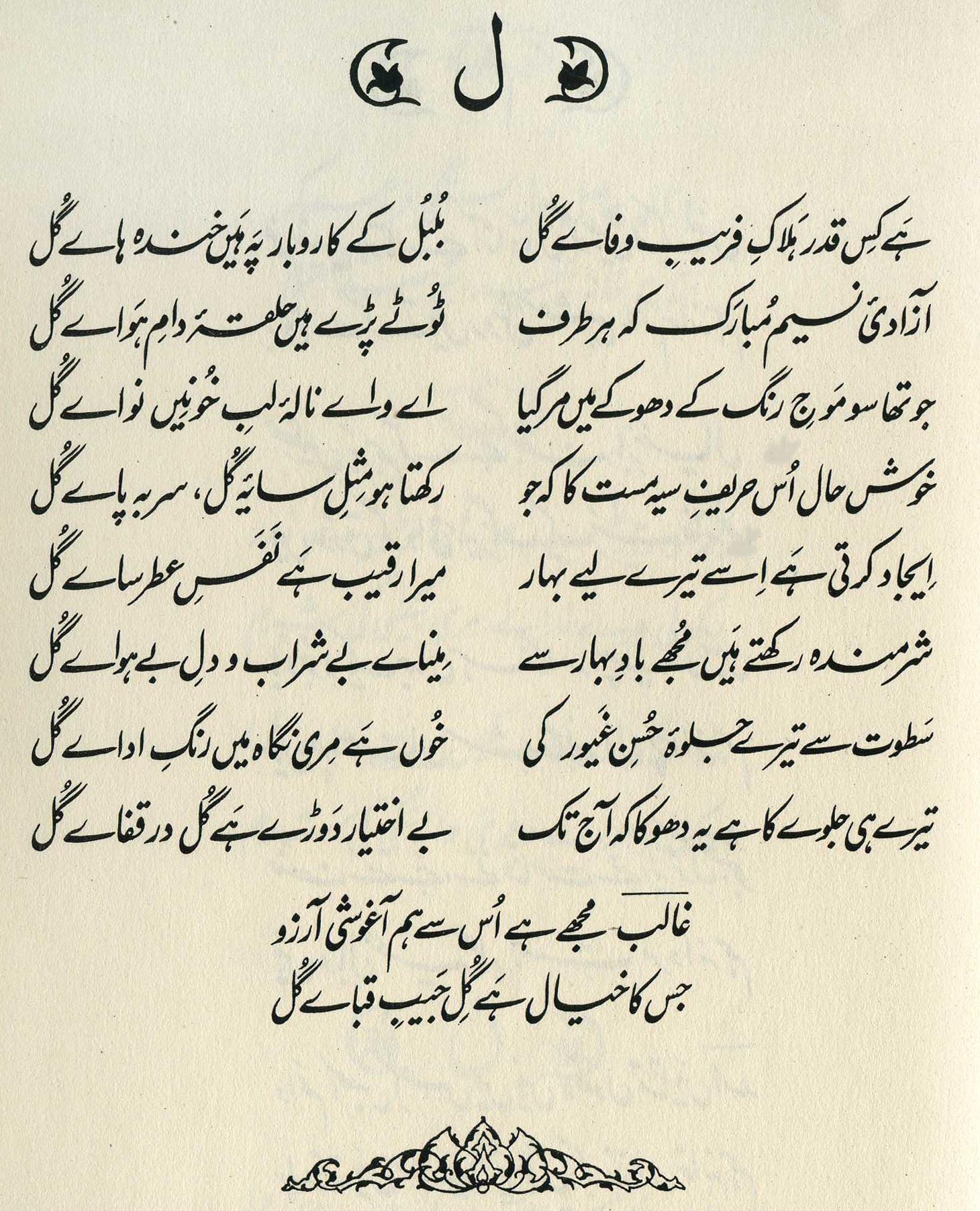
That is, that True Beloved, the thought of whom the rose has made an ornament for its collar-- I want to embrace that one. (82)
== Nazm page 82

is a Persian idiom. In this connection he has not said [as in Urdu] but rather has translated it [literally]. (74)
Oh Ghalib, I have a longing to embrace that one the picture of whom, the thought of whom, is the ornament of the rose's collar. That is, I am becoming mad in ardor for union with my beloved-- the one for whom beloveds die of love. The True Beloved can also be intended. (169)
This is the third of three verses in this ghazal-- the others are 80,4 and 80,8 -- that repeat in the second line. For discussion, see 80,4 .
What an irresistible verse! It's my favorite in this whole lovely ghazal. I even found it relatively translatable-- 'Ghalib, I long to embrace her / The thought of whom is the rose on the dress of the rose'. This verse has its complexities wrapped within such lovely simplicities.
The 'thought of the beloved' is an adornment for the neck of the rose's robe. In other words, it's a kind of corsage. For this intangible 'thought' to be used as a rose-corsage by the rose itself is not only remarkably abstract, but also paradoxical-- a weirdly hyper-twisted conceit.
And in whose head is this corsage-like 'thought' of the beloved? It could be either in the lover's (he imagines her beauty as a supreme adornment even to the rose itself) or in that of the rose (which proudly pins to its neckline a corsage of the thought of her).
All this abstraction is in fine counterpoint to the simple, direct physicality of the first line. The lover longs to embrace 'that one'. Which one? In the classic style of an effective mushairah verse, we have no clue until we're allowed to hear the second line. And the answer is that he longs to embrace-- a very physical action-- the one defined only as a thought, only by being thought of-- and even then, only in an impossible kind of decoration worn hypothetically by a flower. The full impact of the second line is deferred and strung out, withheld until the last possible moment in a series of constructions including both rhyming elements.
Compare the first line of 10,9 , in which the vision of the beloved becomes more and more attenuated as the line progresses; similarly, in the second line of 81,3 'we' become more and more abstract and microscopic.
'Ghalib, I long to embrace her-- the thought of whom is the rose on the dress of the rose'-- doesn't that send your mind ricocheting vertiginously back and forth between the very concrete and the radically (though delightfully) paradoxical? Can we really wrap our mental image-making powers around it at all?
graphics/rosebeloved.jpg