Verse 2after 1847yehote
G8
In this meter the first long syllable may be replaced by a short; and the next-to-last long syllable may be replaced by two shorts.
1
whether you are a calamity, or are a disaster-- whatever you are
2
if only you were for me!
'Force, power, violence, vehemence, severity; excess; boundlessness; oppression; subjection; rage, fury, wrath, indignation; vengeance; torment, punishment, chastisement; a judgment; a calamity; — a mischievous person, a firebrand'.
'Trial, affliction, misfortune, calamity, evil, ill; a person or thing accounted a trial, affliction, &c.; evil genius, evil spirit, devil, fiend; a wonderful or extraordinary person or thing; an awful or terrible person or thing'.
The spelling of instead of is to permit the to be metrically long.
| References | |
|---|---|
| Arshi, Imtiyaz Ali | Ghazal# 222 |
| Raza, Kalidas Gupta | 406 |
| Hamid Ali Khan | Open Image |
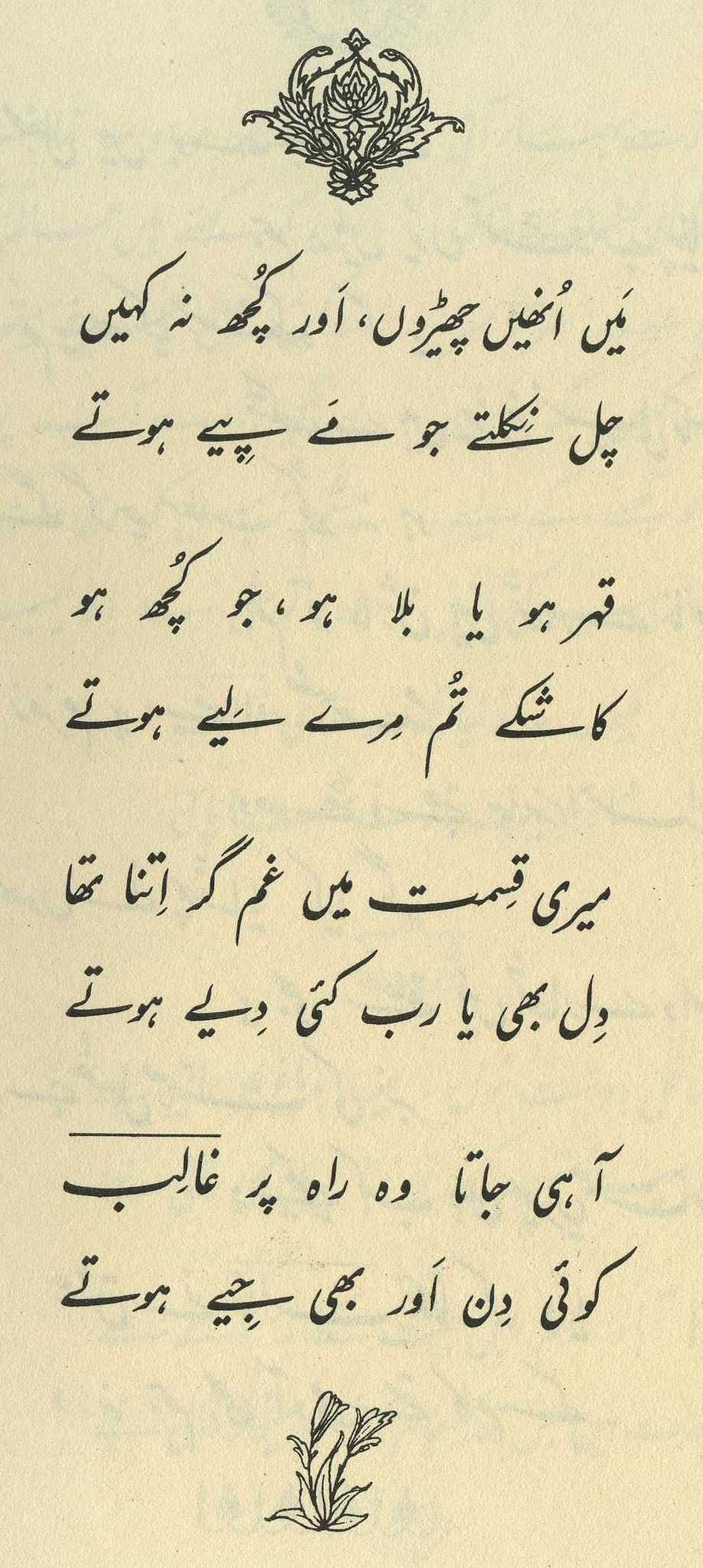
That is whether you are a calamity or you are a disaster-- whatever you are, if only you were in my destiny! And to seek out calamity and disaster for oneself is a rare/choice [] theme . In addition to this, the beloved's mischievousness of temperament and combativeness, and his own ardor and longing-- in composing this verse he has captured a picture of both these things. (202)
== Nazm page 202

He says, I've been specially selected for calamity and disaster, and you are entirely anger and entirely mischief. If only you had been written in my destiny-- and especially, if only you had become mine! The excellence with which he has sketched a picture of the beloved's mischievousness and ill-temper, and his own ardor and longing-- it's impossible to praise it enough. (261)
The Rival has called the beloved a calamity and a disaster. She, being displeased, repeats his very words. The captive lover says, 'all right, so be it, indeed. Whether you are a calamity or a disaster, whatever you may be, if only you were mine!' That is, how would the Rival know your worth? If you had become mine, then I would have valued you as you ought to be valued. (356)
Compare 234,4 . (311)
Under mushairah performance conditions, we would hear the first line, followed by at least a short interval before we were allowed to hear the second line. And hearing that first line, we would of course read it with future subjunctive verbs, as 'whether there would/might be a calamity, or there would/might be a disaster-- whatever there would/might be'. It sounds like the lover's usual range of dire prospects, for some abstract event, or for life in general. Only after we heard the full second line would we realize that the beloved herself is envisioned as the 'calamity' or 'disaster'; on the fly, we would go back and mentally reframe the verbs in the first line as familiar indicatives ( ).
The lover is eager to accept the beloved no matter what she is-- whether she's a 'calamity' or a 'disaster'! Perhaps these are two ends of a spectrum ('I'll take X whether it's black or white')-- in which case the range of possibilities seems to be, we notice with amusement, from 'calamity' to 'disaster'. Or perhaps the two alternatives have been carefully chosen, as the pair of attributes that best sum her up. Or perhaps they're just the first two possibilities that spring to mind when thinking of her. No matter how we read them, their considerable synonymousness (see the definitions above) is so witty and clever that it's impossible not to relish it.
Still, the verse presents itself as the cri de coeur of a sincere, naive lover. It consists of the simplest one- and two-syllable words, with no fancy rhetorical tricks or adornments whatsoever. Whatever amusement we in the audience find in the first line, the lover shows no sign of even noticing it, much less sharing it. He's too consumed with the simple longing that the beloved would be written into his destiny, would be 'for him'. As Nazm observes, he's thus ardently wishing upon himself calamities and disasters-- a 'rare' and 'choice' theme indeed.
Despite its wit, we can surely call this, structurally at least, a verse of ' unattainable simplicity '. It's reminiscent of the verse by Momin for which, according to Hali, Ghalib would have traded his whole divan : see 5,1 . Or consider this even more comparable verse from the same ghazal of Momin's:
[you did not in any way become ours
otherwise, what does not happen in the world?!]
graphics/storm.jpg