Verse 11816aar;haif
G3
1
through dread of the Rival , we do not take leave of consciousness
2
we became compelled/oppressed to this extent-- oh Power/control, alas!
'Fear, terror, dread; danger, risk'.
'Choice, election; preference; option, will, pleasure, discretion; disposal, management, control, power, authority; right; privilege; liberty; office, official position or power, jurisdiction; rule, sway'.
'Iniquity, injustice, oppression; a pity; --intj. Ah! alas! what a pity!'
| References | |
|---|---|
| Arshi, Imtiyaz Ali | Ghazal# 76 |
| Raza, Kalidas Gupta | 193 |
| Nuskhah-e-Hamidiyah | 125-126 |
| Asi, Abdul Bari | 143-144 |
| Gyan Chand | 235-236 |
| Hamid Ali Khan | Open Image |
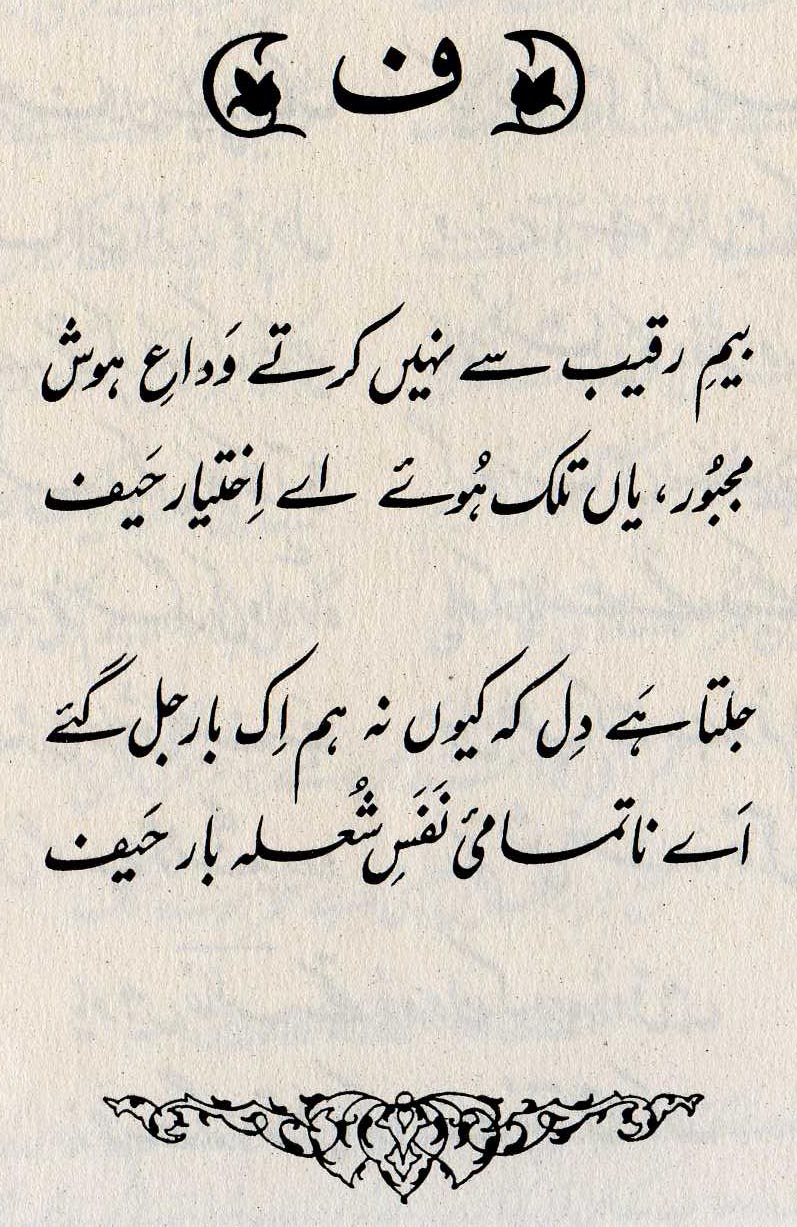
The cause of the fear is that the Rival, seeing me unconscious, might become acquainted with the secret of passion. This is love at the extreme-- that one is not even in control of his own consciousness, even in that there is fear of the Rival.
Poets nowadays have rejected the word , and consider it un-eloquent []. In place of talak they say . But in every language the standard of eloquence is idiom. Both and are current. Thus there's no reason to reject . (78)
== Nazm page 77 ; Nazm page 78


The meaning is that my inner self wants me to necessarily become unconscious; and the occasion too is such that I would do so. But with the thought of the revelation of the secret, I can't do such a thing. (124)
[Or else I fear unconsciousness because] the Rival will get up to some game with the beloved....
[About and ] I agree with every word Janab [Nazm] Tabataba'i has said. In fact, I want to say this much more: that is more eloquent than . (160)
In the second line, Ghalib has joined together two antonyms [] and created the excellence of the verbal device of opposition . Force [ , source of , 'compelled'] and power [] are opposites. (467)
The divan form of this ghazal has no opening-verse . The original opening-verse was 76,3x .
The word is stronger than the ordinary , and suggests a degree of dread or terror from which one might indeed faint, or , 'take leave of one's awareness'. The first line thus becomes amusing and piquant: the lover complains not of fainting with fear, but of being too fearful to allow himself to faint.
Why does the lover fear to faint or swoon? The commentators generally follow Nazm: the lover fears that the Rival would realize the degree of his passion, and his secret would be revealed. (He would thus be guilty of an indiscretion, and the beloved might be angry; or the Rival might be able to use this knowledge against him.) Or, as Bekhud Mohani suggests, the Rival might take advantage of his unconsciousness to make headway with the beloved.
But why is the lover inclined to 'take leave of consciousness' in the first place? Perhaps from the extremity of passion, and the nearness of the ravishingly beautiful beloved. Or perhaps in this situation what beckons is not unconsciousness but a mystical state of transcendent self-lessness []. If the beloved is imagined as God, these two states of course collapse into one.
The really clever, witty part of the verse is that final exclamation, 'Oh Power/control, alas, what a pity!' []. Only Chishti even tries to explain its appeal. Here are some possible ways of reading it:
=Oh Power/control, alas that you're so strong! (So that I am able to refrain from losing consciousness, even when I long to do so.)
=Oh Power/control, alas that you're so weak! (Since I'm so oppressed by fear of the Rival that I don't even have control over when to lose consciousness!)
=Oh Power/control, alas for our helpless situation! (You and I are trapped, suffering together, so that whatever we do is a painful, oppressive choice.)
=Oh Power/control, shame on you! (Couldn't you have got me out of this somehow? How does it happen that I find myself so oppressed?)
The enjoyable ambiguity of the -- power wielded by whom or what? over whom or what?-- makes all these readings quite possible. It's clear that the lover is lamenting something, and that he feels put-upon, but it's impossible to decide exactly where the blame lies. The lover has set up a paradoxical situation in which because he is (uncontrollably?) forced to control himself, he complains that he lacks control. As usual, Ghalib doesn't let us resolve the situation-- but of course, he makes sure we can see and relish the unresolvability of it.
graphics/wakeful.jpg