Verse 6xafter 1821atsalaamat
G12
1
if the heavens are not [favorable] toward the action/desire/palate of the infirm/flaky heart
2 a
liver-chewing of the ebullition/'boiling' of longing/grief, wellbeing [to you]!
2 b
the liver-chewing of the ebullition/'boiling' of longing/grief-- may it be well/safe!
'(Hindi) Action, act, deed, work, doing, handiwork, performance; work, labour, duty, task, job; business, occupation, employment, office, function; operation, undertaking, transaction, affair, matter, thing, concern, interest'.
'(Persian) Desire, wish; design, intention; --the palate'.
'Wounded, hurt; broken; infirm; sick, sorrowful;--fragile, brittle; crisp, short, light (as pastry)'.
'A wheel; the heavens, the firmament, the celestial globe or sphere; chance, fortune (and her revolving wheel)'.
'(in compos.) Chewing, gnawing, biting; pleasure, anything grateful to the sense'. (Steingass p.445)
'Boiling, ebullition; effervescence; heat, excitement, passion, emotion; lust; fervour, ardour, zeal; vehemence; enthusiasm; frenzy'.
'Safety, salvation; tranquillity, peace, rest, repose; immunity; liberty; soundness; recovery; health; --adj. & adv. (used predicatively) Safe, sound, well; --in safety, safely, securely'.
| References | |
|---|---|
| Arshi, Imtiyaz Ali | Ghazal# 52 |
| Raza, Kalidas Gupta | 356-357 |
| Asi, Abdul Bari | 100-101 |
| Gyan Chand | 174-176 |
| Hamid Ali Khan | Open Image |
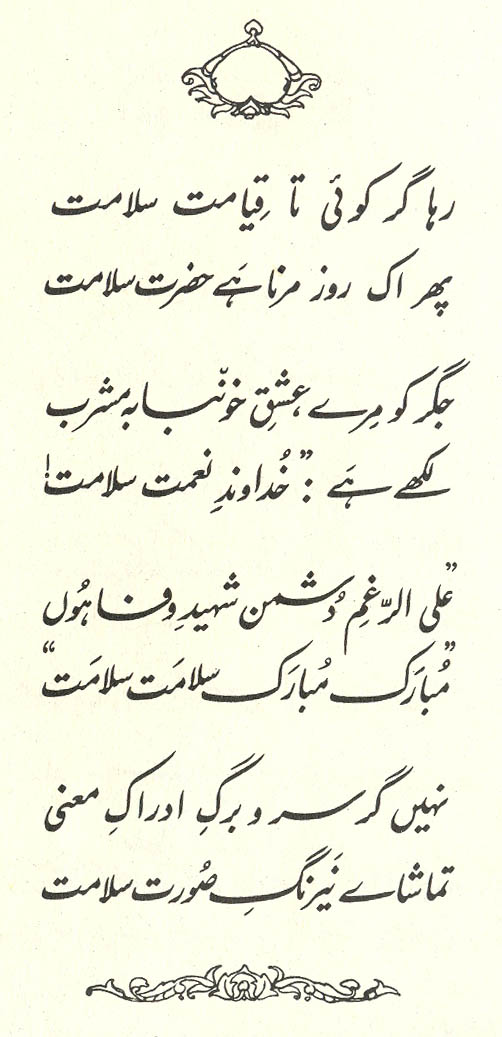
If the sky does not revolve in a way favorable to our purpose, if it is no sympathizer or helper of ours, then this is no cause for grief. May the sympathy and help of our ebullition of longing, which constantly keeps showing compassion for our condition, remain auspicious for us.
== Asi, p. 100
[Zamin's text has ] has no meaning. It's possible that Mirza might have composed . This verse ought not to have been retaine d in this ghazal.
== Zamin, p. 145
The liver is the symbol of strength and courage/spirit; thus the meaning of [Gyan Chand's text has ] is the desire for the power of endurance. If the sky doesn't revolve according to the goals and desires of our wounded heart, then we have the desire for the power to endure longing/grief. May this desire of ours remain safe/well!
== Gyan Chand, p. 175
For background see S. R. Faruqi's choices . For more on Ghalib's unpublished verses, see the discussion in 4,8x .
The wonderfully multivalent word has a range of meanings that Ghalib delights in exploiting (for other examples, see 22,6 ). Here, all three senses are beautifully appropriate. 'Action, work' and 'desire, wish' are certainly the obvious candidates, the usual suspects, the ones that we would emphasize in our minds on a first reading.
But then, after (under mushairah performance conditions) a suitable interval, we are allowed to hear the second line, we at once encounter the idea of 'gnawing, chewing' the liver-- which of course reminds us that also means 'palate, throat'. And we might also notice that is also a quality of delicate pastry (see the definition above), and ebullition or 'boiling' [] is itself a technique of cooking-- one that softens tough meats, so that they require less 'gnawing', and impose less of a burden on a 'worn-down' eater. And as so often, it's the 'heart' that's frail, and the 'liver' that's tough; for more such contrastive verses see 30,2 .
In short, if the heavens won't cater to the needs of the heart, let's hear it for the liver-gnawing 'of' the turbulent boiling 'of' longing. Thanks to the constructions, we can't tell whether the gnawing is caused by the boiling, or is identical with the boiling, or simply pertains to the boiling in some other, unspecified way. (And all the same range of possibilities obtain in the case of the boiling 'of' longing, too.) In this verse, the imagery is so abstract that perhaps we don't even care very much about working out all the possible permutations.
But it's that that energizes it all. Is gnawing on one's own liver really an adequate consolation for the unresponsiveness of the sky? Is the verse gallant, rueful, despairing, anxious, or even perhaps cheerful? Ghalib leaves us to decide for ourselves, since we have to choose a tone for the verse every time we recite it.
For more on the double reading of proposed in the second line, see the discussion in 51,4 .
graphics/liver.jpg