Verse 8xafter 1821atsalaamat
G12
1
there/it is an abundance of faithfulness, there/it is a crowd/rush of disasters/afflictions
2
wellbeing-- disgrace! disgrace-- wellbeing!
'Multitude, plenty, abundance'.
'Attacking; crowding, swarming (round, or about, - ); --assault, attack; effort; impetuosity; --crowd, throng, concourse, mob; a swarm'.
'Reproof, rebuke, censure, reprehension, reproach, accusation, blame; reviling; disgrace; opprobrium; contumely'.
'Safety, salvation; tranquillity, peace, rest, repose; immunity; liberty; soundness; recovery; health; --adj. & adv. (used predicatively) Safe, sound, well; --in safety, safely, securely'.
| References | |
|---|---|
| Arshi, Imtiyaz Ali | Ghazal# 52 |
| Raza, Kalidas Gupta | 356-357 |
| Asi, Abdul Bari | 100-101 |
| Gyan Chand | 174-176 |
| Hamid Ali Khan | Open Image |
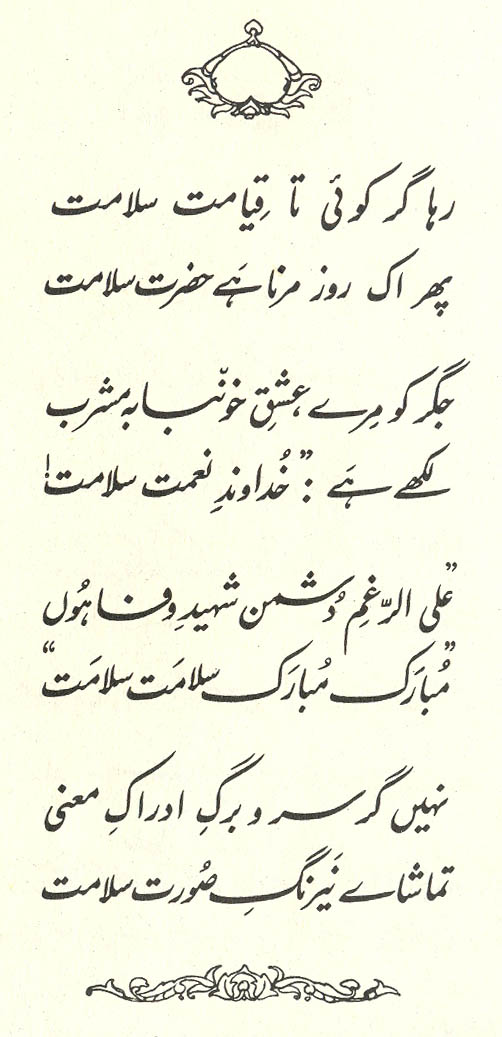
[Asi's text reverses the positions of and .] There is an abundance of disasters, and a crowd/rush of faithfulness. May disgrace be well, since wellbeing is disgrace.
== Asi, p. 100
[Zamin's text reverses the positions of and .] That is, my attraction to faithfulness and the crowd/rush of disasters are mutually necessary. Neither will faithfulness be renounced, nor will disasters. Indeed-- let the disgrace-causers cause disgrace, and may they remain well.
== Zamin, p. 145
I am showing much faithfulness to the beloved. Because of passion, a crowd of disasters is upon me. In passion, to live with wellbeing is an occasion for disgrace and shame. Thus when people reproach me, may that remain safe/well; because 'the name of wisdom has become madness; of madness, wisdom'.
In the same way, the opposite of wellbeing is reproach. And we want the wellbeing of reproach. The pleasure of the difference in meaning between the two utterances in the second line is the basis of the excellence of the verse.
== Gyan Chand, p. 175
For background see S. R. Faruqi's choices . For more on Ghalib's unpublished verses, see the discussion in 4,8x .
This is surely one of the most remarkable 'sound effects' verses Ghalib ever composed, and I wish he had included it in his divan . In both lines, the semantic structure perfectly and emphatically follows the foot pattern:
vu-FUU-RE / va-FAA-HAI / hu-JUU-ME / ba-LAA-HAI
sa-LAA-MAT / ma-LAA-MAT / ma-LAA-MAT / sa-LAA-MAT
In addition, both lines feature strong internal rhyme at the halfway point. And the first line also offers an astonishingly perfect reduplication of vowels in each half: u-uu-e a-aa hai , u-uu-e a-aa hai . The incantatory sound of is a special pleasure in itself. And the second line, since it consists of two repetitions each of two nouns that differ only in one letter, could hardly be more rhythmic and energetic.
As so often, we find that apparent simplicity actually makes for the most radical kind of open-endedness. The first line simply informs us of the existence of two seemingly parallel things: an abundance of faithfulness and a crowd of disasters. And the grammar in Urdu of 'A is' can be read in two distinct ways: (1) There exists (an) X; and (2) It/this/that is (an) X. The second possibility, with the subject colloquially omitted, invites us to look for a nearby subject-- and what could be nearer than the second line?
When-- after, in mushairah performance, a suitable delay-- we hear the second line, it presents us with two pairs of nouns, in A B B A order, and nothing else whatsoever. Thus it's tempting to think that each of the two entities in the second line is to be correlated with one of the two entities in the first line-- but how? The 'abundance of faithfulness' might be correlated with 'wellbeing', because it's a desirable state for a lover; or it might be correlated with 'disgrace', because an excess of passion often has that result. Similarly, the 'crowd of disasters' might be correlated with 'wellbeing', because the mad lover's life is hostile to worldly success; or it might be correlated with 'disgrace', because scandal and public condemnation are routine, disastrous parts of the lover's experience.
But even if we don't try correlating the two lines, the second line in itself proves impossible to pin down. Here are some perfectly plausible ways of reading it:
=Wellbeing, disgrace to you! Disgrace, wellbeing to you!
=Wellbeing is really its seeming opposite, disgrace; and disgrace is really its seeming opposite, wellbeing.
=Wellbeing and disgrace are the same thing; disgrace and wellbeing are the same thing.
=Wellbeing always turns into disgrace, and disgrace then turns back into wellbeing.
=The speaker considers 'wellbeing' to be a disgrace to him; he considers 'disgrace' to be his wellbeing.
=The speaker's life is a sequence of alternating waves of 'wellbeing' and 'disgrace'
=The speaker's life is a chaos in which 'wellbeing' and 'disgrace' are inextricably blended.
For a discussion of other such wide-open, verb-deprived 'list' verses, see 4,4 .
graphics/opposites.jpg