Verse 1after 1821atsalaamat
G12
1
if until Doomsday someone would remain well/safe
2
still/then, one day it's necessary to die, [Your] Excellency who is well/safe!
'Safety, salvation; tranquillity, peace, rest, repose; immunity; liberty; soundness; recovery; health; --adj. & adv. (used predicatively) Safe, sound, well; --in safety, safely, securely'.
| References | |
|---|---|
| Arshi, Imtiyaz Ali | Ghazal# 52 |
| Raza, Kalidas Gupta | 356-357 |
| Asi, Abdul Bari | 100-101 |
| Gyan Chand | 174-176 |
| Hamid Ali Khan | Open Image |
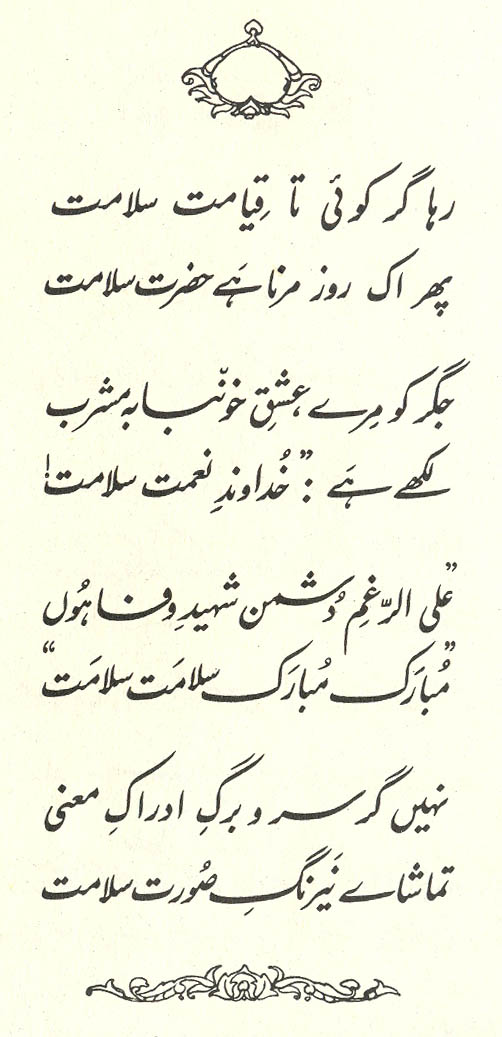
== Nazm page 47

He says, even if some individual lives until Doomsday, then so what? It's necessary to die-- he'll die on Doomsday. Dying on Doomsday has created this pleasant effect, that Doomsday is the day when the dead come to life. For someone to die on that day will not be devoid of pleasure. (91)
It seems that someone has expressed a longing for a long life, or a regret at someone's dying at an early age. This verse is in answer to that. (115)
is a colloquial idiom meaning 'Your Excellency'. With regard to dying, the word in this utterance is nothing less than mischievousness of style. (125)
SETS == EXCLAMATION; PETRIFIED PHRASES
DOOMSDAY: 10,11
LIFE/DEATH: 7,2
As Josh observes, the use of the petrified phrase is the chief pleasure of this verse. As a common title of respect, it means something like 'Your Auspicious Excellency', or in this case 'Your Excellency who possesses '. Since means something like 'wellbeing', including 'health' and 'safety', the use of this seemingly respectful title for the addressee comes across as tongue-in-cheek, and reminds the addressee that he shares our common human vulnerability.
The original closing-verse of this ghazal, 51,10x -- one that didn't make it into the divan -- used this same rhyme -word, which might well have given it a kind of closural effect. And in virtually every verse, the refrain tends to give the second line considerable exclamatory force.
Bekhud Dihlavi points out that , 'Doomsday', is literally a day of resurrection, with a root meaning 'to stand'. It's the day when God will cause the dead to rise up and receive judgment. To say that someone will live till the day the dead rise, and still/then [] die one day, is a piquant notion that could suggest some odd theological possibilities. (What kind of an will it be when such a person dies?)
There is also, of course, the enjoyable and metrically-reinforced sound-play of and . Ghazals of the 'short meter ' kind, like this one, can make good use of fixed expressions with many nuances, like ; for another short meter example see 21,1 .
On the use of the perfect verb form as a subjunctive, see 35,9 .
graphics/death.jpg