Verse 21853aamke
G14
1
what complaint is there toward you about brokenness/sorrow?! --for these
2
are the stock-in-trade of the blue-colored sphere
'Wounded, hurt; broken; infirm; sick, sorrowful; --fragile, brittle'.
'Ready at the hand (of); familiarly acquired and ever at command; --s.m. An art, or accomplishment; a handicraft, profession; --a habit, custom, knack'.
| References | |
|---|---|
| Arshi, Imtiyaz Ali | Ghazal# 231 |
| Raza, Kalidas Gupta | 445 |
| Hamid Ali Khan | Open Image |
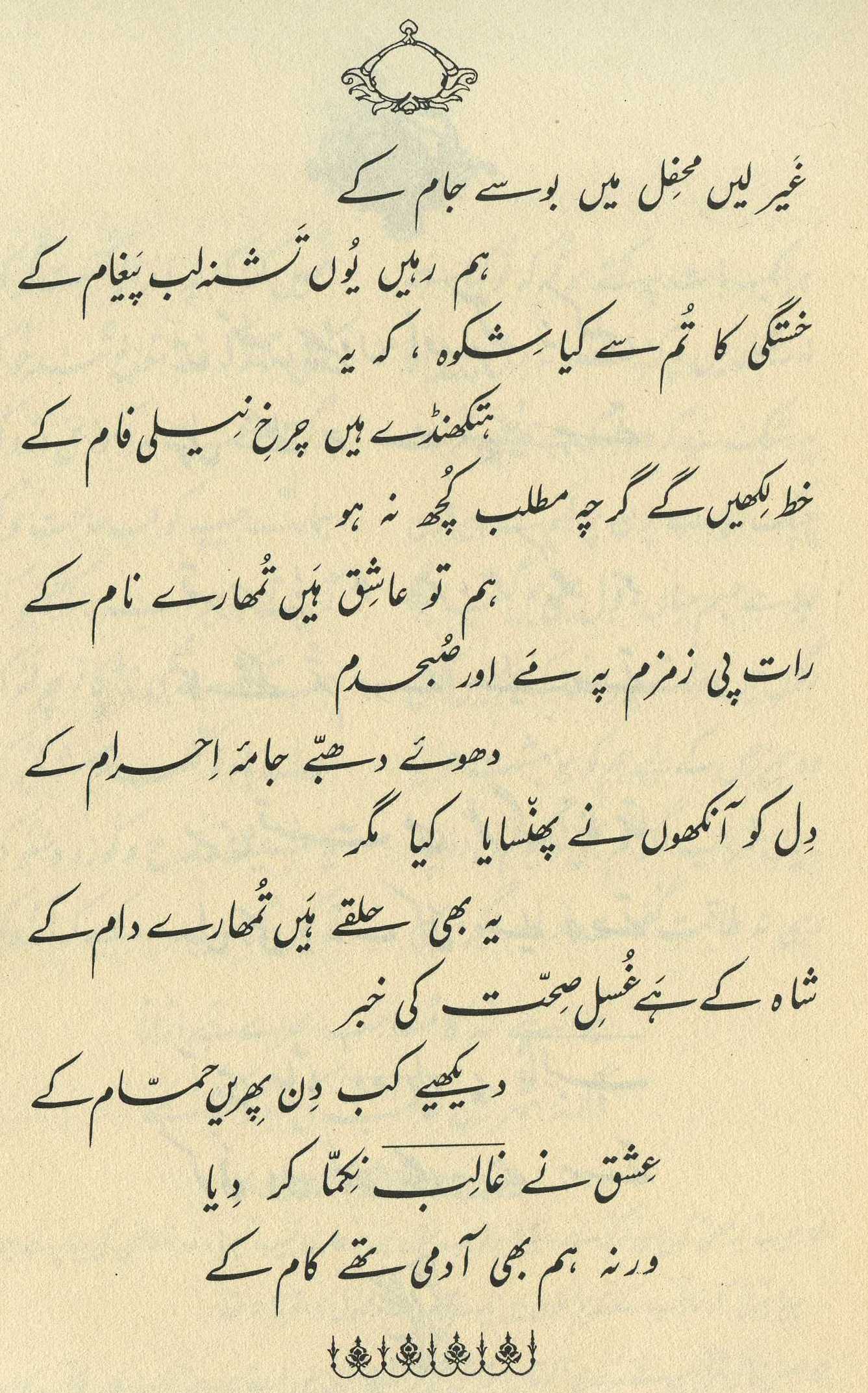
That is, the complaint is not to you, there's a complaint to my own destiny. And the word 'blue-colored' in this verse is only for the sake of the [rhyme of the] verse []; it plays no part in the meaning. In elucidation [], we can say that a blue color is inauspicious, and is a sign of grief. (203)
== Nazm page 203

He says, 'We don't complain to you of our ruin and destruction. This is the doing of the tyrannical and cruel ways of that inauspicious sky. That cruel one night and day keeps inventing new excuses and occasions [for oppression].' (261-62)
[Disagreeing with Nazm:] How would I say that this word is for the sake of the [rhyme of the] verse, and plays no part in the meaning! 'Azure-robed' [] in the meaning of 'trickster' [] is common. [Three illustrative Persian verses, from Sa'adi, Jami, and Hafiz.] The word kept tugging on his sleeve, but the pitiless commentator wouldn't listen for even a moment. This verse has no need for 'elucidation'-- and the 'elucidation' that was given is entirely inappropriate: this verse has no scope for 'inauspiciousness'. (358)
Bekhud Mohani has been waiting for a chance like this, and does he ever love it! He's got Nazm dead to rights: he skewers him, then twists the knife in the wound.
This is the third of Arshi's group of three related verses; for each of them, he's been recommending comparison with the other two. And he's exactly right, of course-- they're a natural group to compare, and they really do shed light on each other.
This verse centers on -- and what a fine rich center it is! It shows (if showing was at all needed) that Ghalib is just as able and willing to play with the possibilities of colloquial Indic words as with those of fancy Persian ones. Every one of its meanings (see the definition above) is relevant to the first line, each in its own individually nuanced way. And it certainly also deserves some ' fresh word ' credit; this is its only occurrence in the divan . Our poetry group unanimously affirms (Dec. 2022) that (nowadays, at least) the word is colloquially used in an entirely negative sense, implying a trick or deception.
If the 'you' is the beloved, then the verse may actually, for once, exonerate her of the usual charges of cruelty, oppression, etc., since these have been outsourced to the sky. (But compare 179,2 , in which the beloved is a calamity in her own right, and 126,8 , in which the sky seems to have outsourced its cruelty to the beloved.) If the 'you' is addressed to God, then the verse still seems inclined to let Him of the hook. But of course, there are many tones in which it could be said (bitter? resigned? judicious?), and these will provide a large part of the verse's emotional relish.
I'm glad to have been able to come up with 'stock-in-trade' as a rough translation . With its literal connection to merchandise and selling, and its colloquial sense of habitual activity or readily expected behavior, this phrase captures as many as possible of the senses of . It would have been good to work in 'sleight-of-hand' too, in order to pick up the 'hand' imagery, and the evocation of the sky as an 'azure-robed' trickster.
Note for grammar fans: In the first line, is singular, so we're inclined to read theas singular too. But the second line has a plural verb, so we're obliged to retrospectively read the as plural, and take it as referring to some unspecified set of evil practices.
graphics/bluesphere.jpg