Verse 11816aa;Nkii
G2
1
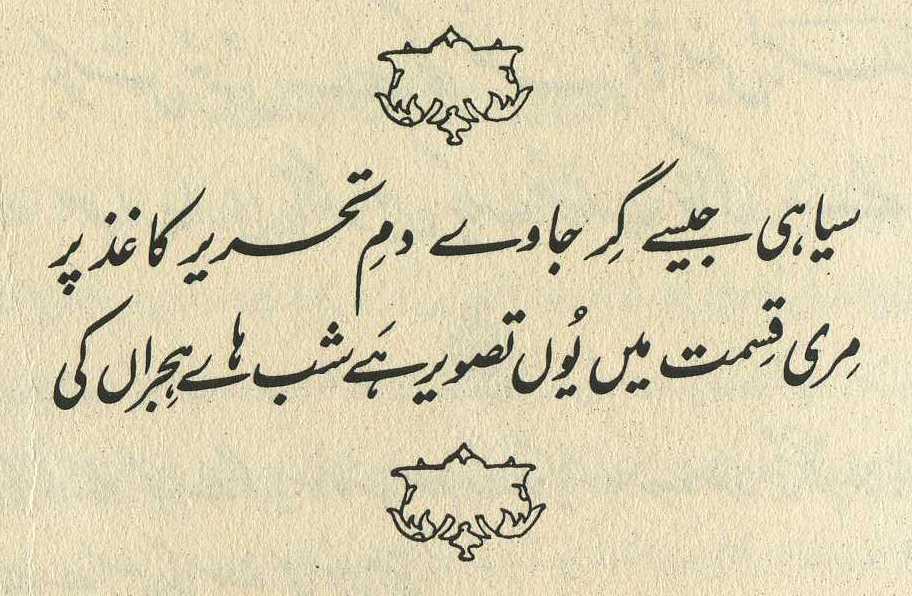
the way ink/'blackness' would fall, at the moment of writing, on the paper
2
in my fate, casually/causelessly/'like this', is the picture/image of the nights of separation
'Blackness, darkness; shade; a black spot; a black dye or tincture; ink; blacking; lamp-black (syn. ); (met.) a stigma, brand'.
'To fall, drop, come down; to tumble; to alight, to perch (on, ), to descend; to fall (upon, )'.
'Thus, in this wise, in this manner; —just so, for no particular reason; without just ground, vainly, idly, causelessly, gratuitously; to please oneself'.
| References | |
|---|---|
| Arshi, Imtiyaz Ali | Ghazal# 183 |
| Raza, Kalidas Gupta | 229 |
| Nuskhah-e-Hamidiyah | 203-204 |
| Asi, Abdul Bari | 222-224 |
| Gyan Chand | 339-341,549 |
| Hamid Ali Khan | Open Image |
By fate is meant the writing of fate, and he has supposed that the letters of the writing of fate are all pictures. For example, the kind of letters that used to be customary in ancient Egypt; and those people who are sign-readers or who look at palms also have this opinion. (253)
== Nazm page 253

He says, 'The way at the time of writing ink falls and hides the letters, in the same way in the writing of my fate the picture of the nights of separation has been captured'. The meaning is that the nights of separation have hidden the writing of my fate in such a way that I can't even know what is written in my future. (310)
He has captured a picture of the memorable nights of separation written in my fortune like this: the way at the time of writing ink would fall on the paper, and except for darkness nothing would be visible. That is, in my fate there are only nights of separation, and that's it. (459)
Now please reflect on the aspect of meaning. At the time of writing if ink would fall on the paper, then it becomes a biggish blot. This blot is not of any particular kind, but rather is erratic and without regularity. The written destiny of the speaker is such that in it where the nights of separation should have been mentioned, there's a biggish blot, as if at the time of writing the ink would have fallen. This blot can have the following interpretations:
(1) In my lot the nights of separation are so many, so black, and so formless that it was proper to express them only by means of a blot. That is, the writer of destiny didn't have the words for them.
(2) My nights of separation are so murderous and painful that the writer of destiny considered it proper to hide their nature, and made a biggish blot.
(3) The expression of my nights of separation was so painful that the writer's courage left him, he no longer had control of his pen, and a biggish drop of ink dropped from his pen and spread on the paper.
(4) The writer of destiny thought, 'How would I express this person's destiny-- in it is mostly the blackness of nights of separation!' Thus, expressing his carelessness, made a biggish blot: this very thing is his fate.
== (1989: 345-46) 2006: 373-74
Between the black ink and the white paper there's a difference of night and day-- literally so, in this verse. Fate would seek to write its decree for the days of the speaker's life, but at the very moment of writing, a spill of black ink darkens them all into nights-- the endless nights of separation. These nights of separation are cosmic and all-pervading, and no day can ever really succeed or redeem them, just as after an ink-spill the page can never really be white again. These black nights cover the page of his destiny with a hopeless blot, making it unreadable; thus they're all the destiny he'll ever have. For more on the complexities of , see 30,1 .
That's the obvious reading, and the one that the commentators prefer. But what does it mean for ink to 'fall' on paper? One meaning is certainly to 'spill', as from a dripping pen or even an overturned inkwell. But other meanings include 'to alight', 'to descend', and 'to perch on'. In this sense, the falling of black ink onto white paper could simply refer to the time when fate begins to write the speaker's destiny. Faruqi's commentary explores some of these possibilities; I'd like to emphasize one more.
For the moment of writing is also the time when the white paper begins to be constrained and overpowered by the first of those black lines that will ultimately cover it with black words. It would thus refer to a normal event (which seems to be quite possibly what the grammar of the first line suggests), rather than to a sudden accident. This reading would also consort better with 'at the moment of writing'. For an ink-spill could occur at any point, not just at a particular moment; while gives a sense of inception, of seeing the instant of origin.
And though less melodramatic, this latter reading would be in a way even more deadly and irrevocable. For the very first letters and words of the speaker's fate are black like the nights of separation, and so are all the later ones, making the page of his fate blacker and blacker over time. And we've known ever since 1,1 that fate (or divinity) is a casual, careless, 'mischievous' writer at best, so that its letters are often poorly shaped (and inclined to complain about it).
But there's another nice little twist as well: without ink, no writing. Without the blackness of ink to irrevocably darken the whiteness of paper, there's no destiny at all-- no cosmic decrees, no divine 'mischievousness', no human creativity, not even (perish the thought!) the ghazals of Ghalib.
Compare another 'ink' verse: an unpublished cousin, from this same ghazal: 225,2x .
For another attempt to reckon with the unreckonable nights of separation, see 97,2 .
graphics/inkdrop.jpg