Verse 2x1816aa;Nkii
G2
1
I always, even/also in childhood, practiced misfortune/'black-dayness'
2
the ink/'blackness' of the school-tablet is in my days
'Misfortune, adversity'.
'Blackness, darkness; shade; a black spot; a black dye or tincture; ink; blacking; lamp-black (syn. ); (met.) a stigma, brand'.
'A tablet; a plank, a board (especially on which anything is written); — a title-page'.
| References | |
|---|---|
| Arshi, Imtiyaz Ali | Ghazal# 183 |
| Raza, Kalidas Gupta | 229 |
| Nuskhah-e-Hamidiyah | 203-204 |
| Asi, Abdul Bari | 222-224 |
| Gyan Chand | 339-341,549 |
| Hamid Ali Khan | Open Image |
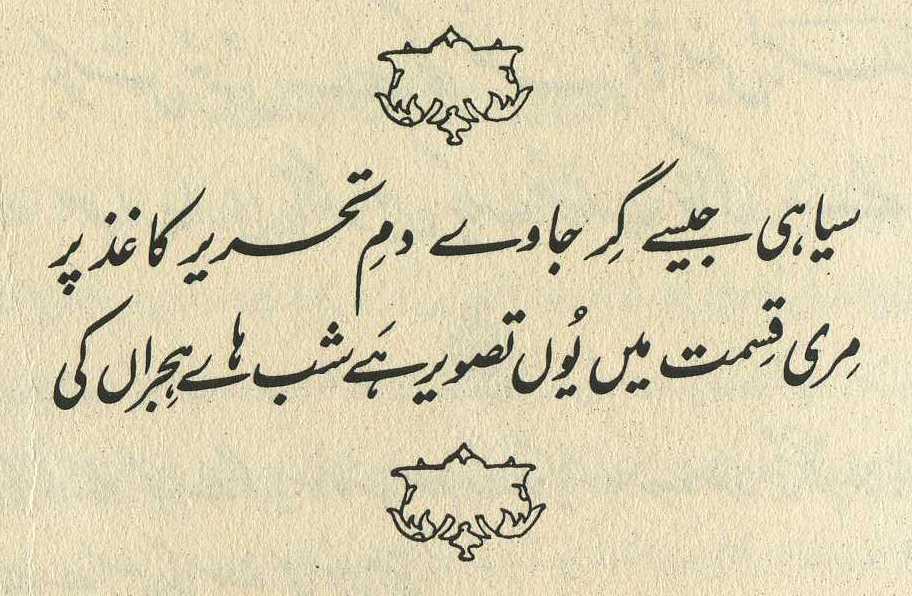
I am so ill-fortuned that from childhood itself I have kept practicing 'black-dayness'. And the darkness and ink/blackness of my days is that which used to be used in school, when I practiced on the practice-tablet. From this only this much meaning emerges: that I am ill-fortuned from eternity, or unfortunate by nature.
== Asi, p. 222
The meaning is clear, but the defect of imagination [] is that 'black-dayness'-- that is, ill fortune-- is not adoptable, such that it could be 'practiced'. [He proposes ways to re-word the verse.]
== Zamin, p. 331
In childhood, in school I made the tablet [] black. That very ink/blackness has filled up my life. From childhood I have kept practicing blackness/ink; for this reason my fortune is black.
== Gyan Chand, p. 339
For background see S. R. Faruqi's choices . This verse is NOT one of his choices; I thought it was interesting and have added it myself. For more on Ghalib's unpublished verses, see the discussion in 4,8x .
This verse is a less successful cousin of the single divan verse from this ghazal, 225,1 . The young poet was trying things out.
Zamin makes a useful point: that the verse has a 'defect of imagination' because ill fortune is not something that one can choose and adopt, that one can 'practice'. It's clear how Ghalib means for the imagery to work: that a child in school uses black ink on a wooden tablet (which can later be scraped down and reused) to 'practice' writing. In his writing 'practice' (and playful doodling too), he creates blotches and spills of ink. A careless child might even spill ink all over his tablet. This careless 'practice' (of writing, and also of inky 'blackness') is what the speaker claims to have continued all his life, so that he has somehow participated in the 'writing' of the 'blackness' of his own fortune.
I would phrase Zamin's criticism differently: the verse gives us no mechanism or reason, no poetic 'proof', for the efficacy of the child's ink-blotchy writing as a determinant of the adult's (written) fate. But there's always 34,2 , in which Ghalib himself, in a letter, seeks to make a similar connection between childhood actions and ongoing effects by invoking a lifelong 'practice of madness' []'. Does this justification really work? We're left to decide for ourselves.
graphics/tablet.jpg