Verse 51821aryaad aayaa
G11
In this meter the first long syllable may be replaced by a short; and the next-to-last long syllable may be replaced by two shorts.
1
life would have only/emphatically passed even/also {like this / vainly, idly / for no particular reason / to please oneself}
2
why did your road/passage come to mind/recollection?
'Thus, in this wise, in this manner; --just so, for no particular reason; without just ground, vainly, idly, causelessly, gratuitously; to please oneself'.
| References | |
|---|---|
| Arshi, Imtiyaz Ali | Ghazal# 27 |
| Raza, Kalidas Gupta | 328 |
| Nuskhah-e-Hamidiyah | 74-75 |
| Hamid Ali Khan | Open Image |
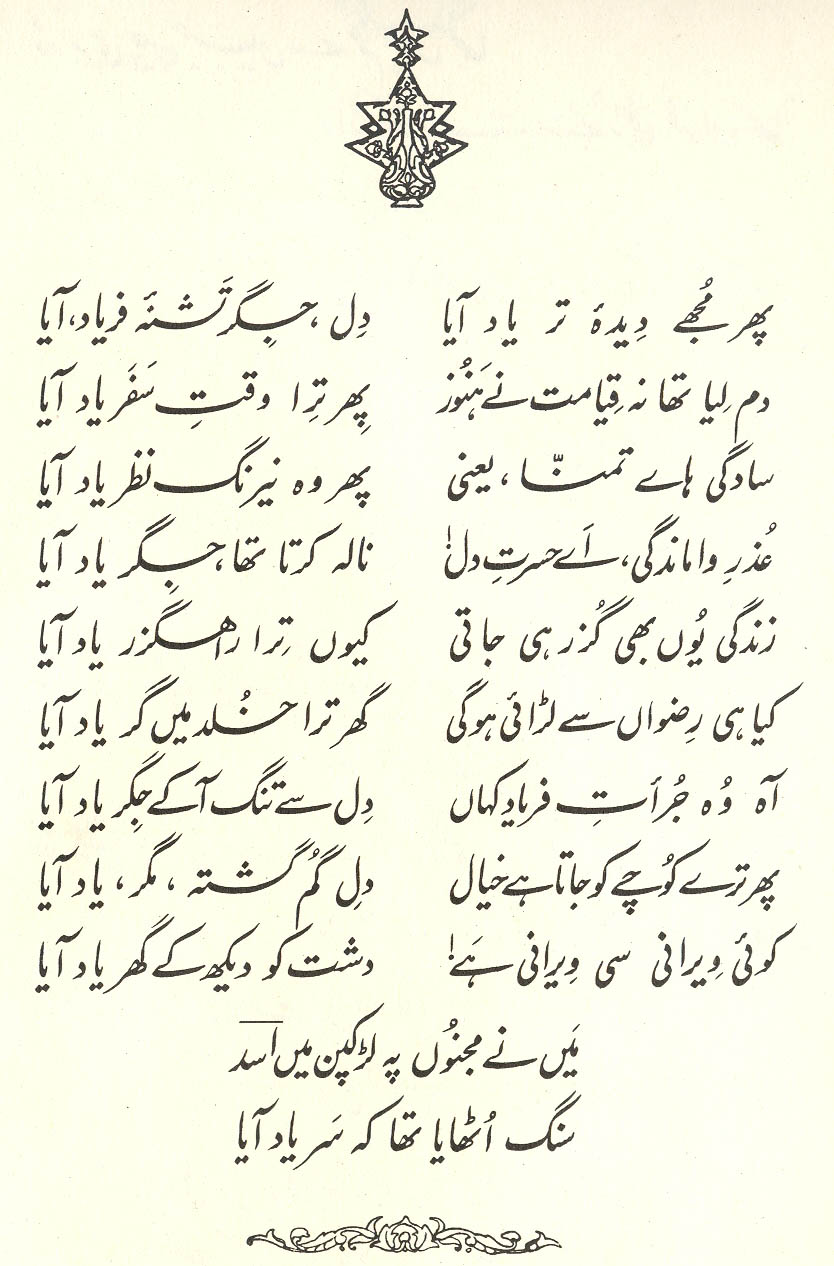
He says, from your road coming to mind, my life has passed away. And this proved to be a good thing, because I was disaffected with life. But from its coming to mind such sorrow and suffering resulted, that-- if only it hadn't come to mind! Life would have passed somehow or other, after all. (35)
== Nazm page 35

The excellence that he has created in this verse is that he has taken the work of fate and destiny to be the cause of his foolishness, and expresses regret at it.
In Mirza Sahib's time, used to be spoken and written as masculine. But now, as it happens, the people of Delhi treat it as feminine. (68)
That is, when there's no expectation of union, nor of a sight, then it's useless for your street to come to mind. Now there remains life-- that passes away in any case. (83)
Both lines offer, for our reflection, the conspicuously (in such a short meter) repeated word . Life would have passed (away), you have passed-- why did I remember the road by which you passed?And the makes it either emphatic (life would have passed, after all!) or restrictive (it would have done nothing else but pass!).
But then what does it mean to say 'Life would have passed, 'even' or 'also' {like this / vainly, idly / for no particular reason / to please oneself}'? Is a life like that (and/or its passing) being depicted as good, or bad, or neutral? The colloquial is notoriously hard to translate at best, and Ghalib has carefully given it a remarkably uninformative context. (For more on usages, see 30,1 .)
Perhaps the tone is regretful: 'What a vexation-- I wish I had been left to my casual, life!' Or perhaps it's amazed at such good fortune: 'What a lucky chance-- now instead of a desultory life I'll have a truly meaningful death!' Or perhaps it's just puzzled or wondering-- 'Something would have killed me anyway-- why did fate even bother to send me this particular memory?'
Thus 'Why did your road come to mind?' is either a serious, thoughtful question, or a rhetorical one-- one perhaps full of rueful exasperation, or else disbelieving delight, like 'Why did I go to that party?!'
This is such a moody, evocative, lovely verse; and the mood shifts as different aspects of it are emphasized. Even the effort to figure out its implications seems to take place in a twilit realm of nostalgia and fatalism.
Here's my long-ago attempt at a translation (1985) .
graphics/departure.jpg