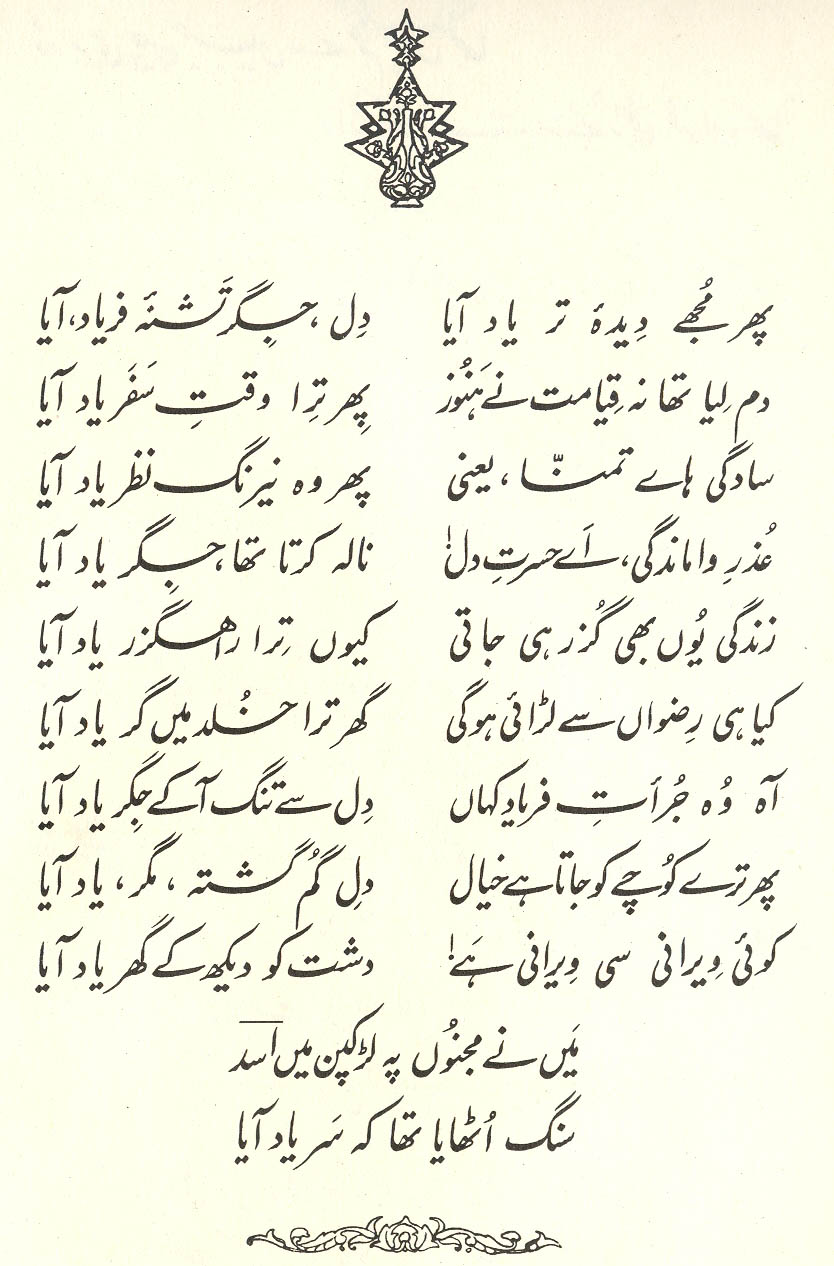
Verse 11821aryaad aayaa
G11
In this meter the first long syllable may be replaced by a short; and the next-to-last long syllable may be replaced by two shorts.
1
again/then wet eyes came to mind/recollection
2
the heart became ardent/'thirsty-livered' for lament
'Thirsty; thirsting (for), eagerly desiring; greedy, insatiable'.
'Thirsting, longing'. (Steingass p.366)
| References | |
|---|---|
| Arshi, Imtiyaz Ali | Ghazal# 27 |
| Raza, Kalidas Gupta | 328 |
| Nuskhah-e-Hamidiyah | 74-75 |
| Hamid Ali Khan | Open Image |
In the second line is used with the meaning of hu))aa ; it's a Persian idiom, and the idiom is not used this way in Urdu. (34)
== Nazm page 34

The meaning is that the memory of wet eyes again made the heart long to lament. (34)
The heart is preparing to lament. At this time my tear-shedding comes to my mind. That is, formerly when I used to be preparing to lament, then wet eyes always used to keep that afflicted one [the heart] company. But all the blood flowed out. Now in the wet eyes dust is flying. How could the eyes keep it company? The point is that now we are in no state for shedding tears and extinguishing the flaring fire of the heart. (82)
Some people take 'wet eyes' to refer to the beloved's wet eyes. (114)
It is established that with the meaning of 'ardent' [appears in at least one early Persian dictionary]. The second point is that is no novel construction: it's the inversion of [which itself appears in two Persian dictionaries].... From the above discussion it becomes established that in Ghalib's verse is entirely correct; in it there's neither obscurity nor novelty nor innovation. (57)
== 2006: 57
This is one of only a handful of ghazals from which Faruqi has selected every single divan verse as superior.
As usual, so much can be done (and in fact must be done) to figure out the relationship of these two extremely simple lines. Hasrat and Baqir take the first line to be the cause, and the second line the result: wet eyes came to mind, therefore the speaker felt like weeping. Bekhud Mohani takes the second line to be the cause, and the first to be the result: the speaker felt like weeping, therefore he remembered the old days when he actually had tears to weep with. Or, of course, both lines could be parallel, and would just describe his habitual melancholy.
'Wet eyes' are also ambiguous. The speaker's? The beloved's? A sign of grief, and thus grief-evoking? A sign of proper lamentation, and thus nostalgia-evoking? And how are we to read -- did this experience happen 'again' (so that it's something that frequently occurs), or 'then' (in response to the second line, or to some other stimulus)? Obviously there's 'wetness' in one line and 'thirst' in the other, but how exactly are they to be connected to each other?
Making the 'heart' appear as 'thirsty-livered' adds to the complexity, since these two organs are often depicted in opposition to each other; for more on this see 30,2 (and also, in the present ghazal itself, 35,4 and 35,6 ). Now the heart and liver are somehow working in tandem, or else the heart has its own (metaphorical) liver. But are they working successfully, generating tears? Or are they working unsuccessfully, vainly lamenting their loss of the power to generate tears?
This whole ghazal, one of Ghalib's great classics, is a triumph of that ghazal quality called mood . It's in a 'short meter' [chho;Tii ba;hr], and has in yaad aayaa , 'came to mind', an unusually long and evocative refrain . What ghazal could be easier to memorize, or more tempting to recite? Small wonder that it's been a favorite with singers.
Note for meter fans: This verse has the same kind of ' contrived rhyme ' that 26,9 does (see that verse for discussion).
Here's my long-ago attempt at a translation (1985) .
graphics/weteyes.jpg