Verse 11821aazahthaa
G1
1
last night the intoxication/hangover of the ardor of/for the Cupbearer was in the measure/style of Judgment Day
2
as far as the ocean/circumference of wine there was a picture-house of a yawn/stretch/gape
'The resurrection, the day of judgment'; : 'Growing, growth'; : 'Springing up'.
'Measure, measurement; quantity; weighing, weight; degree, amount; valuing, valuation, value; rough estimate; conjecture, guess; proportion, symmetry; elegance, grace; mode, manner, style, fashion, pattern'.
t>> : 'Surrounding, encompassing, enclosing, encircling, circumambient; ... periphery, circumference (of a circle); the ocean'.
'Stretching; yawning, gaping ;....punishment, retribution, reward, fruit'.
| References | |
|---|---|
| Arshi, Imtiyaz Ali | Ghazal# 12 |
| Raza, Kalidas Gupta | 324-325 |
| Nuskhah-e-Hamidiyah | 53-54 |
| Gyan Chand | 90-91 |
| Hamid Ali Khan | Open Image |
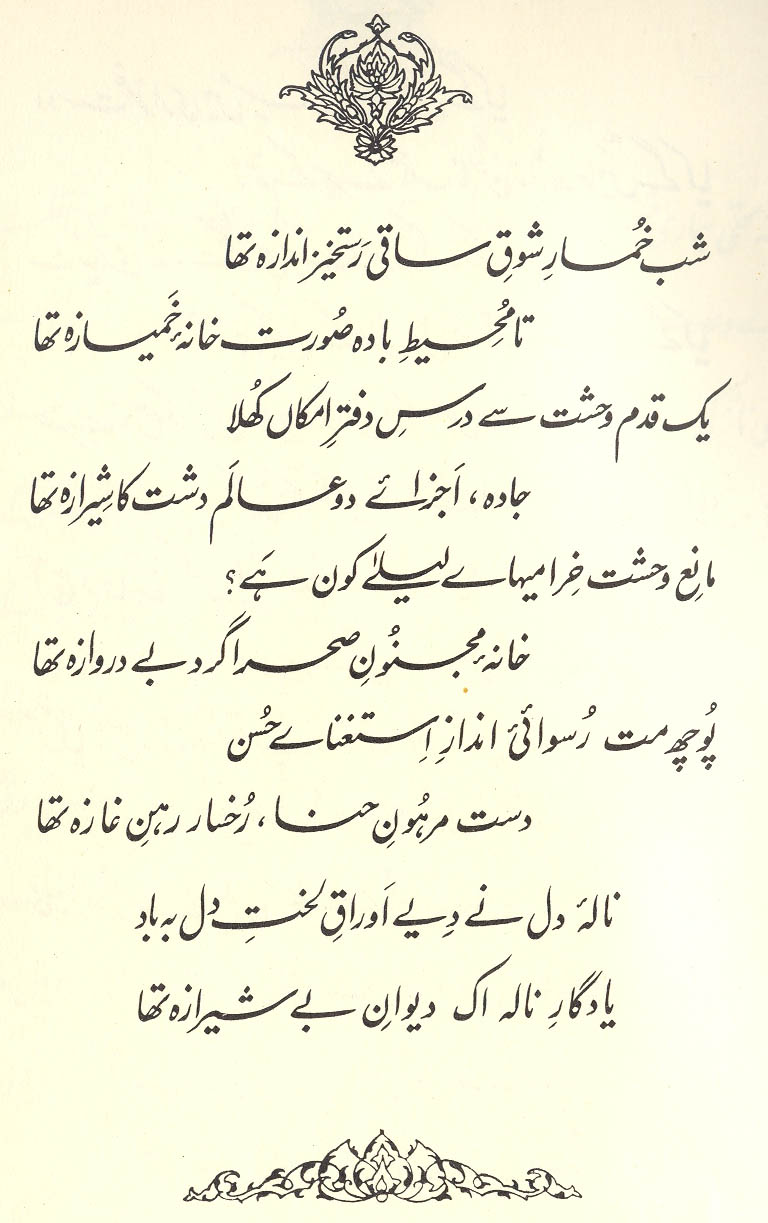
That is, last night my ardor had stirred up a Doomsday; and because of the displeasure and distaste in the ardor, he has used the simile of 'intoxication'. He says, from here to the sea of wine had become a picture-house of my yawn. That is, in intoxication I gave vent to such huge yawns that their length reached to the ocean of wine. The author's gist is that in yawning, the way he stretched out his hands and feet was as if he were searching for wine. (18-19)
== Nazm page 18 ; Nazm page 19


Urdu text: Vajid 1902 {18}
The way on the Day of Judgment the dead will rise from their graves, in the same way everything, wherever it had been placed, began to rise up.... The rule is that wine-drinkers, as their intoxication abates, yawn and stretch. In stretching, their hands rise up and come together, and this is the aspect of Judgment Day. The meaning of the verse is that while waiting for the Cupbearer, the wine in the flagons too, like me, began to stretch. He has used the image of a stretch for the wine becoming agitated, which is an inferior example of Mirza Sahib's ' high-flyingness .' (38)
Let people of insight consider the extent to which Mirza had expertise in the selection of words. is that line on the flagon up to which the wine is poured. (44)
has several meanings, but here two meanings are helpful for our purpose: (1) intoxication; (2) after the intoxication abates, or while it abates, the flaccidness and broken-downness that abates only/emphatically after drinking [more] wine. Thus it means the abating of intoxication, the pursuit of wine....
The meaning of can be not only 'waiting for the Cupbearer', but also 'the relish and ardor of/for the Cupbearer'. Now the meaning will be not while waiting for the Cupbearer, but rather in the decline of the relish and ardor of/for the Cupbearer, there was a Day of Judgment condition of fatigue and distaste. That is, the relish and ardor of/for the Cupbearer was swift and sharp like intoxication. As the night passed, a decline took place, and a condition of was created. In it there was the same flaccidness and distaste that exists in the of wine.
Or rather, this bore such an intense distaste that even the wine that was rippling in the wineglass and leaping up to the wine-circumference line presented the scene of a yawn. That is, the rippling of the wine, instead of increasing the relish of/for wine-drinking, was reducing it. Or else that the drinkers were feeling such flaccidness and distaste that they considered even the rippling wine to be a yawn/stretch of .
Another point is that Bekhud Dihlavi has suggested the affinity of yawning and the Day of Judgment, but between the foaming of the wine-- that is, its getting stirred up and splashing and rising up, for which the meaningful word has been used-- and the Day of Judgment there is also a subtle affinity. That is, for wine to become stirred up is for it to rise and ascend. 'To rise' [] is used for the Day of Judgment also. And on the Day of Judgment people too rise, and come out of their graves.
[Nazm] Tabataba'i has taken to mean not 'line on the wine-flagon', but 'ocean of wine'. This meaning too is possible, and Ghalib's own verse is a proof: 12,2 . Since waves only/emphatically arise in the ocean, (in which the hands become elevated) is in this regard very suitable. In the wine-house there was such an abundance of wine that it was as if an ocean of wine would be flowing. And the waves of this ocean (that is, the rippling of the wine) was presenting the scene of a yawn/stretch.
== (1989: 38-39) 2006: 48-49
Faruqi is right to emphasize 12,2 , which plays with many of the same elements (and also provides discussion and examples of the idiomatic terms and ).
Thanks to the clever ambiguity of the , we don't even know whose ardor 'of/for' the Cupbearer was so intense-- the wine-drinkers', the Cupbearer's, and/or possibly that of the ocean of wine itself.
In this verse the wordplay is so elaborate and so contrived that it's hard even to pick out the basic analogies on which it rests. Obviously the commentators too are somewhat at sea (sorry, all this wordplay gets to me).
A glass of wine, full up to a certain level, might be a rounded, wide-open mouth; an ocean of wine might also be a rounded, wide-open mouth; but what is meant here seems to be an extended bout of stretching, with a series of yawns, like someone getting up from a table after many hours of now-ebbing intoxication.
Bringing in , 'as far as, up to,' suggests that the state of , which extends right up to the edge of the ocean of wine, is the twisting, stretching shape of the shoreline. This is made explicit in 12,2 . The drinkers' relationship to the ocean of wine is like that of the shore to the sea: they press close to it, they never leave it, they contain it within bounds, they devote themselves to it with a constant and fixed attention. If we aren't meant to make use of this pairing of images (shore/sea), then why should be present?
Thus the drinkers' rising or standing, in order to yawn and stretch-- and to evoke the 'rising up' of Judgment Day-- appears to be secondary. And why do we also need a 'picture-house' []-- how does that fit in? The imagery seems to take us in too many directions at once, without being satisfactorily integrated.
graphics/seashore.jpg