Verse 1after 1821aazkaa
G3
1
only/emphatically you are not an intimate of the voices/sounds/music of the secret/mystery
2
otherwise, that which here is a curtain/veil, is the veil/tone of a [musical] instrument/concord
'Spouse, consort; anyone to whom the or women's apartments are open (as a father, or a son, &c.); —a confidant, an intimate friend'.
'Voice, sound; modulation; song; air; --a certain musical tone or mood; riches, opulence, wealth, plenty; subsistence; --prosperity; goodness or splendour of circumstances; --a splendid situation; --a happy life'.
'A veil; a curtain; —concealment; —modesty, bashfulness, shame '.
'A curtain, screen, cover, veil ... secret, mystery, reticence, reserve; screen, shelter, pretext, pretence; a musical tone or mode; a note of the gamut; the frets of a guitar, &c'.
'A veil, curtain, tapestry ... ; a musical tone or sound, a note; a melody; the key of an organ, harpsichord, or similar instrument; frets or divisions upon the neck or finger-board of a guitar or lute'. (Steingass p.242)
'Ornament; concord, harmony; a musical instrument'.
| References | |
|---|---|
| Arshi, Imtiyaz Ali | Ghazal# 34 |
| Raza, Kalidas Gupta | 354 |
| Hamid Ali Khan | Open Image |
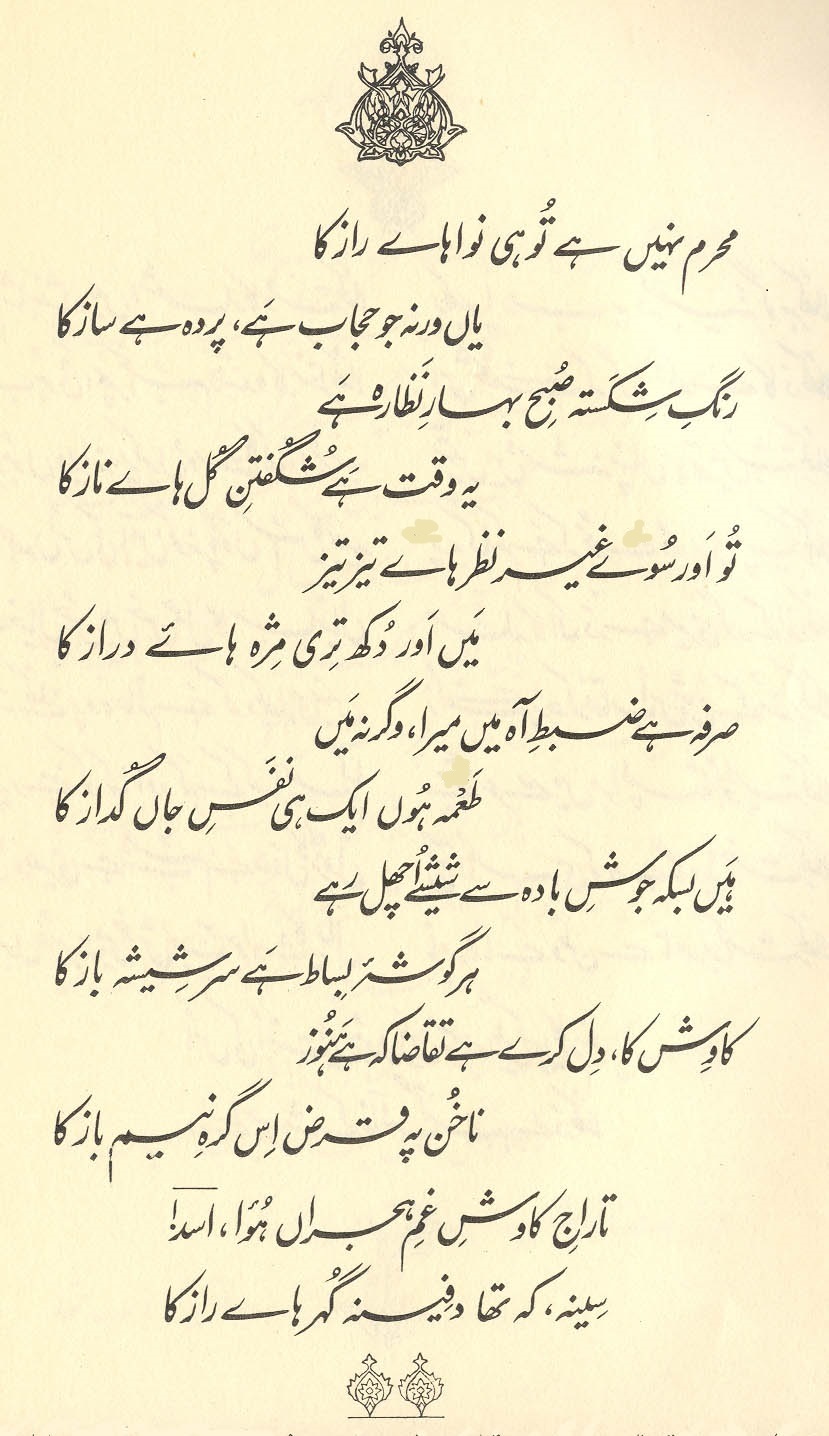
That is to say, you alone are unfamiliar with the melodies of the mystery; otherwise, in the world, that which outwardly looks like a veil is also speaking, is resonating like the string of an instrument, and is expressing divine secrets.
==Urdu text: Yadgar-e Ghalib , p. 139
That is, the thing that you consider a veil of the world of divine reality [], it is the string of a rabab [], from which melodies of the mystery of divine reality arise. But it's you who cannot experience the pleasure of its rhythm and tone. (13)
== Nazm page 13

Urdu text: Vajid 1902 {13}
He says, you yourself are not acquainted with the melodies of the mystery. Otherwise, in the world what looks outwardly like a veil is speaking and resonating like the string of an instrument and is expressing the divine mysteries. He has written a peerless verse. (27)
This is a famous and widely known verse. It comes in handy as a (relatively) polite putdown when people fail to understand things. Bekhud Mohani uses it that way, for example, in 1,1 .
The remarkable 'double activation' wordplay involving is the heart of the verse. It's a perfect illustration of what Faruqi means when he says that wordplay is meaning-play as well. The word in the first line, followed by in the second line, causes us to take in its most common sense of something like 'veil'. Not until the last possible moment does the word suddenly anf firmly clue us in to the additional use of in some musical sense.
In its meaning of 'musical tone, or note, or fret of an instrument', certainly goes with 'voices' or 'sounds' []. It seems that this meaning is especially prominent in Persian (see the Steingass definition above). As Vasmi Abidi points out, 'eardrum' is , so that one could imagine the eardrum itself as a vibrating membrane like the head of a drum. But the other senses continue to make themselves felt. Thanks to its cleverly exploited doubleness (or tripleness?) of meaning, as 'veil' or 'mystery' or 'secret' also participates in a play of affinities involving (an 'intimate' before whom a woman does not keep ), ('secret' or 'mystery'), and ('veil'). For other such cases of 'double activation', see 120,3 .
Why is the intimate used for 'you'? It feels as though the speaker is talking to himself, expounding to himself from a position of maximum closeness the mysteries of Sufism. Or could it be that to talk to someone intimately about his lack of intimate access creates a layer of intriguingly deliberate paradox as well? (And in practical terms, as Vasmi Abidi also points out, the ending for the opening-verse line can be generated only by ; accommodating would mean recasting the whole line.)
The verse is also a textbook case of the very valuable ambiguity of . It can be exclusive (only you are ignorant, everybody else knows), or merely emphatic (you are the one who is ignorant, it's not the fault of the harmony-filled world around you).
For other evocations of (super?)natural mysteriousness in the world around us 'here,' see 40,4x and 45,1 . For a very different use of , see 71,1 .
graphics/veiledstrings.jpg