Verse 31816aaniikii
G2
1
even/also after death, the madman is a pilgrimage-place of children
2
sparks of stone performed rose-scattering on my tomb
| References | |
|---|---|
| Arshi, Imtiyaz Ali | Ghazal# 142 |
| Raza, Kalidas Gupta | 229-30 |
| Nuskhah-e-Hamidiyah | 204-205 |
| Asi, Abdul Bari | 224 |
| Gyan Chand | 341-342 |
| Hamid Ali Khan | Open Image |
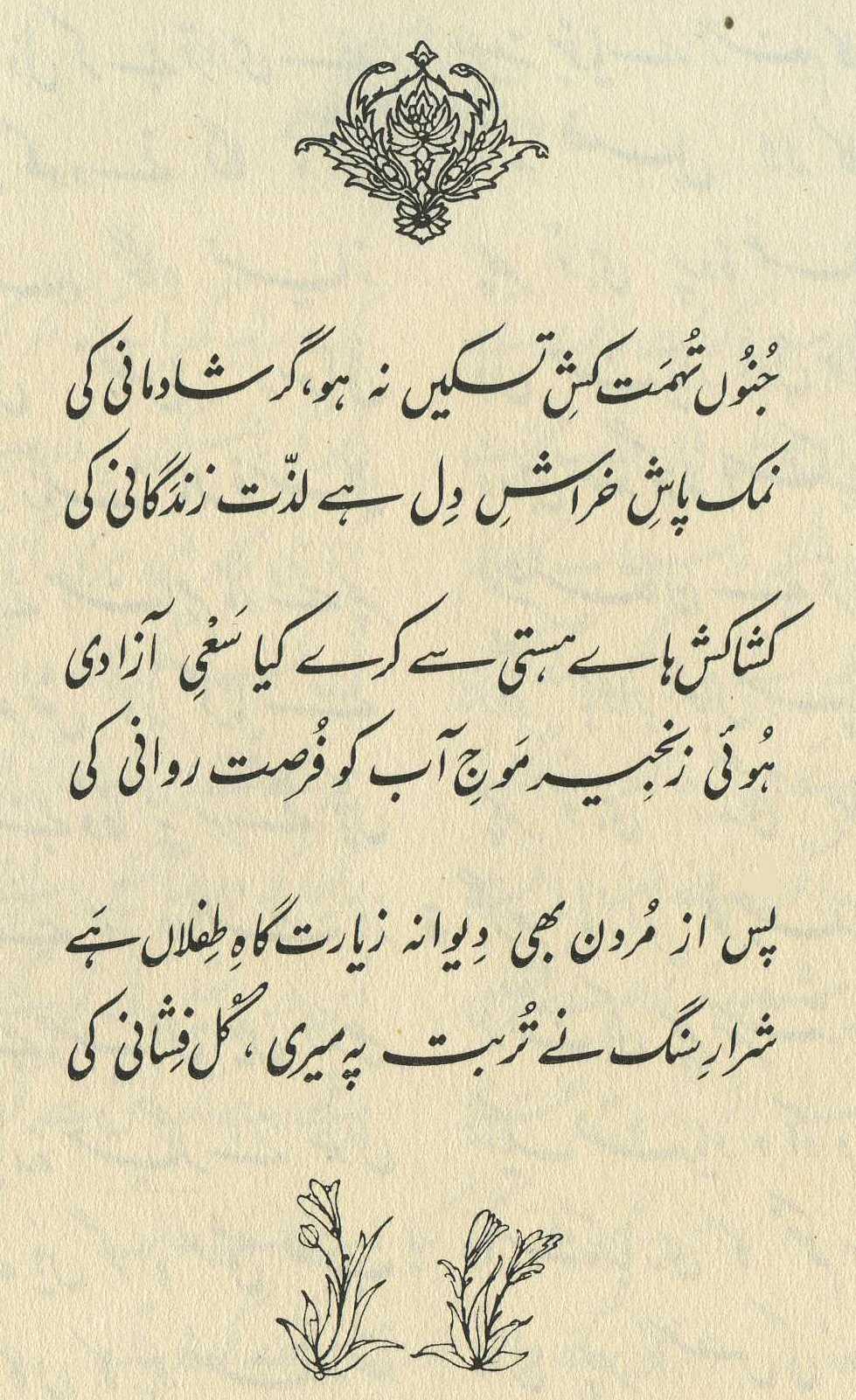
That is, even upon my death boys came and threw stones, and the sparks of the stones scattered flowers on the tomb. (179)
== Nazm page 179

He says, 'Even after my death, the boys made your madman into a pilgrimage place, and they still even now come to my grave and throw stones. The flowers of the sparks of the stones are offered every day upon my tomb.' (239)
Even after my dying, boys come to the madman's grave, and throw stones. The stones fall on the sepulchre. Sparks emerge, and offer up flowers on the madman's tomb. (322)
We know of course that in the ghazal world boys throw stones at madmen, including mad lovers. For discussion of this and more examples, see 35,10 . But why would they be said to make of the mad lover's grave a 'pilgrimage-place'? There's no reason at all for them to have any religious devotion to him or it. The first line sets us up with an intriguing question; then of course, under mushairah performance conditions, we're made to wait as long as conveniently possible for an answer.
And in the best mushairah-verse style, even in the second line the 'punch-word' is withheld as long as possible. To hear 'sparks of stone on my tomb' (the Urdu word order) gives us no help at all: we may quickly think of the children throwing stones, but the idea of a 'pilgrimage-place' remains opaque. Only at the last possible moment, when we hear the actual rhyme -word 'rose-scattering', are we enabled to make the connection. Then we experience the verse all at once-- with a delayed, and thus deepened, rush of pleasure.
The numerous small red sparks made by thrown stones striking the stone tomb resemble numerous small red rose-petals, so that the boys seem to be showing the reverence appropriate to a 'pilgrimage-place'. And why not? Their continuing to throw stones at the mad lover even after he's dead is, after all, a kind of supreme tribute to his madness: the boys found him so satisfactory a target for their taunts and hostility that no mere commonplace madmen, even live ones, have succeeded in distracting their attention and supplanting him in their-- well, maybe 'affections' isn't the right word, but it isn't quite the wrong one either.
This verse is one in which the dead lover speaks; for a full list, see 57,1 .
The 'objective correlative' is the look of tombs of distinguished Sufi saints and other revered figures (including Gandhi) in South Asia. Visitors often show their reverence and respect by scattering rose-petals-- so many that the tomb of a particularly venerated figure will sometimes be actually blanketed in them. Here's a poignant modern example:
graphics/tombroses.jpg