Verse 11816aaniikii
G2
1
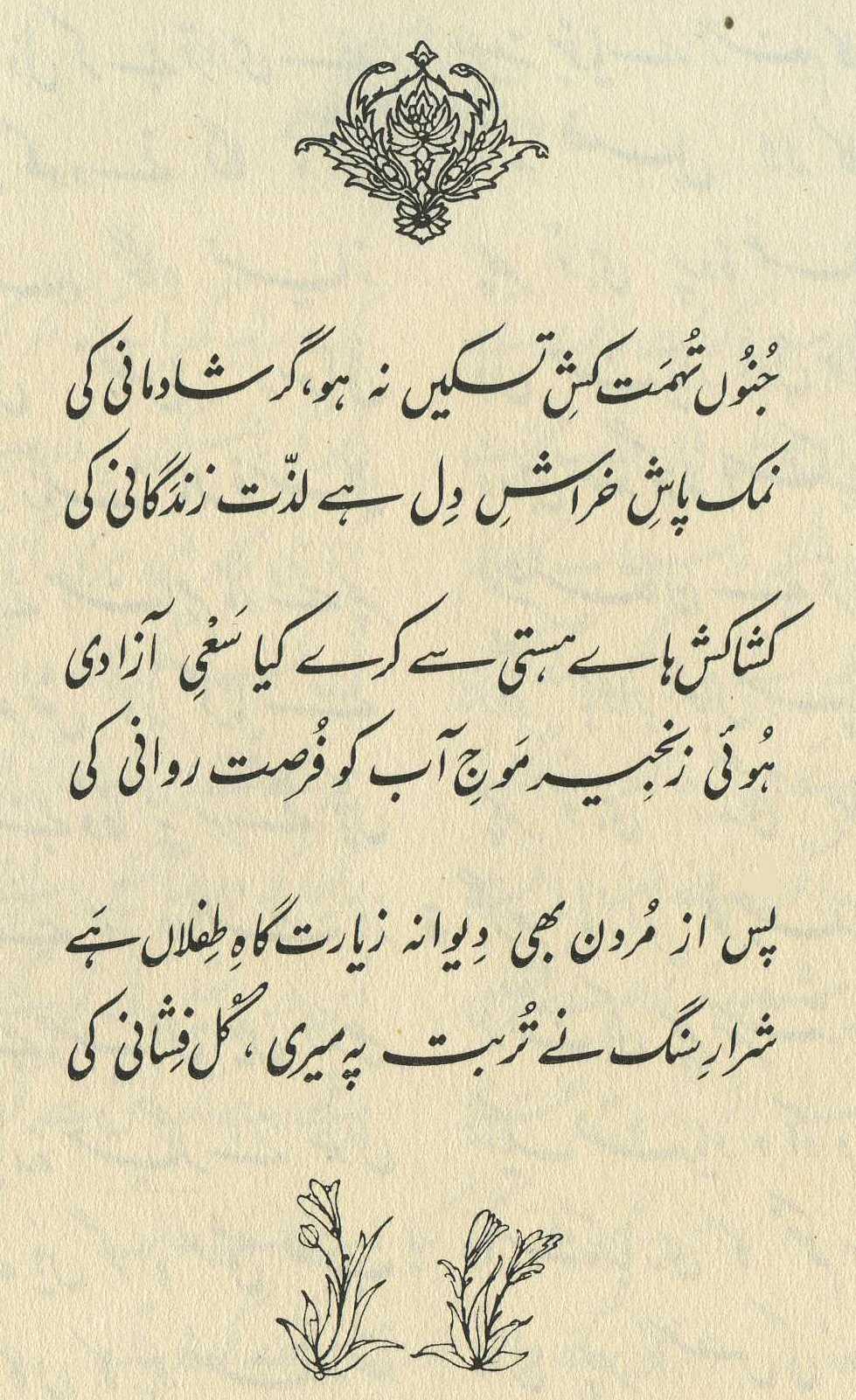
let Madness not be blame-drawing for comfort/calmness, if it rejoiced
2 a
a sprinkling of salt on the lacerations of the heart is the pleasure/relish of life
2 b
the pleasure/relish of life is a sprinkling of salt on the lacerations of the heart
'Calming, stilling, tranquillizing, appeasing, soothing, allaying, assuaging; consolation, comfort, mitigation, rest, assurance, peace (of mind)'.
'Scratch, scraping, cutting, excoriation'.
'Pleasure, delight, enjoyment; sweetness, deliciousness; taste, flavour, relish, savour; —an aphrodisiac; an amorous philter'.
| References | |
|---|---|
| Arshi, Imtiyaz Ali | Ghazal# 142 |
| Raza, Kalidas Gupta | 229-30 |
| Nuskhah-e-Hamidiyah | 204-205 |
| Asi, Abdul Bari | 224 |
| Gyan Chand | 341-342 |
| Hamid Ali Khan | Open Image |
The word 'pleasure' [] is only by way of sarcasm/taunt []. He says, oh Madness, you wouldn't be blamed for comfort. That is, if I rejoiced, then the blame of self-possession can't be placed for it on you. Rather, my rejoicing is because of the salt-sprinkling on the wound of the heart, not because of comfort. And for the pleasure of life to be salt-sprinkling has the meaning that to remain living through such bad situations is to sprinkle salt on the wound of the heart. And from the sprinkling of salt on the heart, the burning becomes even greater-- where is the 'comfort'? (179)
== Nazm page 179

The meaning is that to remain alive in such a bad condition as ours, sprinkles salt on the wound of the heart. And from salt being sprinkled on a wound, the burning of the wounds, and the pain, increases, not the comfort. (239)
[Disagreeing with Nazm:] The word is not by way of sarcasm/taunt, but rather, in its own meaning. Take it to mean that the pleasure of life is in just that: the sprinkling of salt. (322)
Well, we're back at the old pleasure/pain paradox that lies at the heart of passion (and of the ghazal world). That's exactly what Nazm and Bekhud Mohani are disagreeing about, as far as I can tell: Nazm wants to read 'pleasure' sarcastically, while Bekhud Mohani thinks it's used straightforwardly in its normal meaning: the pleasure of life really is in the sprinkling of salt. In favor of Bekhud Mohani is the classic 'salt' verse, 17,7 . In a verse like this present one the mind can ricochet back and forth indefinitely.
This whole pleasure/pain back-and-forth zigzag always reminds me of the wonderful, and equally undecideable, aphorism, 'A sadist is someone who is kind to a masochist'.
And of course, the idea that Madness might be subject to 'blame' if it yields to a few moments of comfort or peace is a peculiarly lover-like one. The lover's defensive tone makes it clear that he very much resents the 'accusation' that he might ever seek, or even accidently find, any respite from the dire straits that are his life. (After all, the salt-sprinkling process seems to be actually his definition of happiness.)
The sound effects are good, with the two sounds so resonantly close together. The enjoyableness of the repetition of is increased by the fact that their sound and spelling are the same, while their grammatical structures are entirely different (the first is a verb, the second a postposition).
For other verses that connect wounds and salt, see 77,1 .
graphics/salt.jpg