Verse 21816aaniikii
G2
1 a
why/how would he/she/it struggle for freedom from the tensions of existence?
1 b
what a struggle for freedom from the tensions of existence he/she/it would make!
1 c
as if he/she/it would struggle for freedom from the tensions of existence!
2 a
for the wave of water, leisure/ease of movement became a shackle/chain
2 b
for the wave of water, a shackle/chain became leisure/ease of movement
'Repeated pulling; pulling backwards and forwards, or to and fro; jostling, hustling; bringing and taking away;... great unpleasantness, or grief, or pain; distraction, dilemma, perplexity, difficulty; struggle, contention, wrangle, squabble; attraction, allurement'.
'Endeavour, attempt; exertion, effort; enterprise, essay; purpose'.
'A time, opportunity, occasion; freedom (from), leisure; convenience; relief, recovery; respite, reprieve; rest, ease'.
| References | |
|---|---|
| Arshi, Imtiyaz Ali | Ghazal# 142 |
| Raza, Kalidas Gupta | 229-30 |
| Nuskhah-e-Hamidiyah | 204-205 |
| Asi, Abdul Bari | 224 |
| Gyan Chand | 341-342 |
| Hamid Ali Khan | Open Image |
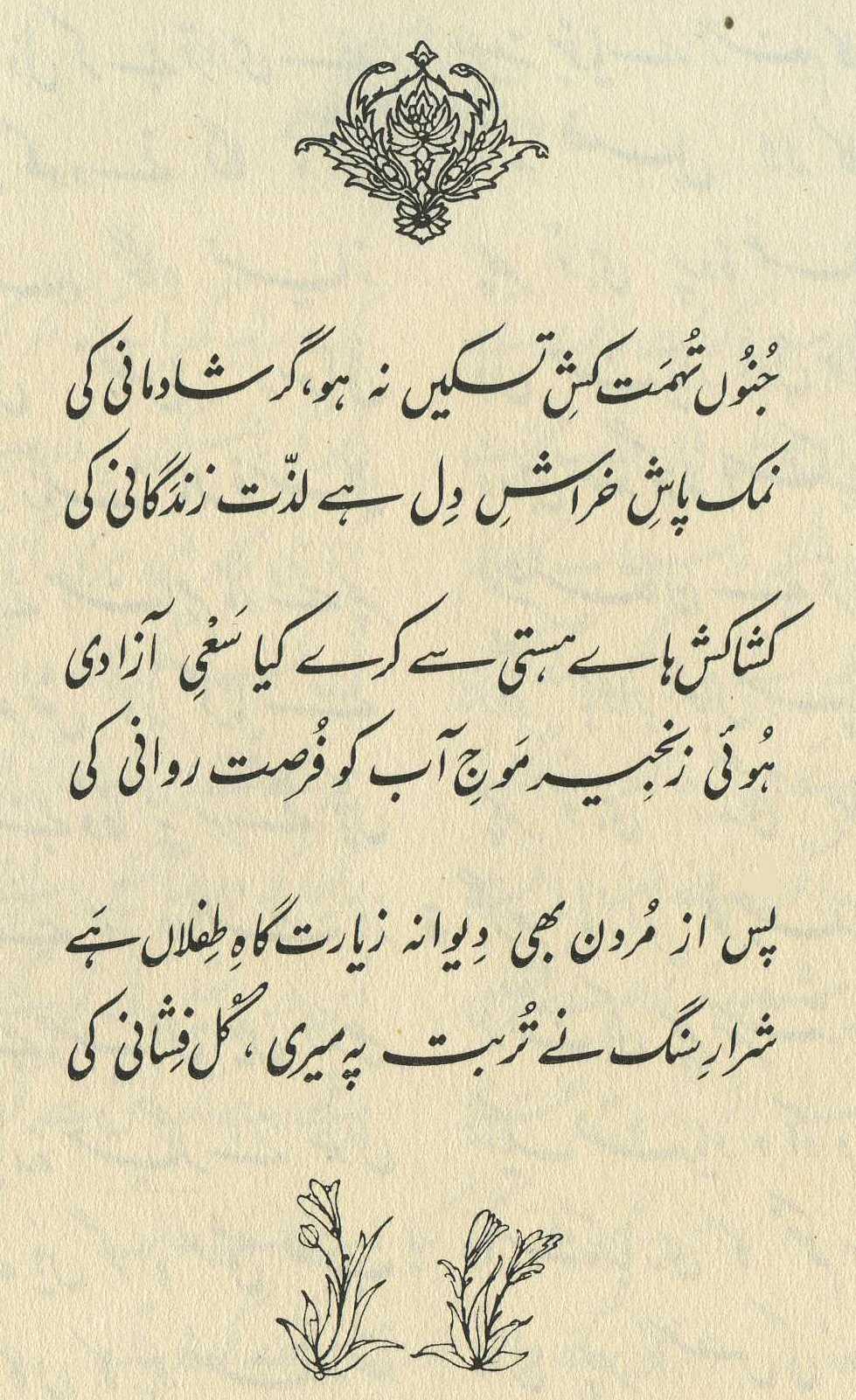
That is, from the tensions of existence, the attempt at freedom can't work its will. The movement of water is exactly what becomes a shackle of bondage. That is, however much effort you make to become free from the tensions of the attachments/connections of existence, by that much your bondage keeps increasing, and the effort keeps being overpowered by the tensions. (179)
== Nazm page 179

The meaning is that to the extent that a person tries to become free from the {creatures / created things} of existence, to that very extent his bondage goes on increasing. By way of a result, his effort becomes overpowered by the tension. (239)
From the tension of existence the struggle for freedom is powerless to achieve anything. Just take a look at what they call the 'movement' of the ocean wave-- in reality it is a shackle. And he has pulled out this idea because when a wave arises, it begins to have the visual aspect of a shackle. That is, to whatever extent the attempt is made for separation from worldly connections, to that extent this bond becomes tight. The way to the extent that a bird flutters in a net, to that extent the meshes tighten around him. (322)
One pivot of this lovely, but bleakly undecideable, verse is , with its literal meaning of pulling and tugging (so much related to 'tension' and 'stress') and its extended meanings of anxiety, suffering, etc. (see the definition above). The other pivot is , with its opposite sense of ease and relief. For also implies the chance to move freely, and in the case of the wave, free movement means not only a , as the waves collide together, roil into one another, hurl each other about-- but also a , as the waves move in their endless back-and-forth sloshing that basically gets them nowhere, like the pacing of a prisoner in his cell.
There's also the visual correlative: the curling crest of the wave assumes the round form of a shackle, and the series of cresting interlinked waves forms the sequential likeness of a chain.
The 'kya effect' gives us the usual three possible readings for the first line: a question (1a), an affirmative exclamation (1b), or a negative exclamation (1c). Then the principle of symmetry (if A=B, then B=A) gives us the two readings for the second line. We could also read as the subject of the first line: 'what would a struggle for freedom from the tensions achieve/do?' The same three 'kya effect' possibilities would still open up.
And how brilliantly, with how many piquant possibilities, the two lines come together! Compare 138,1 , which offers a similar range of possibilities through exactly the same sequence of devices ('kya' in the first line, symmetry in the second).
For a much lighter and more charming reading of the waves' agitated behavior, see 116,9 .
graphics/oceanwave.jpg