Verse 11816aadyaa;N
G1
1
having attached her heart, it fell/'became attached' even/also to her to sit alone
2
once/ finally we received justice/revenge for our forlornness/friendlessness, here
'Once, one time, all at once; at last, at length'.
'Forlorn state, friendlessness, destitution'.
'Statute, law; equity; justice; crying out for justice, complaint; revenge'.
| References | |
|---|---|
| Arshi, Imtiyaz Ali | Ghazal# 95 |
| Raza, Kalidas Gupta | 205-06 |
| Nuskhah-e-Hamidiyah | 153-154 |
| Gyan Chand | 265-266 |
| Hamid Ali Khan | Open Image |
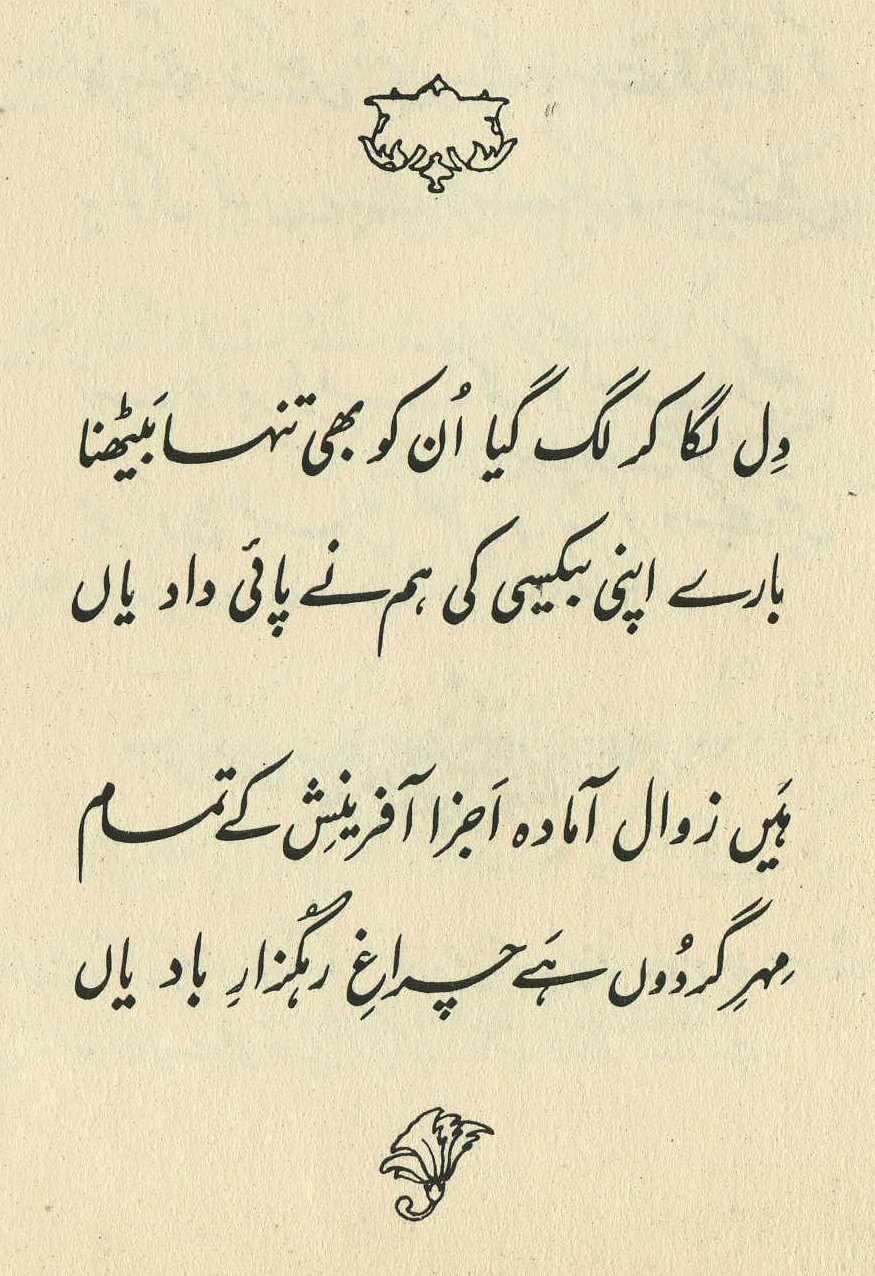
That is, our patience during forlornness and loneliness received justice/revenge in this world. (110)
== Nazm page 110

He said, having fallen in love with someone, she too became loneliness-loving. We found justice/revenge for our forlornness and loneliness in the world. That is, our patience during forlornness has now fallen to her. The state we were in through love of her-- she's now in that state through love of the Other . (160-61)
We're grateful that we've found justice/revenge for our forlornness, in this world itself. The way we, in separation from her, used to avoid the company of our friends and sit in loneliness-- now she too, having fallen in love with someone, is living exactly our life. (211)
Compare 131,2 . (223)
[See his discussion in Mir's M 921,5 .]
The lover can rarely expect any justice/revenge [], even in the next world, even through divine intervention-- although he can hope, as in 111,7 , and fantasize, as in 100,6 . Yet amazingly enough, he now has justice 'here' [] in this world itself, and with no help from God at all. The beloved herself, or perhaps her fate, has been more than sufficient for the task. She has rashly gone and fallen in love with somebody else. Either 'all at once' or 'at last' [] (or both, of course), the tables are turned.
Now the beloved knows what it is to be in the receiving end of the kind of treatment she's meted out to her own lovers. Now it's now fallen to her to sit alone, pining, miserable, and mired in the same 'forlornness, friendlessness' [] that the lover himself knows so well. For more on the beloved's falling in love, see 13,2 .
There's a nice wordplay (and meaning-play) between 'sitting alone' and 'forlornness, friendlessness'. The natural behaviorof suffering lovers is, for all kinds of reasons, to deliberately choose and seek solitude. And yet solitude itself is also a sign of abandonment, misery, forlornness, friendlessness. It sits at the boundary between the voluntary and the involuntary. As, of course, does passionate love itself.
But the best and most fundamental example of wordplay, cleverly positioned for maximum impact, is . The relationship between and is that of transitive and intransitive. If somebody lagaanaa-es something, it would be reasonable to expect it to become lagnaa-ed. So that if one would 'apply, attach, cause to adhere' [] a heart, the heart might very well then 'adhere, stick' []. The first half of the first line leads us to expect something as coherent, punchy, and colloquial as that.
But then in the second half of the line we discover just the opposite: when the beloved 'applied, attached' her heart, what 'adhered, stuck' was-- not a heart, but an abstraction, 'sitting alone'. She gave her heart, and received in return a habit of melancholy solitude. And of course, the little reminds us how well the lover knows whereof he speaks.
Compare Mir 's verse 'I told you so' verse along the same lines: M 1683,1 .
graphics/belovedsuffers.jpg