Verse 7after 1847iirbhii thaa
G5
In this meter the first long syllable may be replaced by a short; and the next-to-last long syllable may be replaced by two shorts.
1
having seen the Other , why wouldn't the liver be satisfied/'cool'?
2
[I/he/it] used to lament, but [I/he/it] was even/also a seeker of effect
'To satisfy the heart's longing, to obtain (one's) wish; to get ease'
'The making an impression; impression, effect'.
| References | |
|---|---|
| Arshi, Imtiyaz Ali | Ghazal# 41 |
| Raza, Kalidas Gupta | 397 |
| Hamid Ali Khan | Open Image |
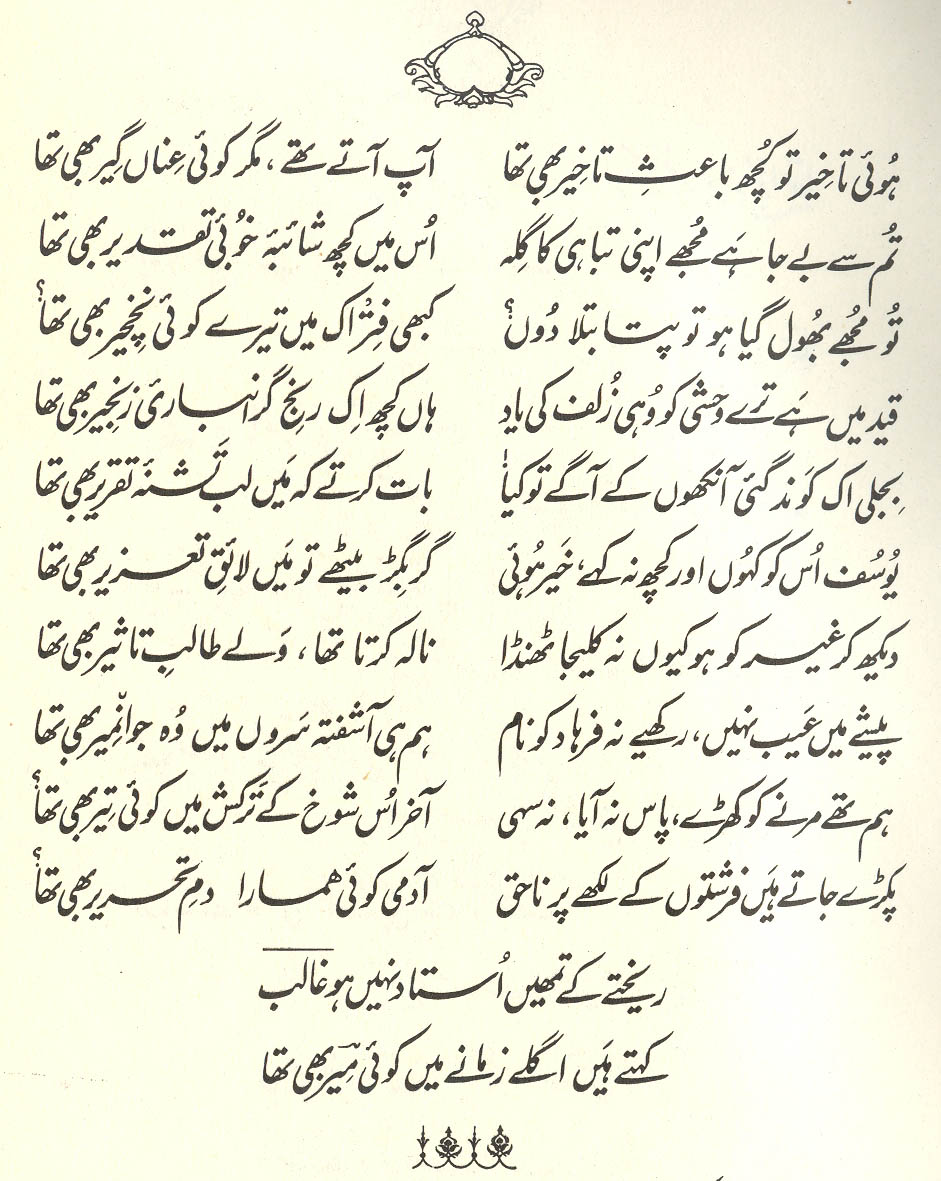
That is, seeing the Other in a bad condition, etc. And in the second line 'I' is omitted . And [for ] is a Persian idiom; in Urdu it is now rejected. (36)
== Nazm page 36

Urdu text: Vajid 1902 {36}
He says, seeing the Other, why wouldn't I be satisfied? Because I used to lament, and also sought for effect from my laments. That is, my laments had no apparent effect on me. Now, seeing the Other in a bad state, I've understood that this was that effect of my lament alone. (71)
The Rival used to lament. But at the same time he also longed for effect in his laments. From this I realize that the Rival is as yet deprived of the pleasure of passion. Otherwise, for a [true] lover, is the pleasure of lamentation a small one? (87)
The meaning is that he too, like me, failed to achieve his goal. If he had not been seeking an effect, then his success would have been proved-- which would have caused me pain. (118)
This verse, like so many, gives us two semantically independent lines, and leaves us to decide how they are connected. The first line, another of Ghalib's countless examples of speech, asks why, seeing the Other and the state that he's in, I shouldn't be satisfied. Or rather, literally it asks why the liver [] shouldn't be 'cool', or content. It thus has the virtue of piquing our curiosity, and of being uninterpretable, under mushairah performance conditions, until we have duly waited for, and finally heard, the second line.
Then, as so often, the second line opens up its own share of internal perplexities as well. The verbs are masculine singular, but no subject is indicated: do they apply to the Other, or to the liver itself, or to the speaker? Grammatically speaking, the first two alternatives, being actually present in the line, outrank the third, which has to be inferred.
And not only do we have to ask who lamented-- we also have to decide who sought the effect, and what effect was sought, and whether or not the effect was attained. Just consider some of the possibilities:
=I used to lament, but I sought for effect-- in vain; and now I am delighted to see the Other in the same futile position. (Or: the liver did and felt these things.)
=I used to lament, but I sought for effect-- and have now finally found it, as Bekhud Dihlavi suggests, since my laments have produced this misery for the Other. (Or: the liver is the subject.)
=The Other used to lament, but he sought for effect-- in vain; I am delighted to see his sufferings.
=The Other used to lament, but he sought for effect-- thus showing, as Bekhud Mohani suggests, that he is a less experienced and/or less sincere lover than I am, a deficiency that I'm glad to notice.
Needless to say, none of these possibilities can be ruled out. The final one is my favorite, since it marshalls a sophisticated array of feelings and ideas about the nature of passion. It's also the one that makes the most logically powerful use of the 'but' between the phrases. Like so many others, the verse is a little 'meaning generator' to which no single interpretation (much less translation) can ever be assigned.
graphics/lament_rossetti.jpg