Verse 2after 1816aachaahiye
G14
1
toward the company/society of rakish ones, wariness is suitable/proper
2
in place of wine, one ought to 'draw' oneself
'Companionship, society, company; an assembly, meeting, association; a fair; discourse, conversation, intercourse; carnal intercourse, coition, cohabitation'.
'A sceptic; a knave, rogue; a lewd fellow, reprobate, drunkard, debauchee, blackguard, profligate, libertine, rake'.
'Necessary, obligatory, binding, incumbent (on); expedient; proper, worthy; convenient; fit, meet; — due, right, just, reasonable'.
'Caution, wariness, vigilance, care; prudence; --fear'.
'To draw, drag, pull; to attract, to draw in, suck in, absorb... to draw out, to stretch; to extract; to pull off, strip off (the skin, &c.); to draw tight, to tighten... ; --to draw away or aside (from), to hold aloof... ; --to drag out, to endure, suffer, bear'.
| References | |
|---|---|
| Arshi, Imtiyaz Ali | Ghazal# 186 |
| Raza, Kalidas Gupta | 299-300 |
| Nuskhah-e-Hamidiyah | 266 |
| Hamid Ali Khan | Open Image |
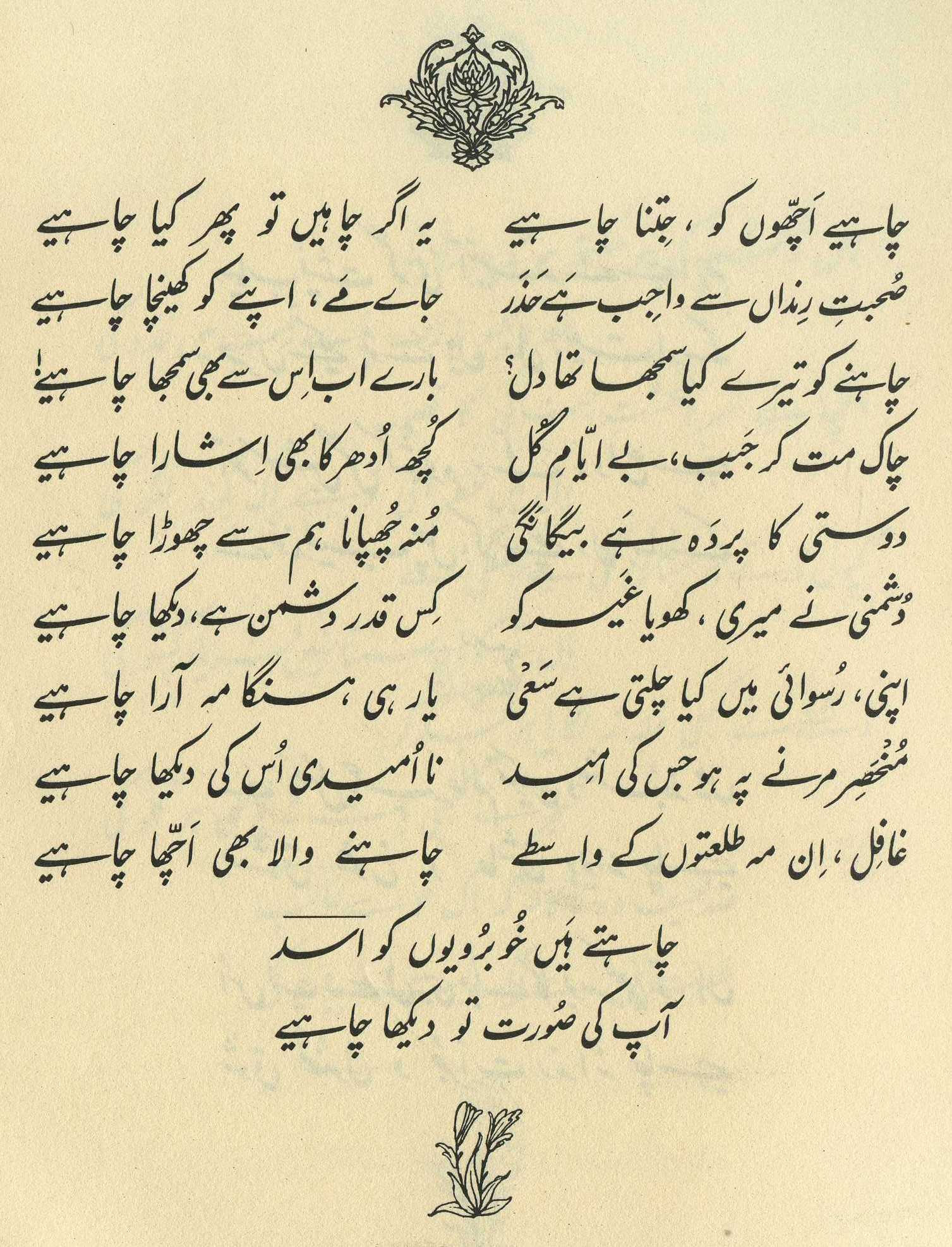
That is, don't 'draw' the wine, 'draw' yourself away from the company of wine. And by the drawing of wine is meant 'to drink'. That is, he has translated ; and perhaps in the author's opinion, to translate Persian literally into Hindi is proper, although it would be contrary to idiom. It is proved by experience that a poet who composes poetry in another language as well-- his own language becomes spoiled. An English poet whose name was Dryden used to say longingly, 'Why did I study Latin, and compose poetry in it? -- for my own language has become spoiled'. (210)
== Nazm page 210

He says, 'In the company of rakish ones, prudence is proper and necessary. Instead of 'drawing' the wine, you ought to 'draw' yourself away from the wine.' That is, you ought to shun the company of rakish ones. And from wine drinking, abstinence is necessary. (269)
You ought to shun the company of rakish ones. And instead of 'drawing' wine, you ought to 'draw' yourself. That is, you ought to remain separate and aloof.
[Disagreeing with Nazm:] To make a literal translation from Persian into Hindi is, in the author's opinion, undoubtedly proper. From this his intention is to adorn the treasury of his language with the jewels of colorful idioms, as Mir, Sauda, all the inventive craftsmen have done. To consider that this is contrary to Urdu idiom is not devoid of connivance []. (368)
On the grammar of , see 1,3 .
You'd think red warning lights would flash in the commentators' brains before they'd settle for a reading that was as prosy, pedestrian, and moralistic as 'Don't drink wine, and withdraw from the company of wine-drinkers'. This is the ghazal world, after all, and on top of that, it's Ghalib! But then, these are the same people who brought us the truly depressing misreading of 90,3 , and for basically the same reasons.
What one ought to show is not a sense of flat rejection, as the commentators will have it, but , 'caution, wariness, prudence' and the like. That alone ought to alert us against a moralistic reading, since it's a much more subtle attitude, and much more flexible. If it were truly about wine, it might suggest that one should have a drink or two, but not indulge in drunken binges.
But when we look more closely, the first line isn't about wine at all, it's about sociability-- it's the , the 'company' or 'society' of rakish ones [], toward which this 'caution' is enjoined. (For further discussion of these 'rakish ones', beyond Platts's moralistic description, see 71,10 .) We might not initially notice this subtlety, but after we read or hear the second line, how can we fail to do so? For the second line has a plain meaning: don't 'draw' (or pull toward yourself, or drink) wine-- as you would do in the lively 'company' of the rakish ones-- but 'draw' (or pull toward yourself, or drink)-- yourself.
The real opposition is thus between companionship and solitude, between becoming part of a lively group and remaining severely alone. And how excellently that fits in with the whole group of verses that I call the 'independence' set. How perfectly the various meanings of (see the definition above) reflect the ways one should dig into the self, and wrestle with it-- draw it in, suck it in, absorb it, strip off the skin, draw it tight, endure it, suffer it. This is just what Ghalib so often urges: whatever you are or do, let it be truly your own; something inferior but that's your own is preferable to something superior that's borrowed from someone else.
Besides 'draw yourself', the meaning of 'draw yourself away' is also certainly there, and works very well with the idea of being wary about socializing, so that you 'hold yourself aloof' from company. The reason I call it secondary is that it doesn't have the piquant parallelism with wine that the first meaning does. 'Don't 'draw' wine, 'draw' the self!' is far more precise and energized (and thus more captivating) than 'Don't 'draw' wine, 'withdraw' the self'. (I think of Thoreau: 'Read not the Times. Read the Eternities.')
'Draw' can mean much more than drink: in 56,6 it appears to mean 'serve' or 'lay out on the table'; and in 119,5 it means something like 'experience'-- and it appears there in a line that serves very well to reinforce the larger point I'm making.
graphics/winedrawing.jpg