Verse 1after 1816aachaahiye
G14
1 a
please desire good/beautiful ones as much as you may please/desire
1 b
however much one needs/desires [something], one needs/desires good/beautiful ones
1 c
good/beautiful ones need/want as much as they need/want
2 a
if these/this would want [something or someone], then what else is needed?
2 b
if we/they/you would want this, then what else is needed?
'To wish, desire, will; to want, demand, require, need; to be inclined to; to tend to; to be about to (with perf. part. of following verb); to intend; to like, love, be enamoured of; to choose, approve; to pray, ask for, crave, entreat, to attempt, try'.
'(the precative form of the aorist of , used as a phrase), Is necessary, is needful or requisite, is proper or right; it behoves; should or ought (=Lat. opus est, necesse est; debet; oportet; --pl. : see Hind. Gram. 439, et seq.): -- , What is not wanting (to me), what do I not want, I want everything; --nothing is wanting (to me), I have everything'.
| References | |
|---|---|
| Arshi, Imtiyaz Ali | Ghazal# 186 |
| Raza, Kalidas Gupta | 299-300 |
| Nuskhah-e-Hamidiyah | 266 |
| Hamid Ali Khan | Open Image |
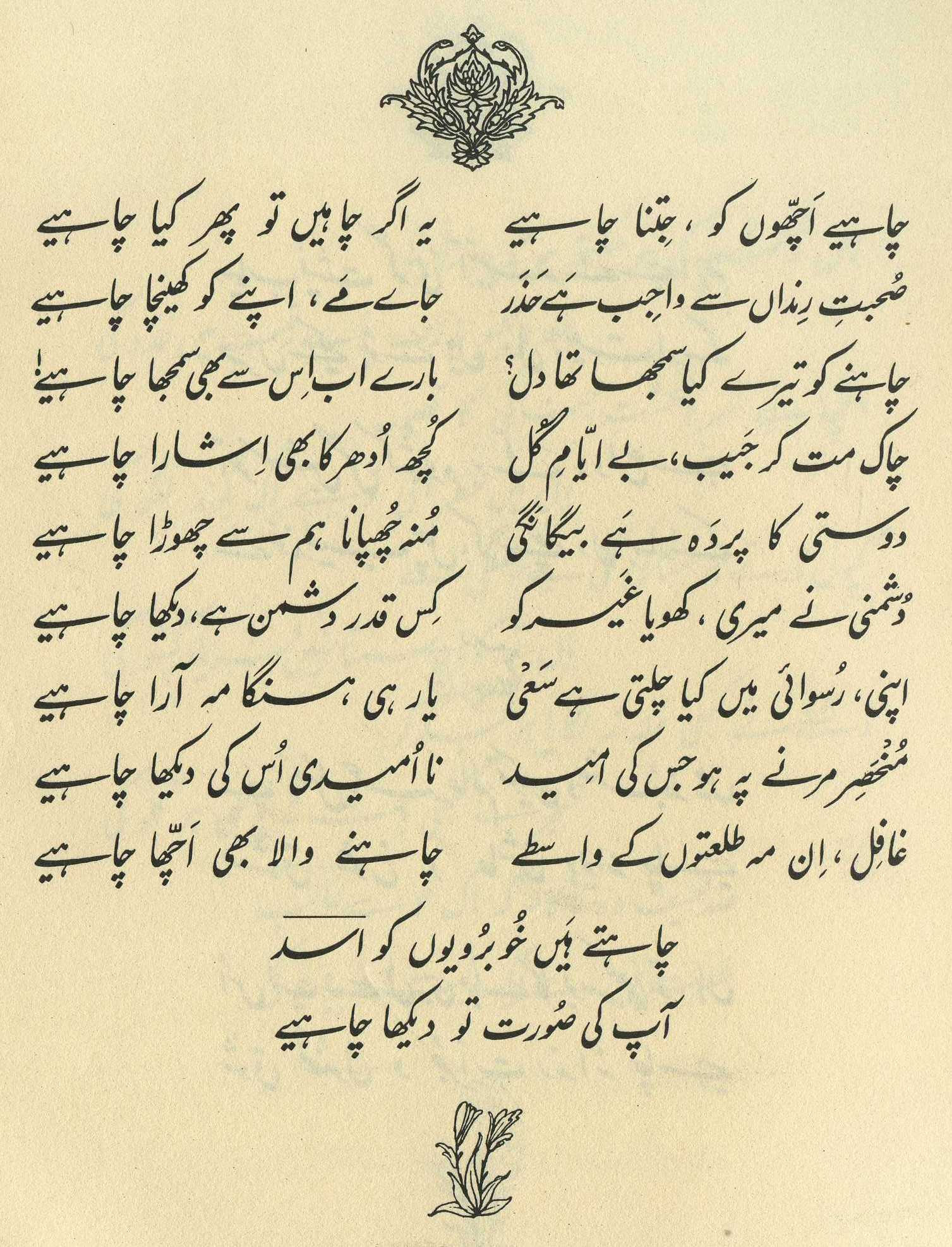
That is, if one would want [] something in the world, then one would want the good ones. And if they themselves would want, then right then the goal is attained. Then any other blessing can either come or not come []. (210)
== Nazm page 210

He says, 'If in the world you would feel love for anyone, then it would be for beautiful ones. And if these people themselves too would want someone, then there's not even the need for any other blessing.' (269)
Even if beautiful ones would not want you, then even so, however much you can, show love for them. And if they would want [you], then how inexpressibly good []. In the world, what is better than this?....
If the beloved should come to have the opinion that she ought to love good ones, then what can be done? How would she be our destiny? (368)
Whatever can be the limit of desire, to that limit desire beautiful ones; or, you ought to desire them []. And if these too would begin to desire you, then what can be better than this? It is a clear, enjoyable, and good opening-verse . (415)
Since this verse is built up completely from interlocking idioms, I want to tread carefully, because I'm very aware of my limitations as a non-native speaker, and because the consensus of native-speaker opinion that this is a simple verse is pretty clear, and is against me. But then, the general 'natural poetry' desire over the whole past century of Urdu critical tradition-- to find 'the' meaning of a verse and then stick to it rather than complicating it-- is so strong and entrenched that I've been fighting it for years, and I'm not going to stop now. So I do maintain that this verse is not simple and clear but remarkably multivalent, and that its clever use of seemingly everyday idioms is just one more example of Ghalib's usual trickery. I maintain that Ghalib deliberately drops us into a thicket of meanings-- and, as usual, leaves us there to flail around.
Reading (1a) in an expanded form becomes (as much as you might desire/wish-- as in -- please desire/want good ones). This reading looks grammatically straightforward, and some of the commentators seem to prefer it. But it's actually not an open-and-shut case, because , though structurally the polite imperative of , is in practice never used as such. That's why it's free to mean, with a verb, 'ought to' []; or with a noun, 'need' []. This repurposing also makes semantic sense, since in practice one never says 'please want some cookies', but 'please take some cookies' or the like, because of the primal truth that (as my philosophy professor used to put it) 'you can do what you want, but you can't want what you want'. If somebody says to you , you'll interpret it not as 'please want tea' (with a polite imperative verb), but as 'do you need/want tea?'-- as shorthand for .
Reading (1b) in an expanded form becomes (however much you need/want [something?], you need/want good/beautiful ones). This reading relies on the common use of with a noun as 'to need'.
Reading (1c) in an expanded form: (however much good/beautiful ones need/want, that's how much they need/want). This reading relies on the same common use of as (1b), except that it takes the 'good/beautiful ones' as those to whom the need is ascribed.
The second line uses the straightforward verb . In reading (2a), if 'this one' (with a plural of respect) or 'these ones' would want, then-- another idiomatic use of appears: literally, 'then what is needed?'; and colloquially, something like 'what could be better?' or 'what more could one want' or or 'nothing more is required' or 'that's the end of the matter'. (For the multiple possibilities of an idiomatic phrase like this, see Platts's analysis of above.) But of course, this (possibly) happy description could equally well apply to the situation of the good/beautiful ones, rather than to that of the lover. Reading (2b) takes the plural subject (we? they? you?) as omitted, and 'this' as the object that is wanted.
This whole verse is a wonderful play on the almost untranslatable idiomatic versatility of , 'to need/want', which takes ;and , 'to want/desire/wish', which is straightforward except for having been stripped of its polite imperative. No matter what we do with the first line, it comes out colloquial-feeling but still rather oracular, and maddeningly hard to pin down. The native speakers who have confidently explained it to me, like the commentators, go for some combination or conflation of (1a) and (1b), coupled with an agreed-upon simple reading of the second line as describing a happy ending for the lover. Yet I don't see how they can so confidently rule out (1c); after all, if we saw then everybody would know it meant 'what do good ones need/want?' And really, how different from is this from (1c)? And how can they reject the variant readings of the second line in which no 'happy ending' is envisioned? For the ambiguity of the grammar makes it perfectly possible that the phrase may apply to the satisfaction of the good ones, not to that of the lover; the whole verse may well be a wry meditation on the powers of the cruel, selfish, indifferent 'good ones'.
graphics/jewels.jpg