Verse 6after 1816aachaahiye
G14
1
enmity for/from me caused the Other to be lost
2
to what extent he/she is an enemy-- it ought to be seen!
| References | |
|---|---|
| Arshi, Imtiyaz Ali | Ghazal# 186 |
| Raza, Kalidas Gupta | 299-300 |
| Nuskhah-e-Hamidiyah | 266 |
| Hamid Ali Khan | Open Image |
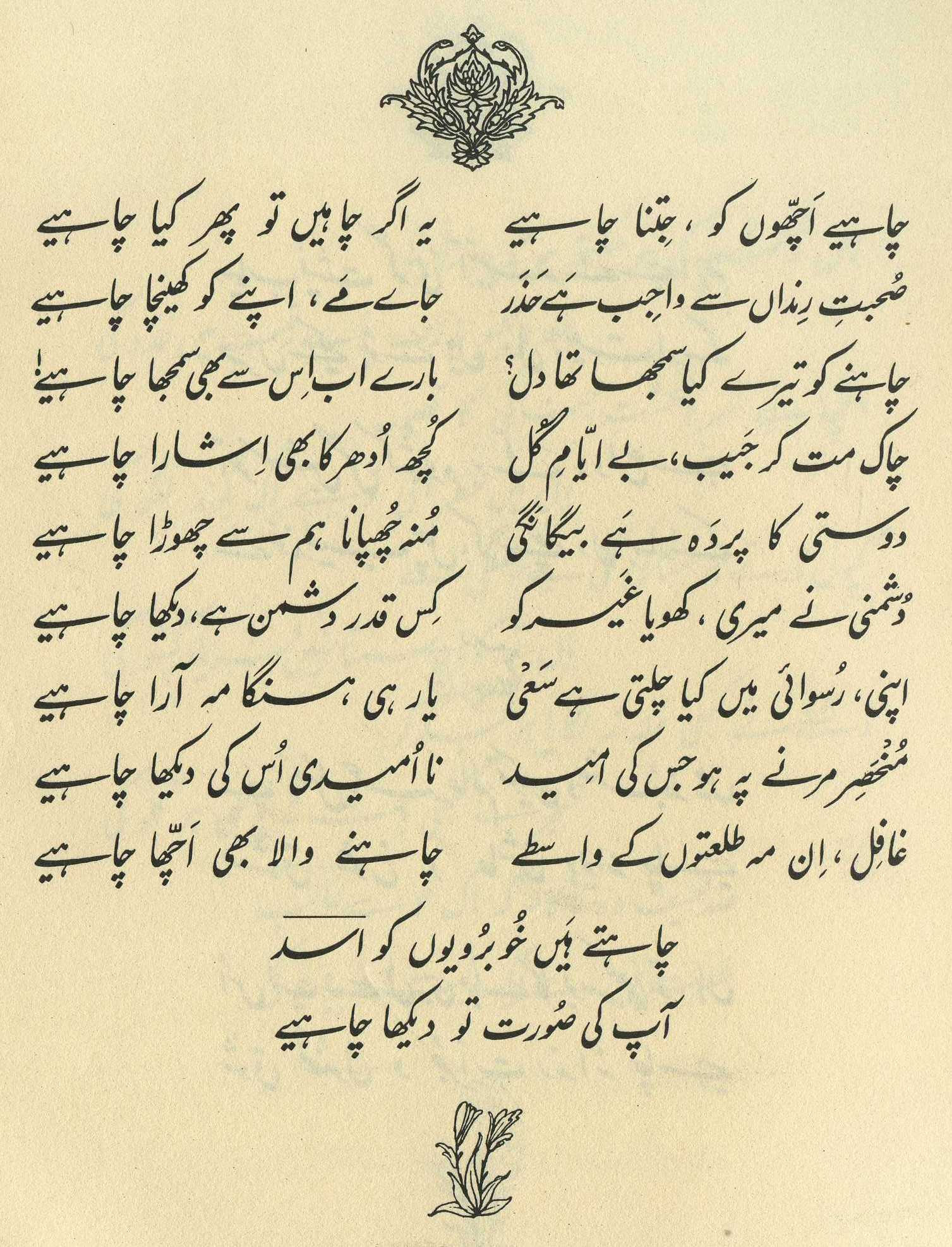
, that is, this thing is worth seeing, that in enmity toward me he erased his own self too. (211)
== Nazm page 211

He says, 'In enmity toward me the Other erased his own self. It's worth seeing, to what an extent he/she is my enemy.' (270)
The thing worth seeing is that in enmity to me, the enemy destroyed his own self. That is, it was such enmity that in brooding about my destruction, he accepted his own ruination.
[Or:] God is great-- what a harsh enemy the beloved is to me! Such that when the Rival showed enmity toward me, the beloved renounced all relationship with him. That is, [she reflected,] 'Why would he maintain a relationship, even of enmity, with our enemy?'. (369)
Compare 100,1 . (228-29, 289)
On the grammar of , see 1,3 .
In the first line, all we really learn that some kind of enmity somehow ruined or finished off the Other , and that that enmity involved the speaker. But was it enmity 'for' the speaker, as the commentators quite plausibly maintain; or was it enmity 'from' the speaker, in the form of some subtle trap or intrigue that the speaker had contrived? In Urdu, 'my enmity' [] can go either way, as enmity 'to' me or enmity 'from' me; for discussion and examples of this flexibility, see 41,6 .
The second line has no explicit subject, which means the subject is to be understood from the context. Under normal circumstances, we would carry over the subject from the first line, so that we'd be continuing to reflect on the situation of the Other. This is what Nazm does. But Bekhud Mohani inserts a new implied subject for the second line: the beloved. This could be justified on two grounds: because the Other is already finished off and done for in the first line, so it doesn't make sense for the verse to continue to explore his situation in the second line; or else because the lover's obsession with the beloved makes her always a hovering, readily available, implied subject.
We're thus left with several possibilities:
=The Other was ruined by his enmity for the speaker-- how remarkable such a self-destructive degree of enmity is!
=The Other was ruined by his enmity for the speaker-- how remarkably much the beloved hates the speaker, to punish the Other for this! (This is Bekhud Mohani's interpretation, reinforced by Arshi's comparison with 100,1 .)
=The Other was ruined by the speaker's enmity for him-- that's how effective an enemy the speaker is! And far more to the point, what a remarkable enemy the beloved is-- she's ready to turn against any of her lovers at the smallest provocation, which is how the speaker could manage to pull off his trick. (See 42,1 , or even more to the point, 38,1 .)
Undecidable no doubt, but not very profound. The ambiguous word- and meaning-play with and is sufficient to make the verse clever, but not particularly compelling.
graphics/enmity.jpg