Verse 4after 1816aachaahiye
G14
1
don't tear open the collar, apart from the days of the rose!
2
some sign from even/also that direction is needed
'Sign, signal; beck, nod, wink, nudge, gesticulation; pointing to, indication, trace, mark; allusion, hint, clue; insinuation, inuendo; love-glances, ogling; dumb-show'.
| References | |
|---|---|
| Arshi, Imtiyaz Ali | Ghazal# 186 |
| Raza, Kalidas Gupta | 299-300 |
| Nuskhah-e-Hamidiyah | 266 |
| Hamid Ali Khan | Open Image |
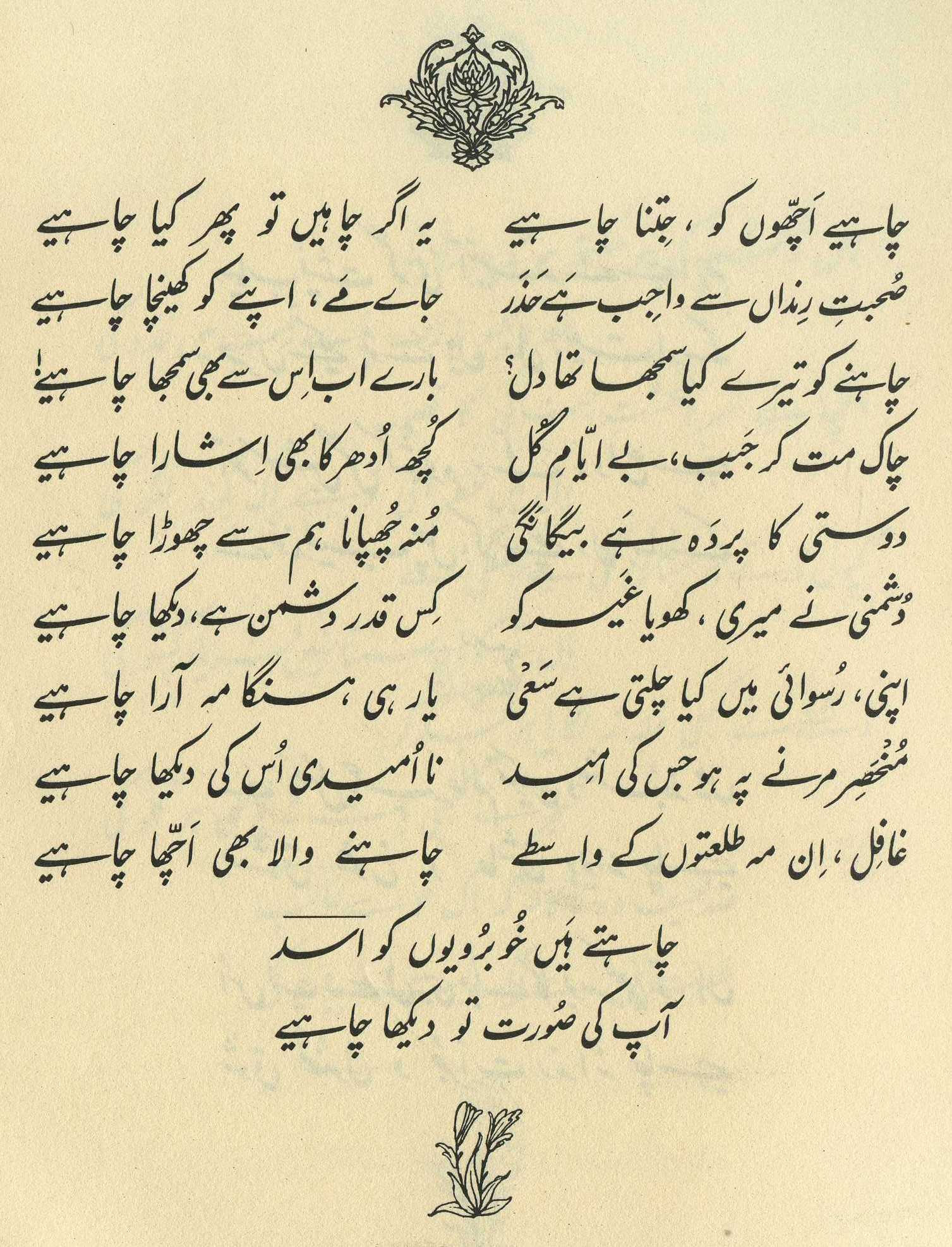
The simile of tearing open the collar is commonly used for the blossoming of a flower. He says that one ought to do every task with the counsel of nature []. Thus, until the flower tears open its collar, don’t you tear open your collar either. The pleasure of this is that for madmen, the turmoil of madness is usually increased in the spring.
==Urdu text: Yadgar-e Ghalib , p. 161
That is, when spring would come, and bloomingness would tear its robe, consider that to be a sign from the Unseen World that you yourself too ought to tear your collar. In these days robe-wearing would pass away; and the sign is a claim by nature. In this verse the meaning of 'tearing the collar' gives great pleasure, for this is a new style of construction. (211)
== Nazm page 211

In spring the buds' ripping of the collar is from a sign of Nature, and this sign is for the lover, that now the time for ripping the collar has come. Apart from spring, to rip the collar is a form of wilfulness, and madness. He's composed a peerless verse. For the force of madness to increase in the spring is a natural thing. (369)
../apparatus/txt_sets.html This is a verse of implication , for the idea at the heart of it is nowhere stated within it. Everybody in the ghazal world knows that the lover is inclined to tear open his collar-- because he's mad, and/or suffocating, and/or in despair. The first line suggests that this should only be done in 'the days of the rose', but we can't tell why, since the lover's wretched condition is a year-round state of affairs.
The second line is, in proper mushairah performance style, uninterpretable until the last possible moment, when we are given the excellently chosen word (spelled to suit its role as a rhyme -word). The lover needs a sign, a gesture, a romantic hint, from 'even' or 'also' over there-- and the 'also' makes us realize what it is about the rose in the 'days of the rose' that provides such a sign. When the rose splits its tight closed bud into a number of outward-reaching, separate petals, it has metaphorically torn open its collar, and shown itself to the world; this gesture deserves, and invites, a similar response from the lover. Then of course, after a brief time of full bloom, the rose's petals will be even more decisively 'torn' and blown away. But all these connections are made on the fly, and only in our minds; it's the mental buzz we get from our own creative (re)construction of the rose's 'sign' that generates the pleasure in a verse like this.
In another excellent twist, the sign should be from 'that direction' or 'that side' []. Does that mean from the rose itself, or from the power of Nature, or God, or whatever is speaking to the lover through the rose, from a place beyond the rose? As so often, the question is left open for us readers to decide for ourselves. Nor are we given the slightest clue about what the rose's ambiguous 'sign' might mean. Does the rose then share the lover's madness, or suffocation, or despair? Or does the rose set an example of self-sacrifice and ripeness-is-all, as its moment of greatest beauty prepares it for imminent death? As so often, Ghalib has left us with nagging questions, and no way to answer them.
graphics/rosepetals.jpg