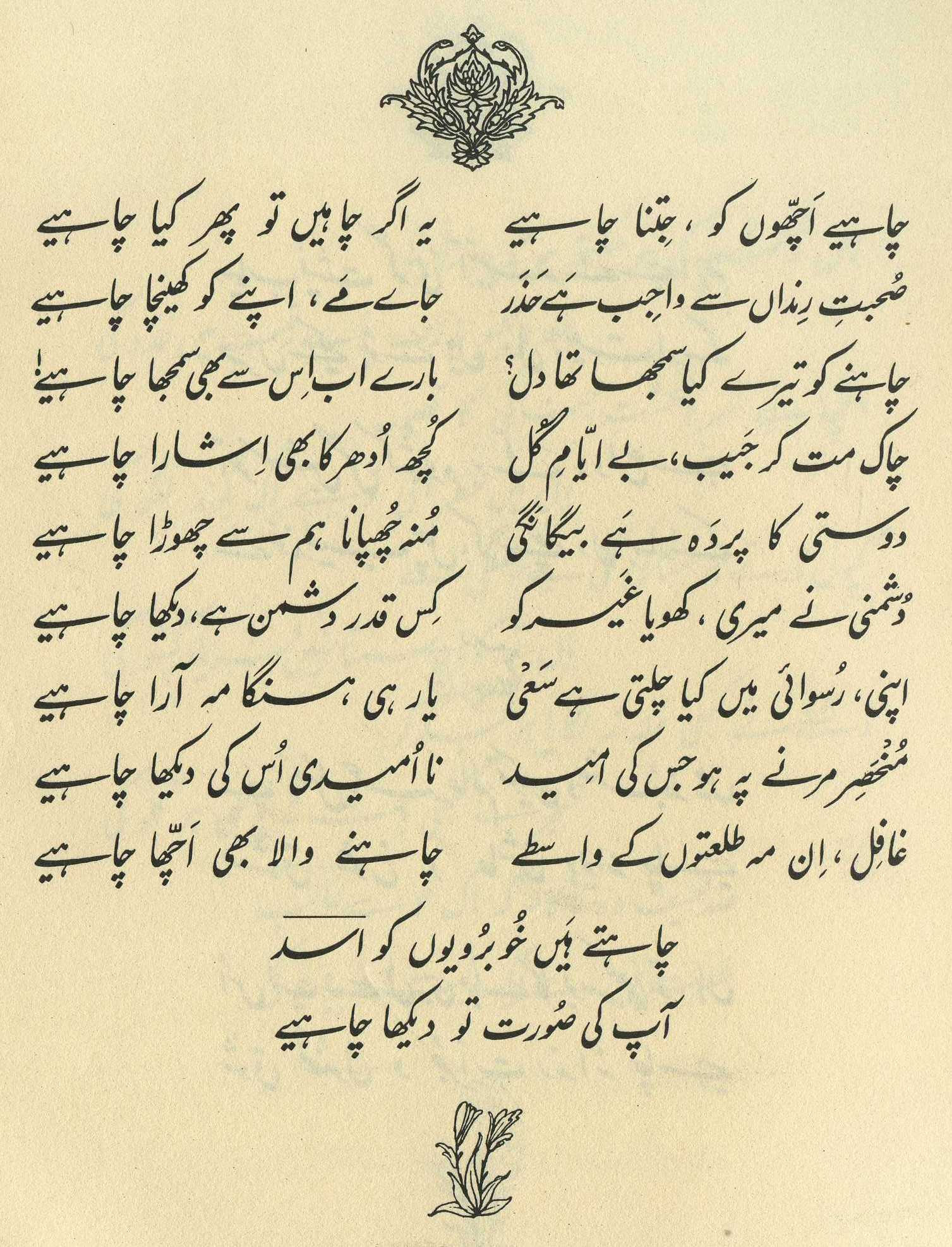
Verse 3after 1816aachaahiye
G14
1
desire for you-- what had the heart considered/understood it to be?!
2
finally now, with even/also it, an 'understanding' is needed
'To cause to know, or understand, or comprehend; to give to understand, to inform, to explain (to), to describe, to account for; to give or render (an account); to impress (on the mind of), to remind; to convince, satisfy; to undeceive; to apologize; to instruct, to advise, to reason with, to remonstrate or expostulate with, to admonish, to warn; to correct, punish, chastise'.
'To come to an understanding (with, -se), to look (to one, for explanation, or payment, &c.), to settle accounts (with, either fig. or lit.), to be even'.
| References | |
|---|---|
| Arshi, Imtiyaz Ali | Ghazal# 186 |
| Raza, Kalidas Gupta | 299-300 |
| Nuskhah-e-Hamidiyah | 266 |
| Hamid Ali Khan | Open Image |
In the second line has the meaning of inquiry/investigation []; that is, he advises the beloved, 'Please just inquire about its nature also: what did it think when it felt passion?'. (210-11)
== Nazm page 210 ; Nazm page 211


He says, 'What did the heart consider desire for you to be? That is, had it considered it a game, had it considered it simple-- what had it considered it? Now please just take a bit of vengeance for that desire on that ineffectual heart.' The meaning is that if there was not the strength and endurance for the restraint of passion and the shock of separation, then what was it thinking when it engaged in passion? (270)
The heart had considered it a game to engage in love for you. This is its punishment for that: subject it to a good dose of tyranny! (369)
This verse, like 189,1 , plays with the multiple and idiomatic meanings of and (see that verse for discussion); it also adds a similarly idiomatic play with and the related transitive (see the definitions above), which have a colloquial range somewhat like that of 'come to an understanding with' in English, including 'settle accounts with', 'teach a lesson to', 'punish', etc. Then, is so strongly idiomatic that I'm not sure whether the derivation should be considered to be from or , but for purposes of interpretation it doesn't seem to make much difference. (On the grammar of , see also 1,3 ; though in this case it does seem more idiomatic.)
The commentators assume that the lover is asking, or even urging, the beloved to take some action with regard to the lover's heart-- to interrogate it, to expostulate with it, to punish it. This is a plausible reading, because then the verse reminds us with wry indirection that the heart is no longer at the lover's disposal. It's left him in order to go and live with the beloved-- so now the only way he can communicate with it, even to reproach it for its folly, is to pass on the message through the beloved. That makes the hectoring tone of the first line, and the ominous tone of the second line, even more amusing, since they come from a person who has to scold and threaten on sufferance, and at second hand.
However, it's also possible that the lover is merely muttering the second line to himself. Perhaps the means that 'even' the heart (not to speak of other parts of the lover's life) must be disciplined; or perhaps it means that he must come to terms with the heart 'too', as he has with other entities (including the beloved?). Either way, the effect is a bit grumpy or even curmudgeonly, and very funny. The first line is an open-ended (rhetorical?) question; the second is an understated threat, so that the whole verse is a cleverly performance.
graphics/heart.jpg