Verse 5after 1816aachaahiye
G14
1 a
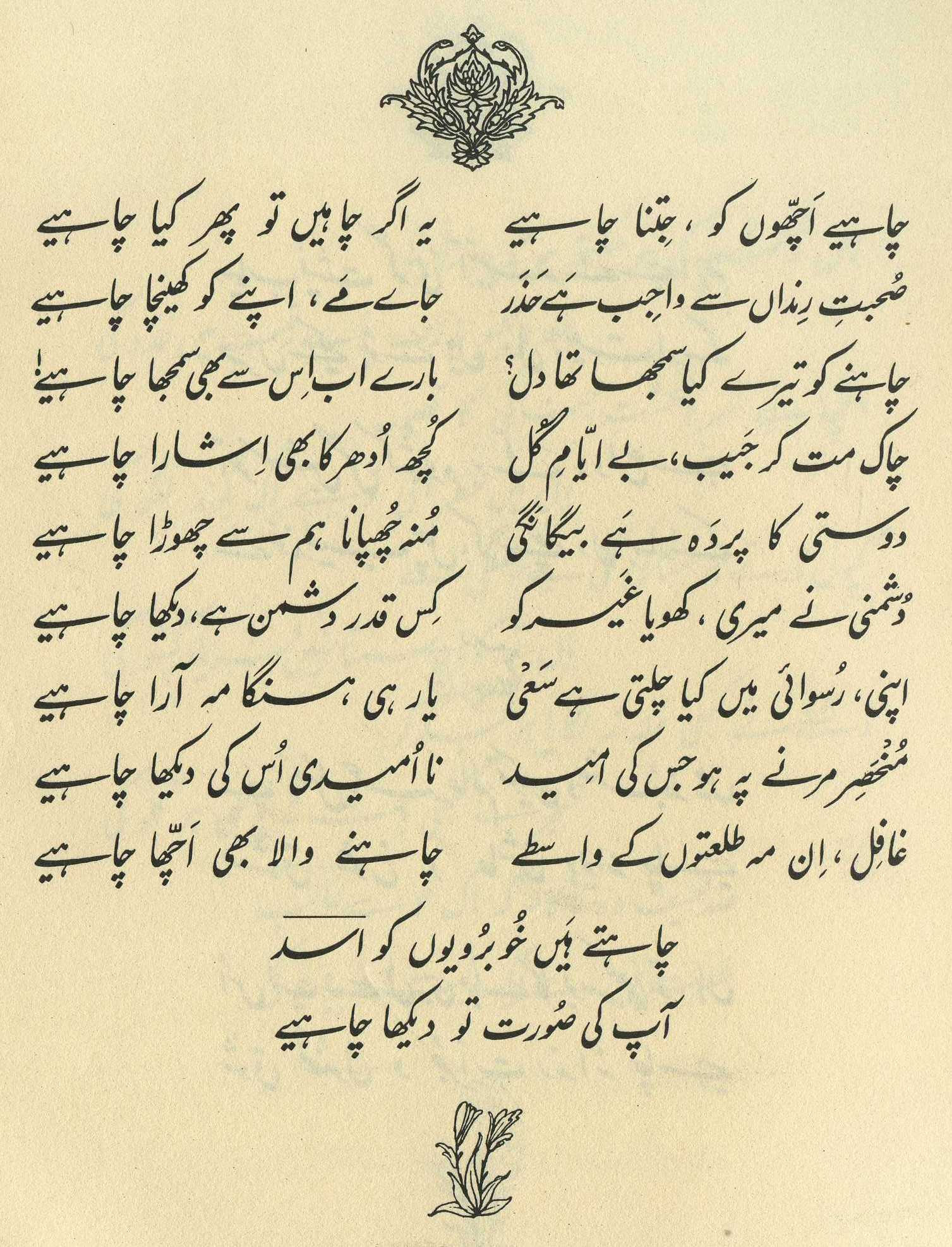
a veil/curtain for friendship/affection is strangeness/estrangement/shyness
1 b
strangeness/estrangement/shyness is a veil/curtain for friendship/affection
2
you ought to leave off hiding your face from us
'Strangeness, the being foreign or not domestic; estrangement; shyness'.
| References | |
|---|---|
| Arshi, Imtiyaz Ali | Ghazal# 186 |
| Raza, Kalidas Gupta | 299-300 |
| Nuskhah-e-Hamidiyah | 266 |
| Hamid Ali Khan | Open Image |
That is, when you hide your face and become a stranger, then in this veiling affection is found. This is, so to speak, a taunt directed at the beloved, through which trick she would leave off veiling herself, and he would attain his goal. (211)
== Nazm page 211

He says,'In that you veil yourself from us like a stranger and hide your face-- in this veiling affection shows a glimmer, and the viewers feel a suspicion. Thus you ought to leave off hiding your face from us.' Mirza Sahib wants through this trick to attain his goal. (270)
You veil yourself from us, and through this your intention is that the secret of love would not be revealed. This is the aspect that reveals more secrets. People consider that there's something there-- otherwise, why do you need this veiling from him? Thus if you will meet us without veiling, the way you meet strangers, then no one would have any suspicion.
Mirza has told the world a new thing, and with such forcefulness that it begins to seem that it's a mistake to act against it. (369)
On the grammar of , see 1,3 .
Why ought the beloved to leave off hiding her face from the lover? As the lover teases the beloved, here are some possible reasons:
=Because people will think that if she's hiding then there must be something to hide, so they'll become suspicious of her carefully hidden face. (This is the commentators' general reading.)
=Because the lover knows that such a show of aloofness is really a disguise for attraction. She ought to stop using that disguise-- it not only doesn't work, but also reveals to him ever more piquantly how fond she is of him.
=Because the lover knows that she really is fond of him, and she knows he knows it too, so there's no need for coyness or shyness. She should just relax, and stop pretending.
=Because a show of aloofness usually cloaks friendship or intimacy, but in this case the cruel beloved actually hates the lover-- so she should cease to send false signals by veiling herself from him. She should show her disdain openly, by not bothering to veil herself from him.
A wide range of moods and paradoxical, 'Catch-22' arguments; as usual, we're left to make our own choices. But the striking, cryptic first line resonates and keeps on resonating. How can there be an end of what it might mean? For another such ambiguous meditation on the nature and uses of pardah, see 198,2 . Even more paradoxically and enjoyably, there's the dense thicket of 332x,8 .
graphics/greekveil.jpg