Verse 2after 1838aanahii;N karte
G13
1
secretly/'behind the curtain/veil' she has a hidden connection with the Other
2 a
there's this outward concealment/veil: that she doesn't do pardah/veiling [from him]
2 b
there's this outward concealment/veil: that she doesn't conceal/veil [things]
A curtain, screen, cover, veil, anything which acts as a screen, a wall, hangings, tapestry;... secrecy, privacy, modesty; seclusion, concealment; secret, mystery, reticence, reserve; screen, shelter, pretext, pretence'.
| References | |
|---|---|
| Arshi, Imtiyaz Ali | Ghazal# 209 |
| Raza, Kalidas Gupta | 387 |
| Hamid Ali Khan | Open Image |
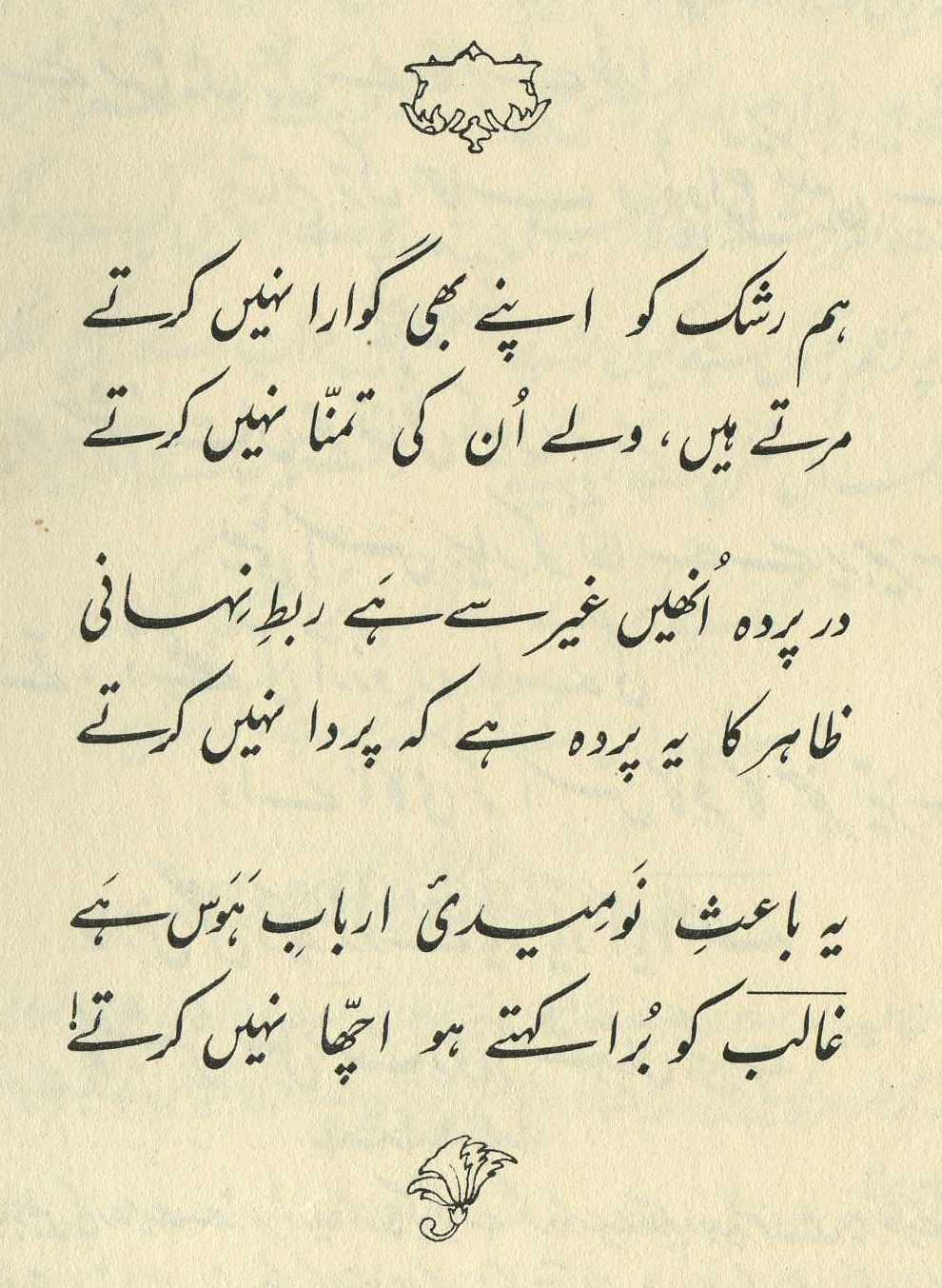
That is, when she makes it clear [] to me that she doesn't keep pardah with such-and-such a person, this is an outward concealment []; in reality, she has a hidden connection with him-- otherwise, why would she not keep pardah with him? Another aspect of her not keeping pardah is that she doesn't hide herself; that is, she doesn't have the habit of hiding anything. (222)
== Nazm page 222

He says, in secret [] she feels inner love for the Other. Her not keeping the customary pardah with him is in order to conceal her inner love. That is, if while keeping pardah she furtively met with him, then she would become disgraced and ill-famed. Now, she is before him, with the intention of concealing her inner love. (280-81)
The beloved secretly has a connection with the Rival . That is, she secretly meets with him, and when she says 'We come before the Rival; if there were anything to it, then we would keep pardah', then this is only a show of concealment []. One more verse of the author's with this gist is presented: 189,5 . (390)
The spelling is used to accommodate the rhyme . There are many such instances of course; I only mention this one because it's so clear (since two spellings of the same word are included in the same verse), in case anybody wants a good and solid example of the kind of thing classical ghazal poets do all the time.
In this verse the many meanings and uses of the word are cleverly deployed. Most of the possibilities are pretty well elucidated by the translations and the definition given above. The intricacies give rise to very amusing 'Catch-22'-style paradox es: the beloved has a 'behind the veil' relationship with someone before whom she uses no veil; she veils her behavior by proclaiming her rejection of veiling; and so on. There's also the wordplay of the 'Other' versus one's own (those before whom one would not use a veil); and of the 'outward' [] as opposed to the inner (which would lie behind the veil).
There's just one thing that might be confusing: the culturally-specific idea of 'keeping pardah from' somebody. The basic idea in the verse is that a woman would 'keep pardah' from any male outsider who might be thought to be a possible sexual partner. Thus if she doesn't keep the usual social kind of pardah from the Other , she is signalling that she has placed him in some non-eligible category, like that of a younger relative, or a servant, or a casual and sexually neutral friend of some kind. Of course, the signal might also be false, a possibility that the verse richly exploits.
Bekhud Mohani is right to point to 189,5 as a fine companion piece, equally full of cleverly engineered paradox and complexity.
graphics/veil.jpg