Verse 3after 1838aanahii;N karte
G13
1
this is a cause of despair to the possessors of desire/lust
2
you abuse/vilify/'call bad' Ghalib-- you don't do well/'good'
| References | |
|---|---|
| Arshi, Imtiyaz Ali | Ghazal# 209 |
| Raza, Kalidas Gupta | 387 |
| Hamid Ali Khan | Open Image |
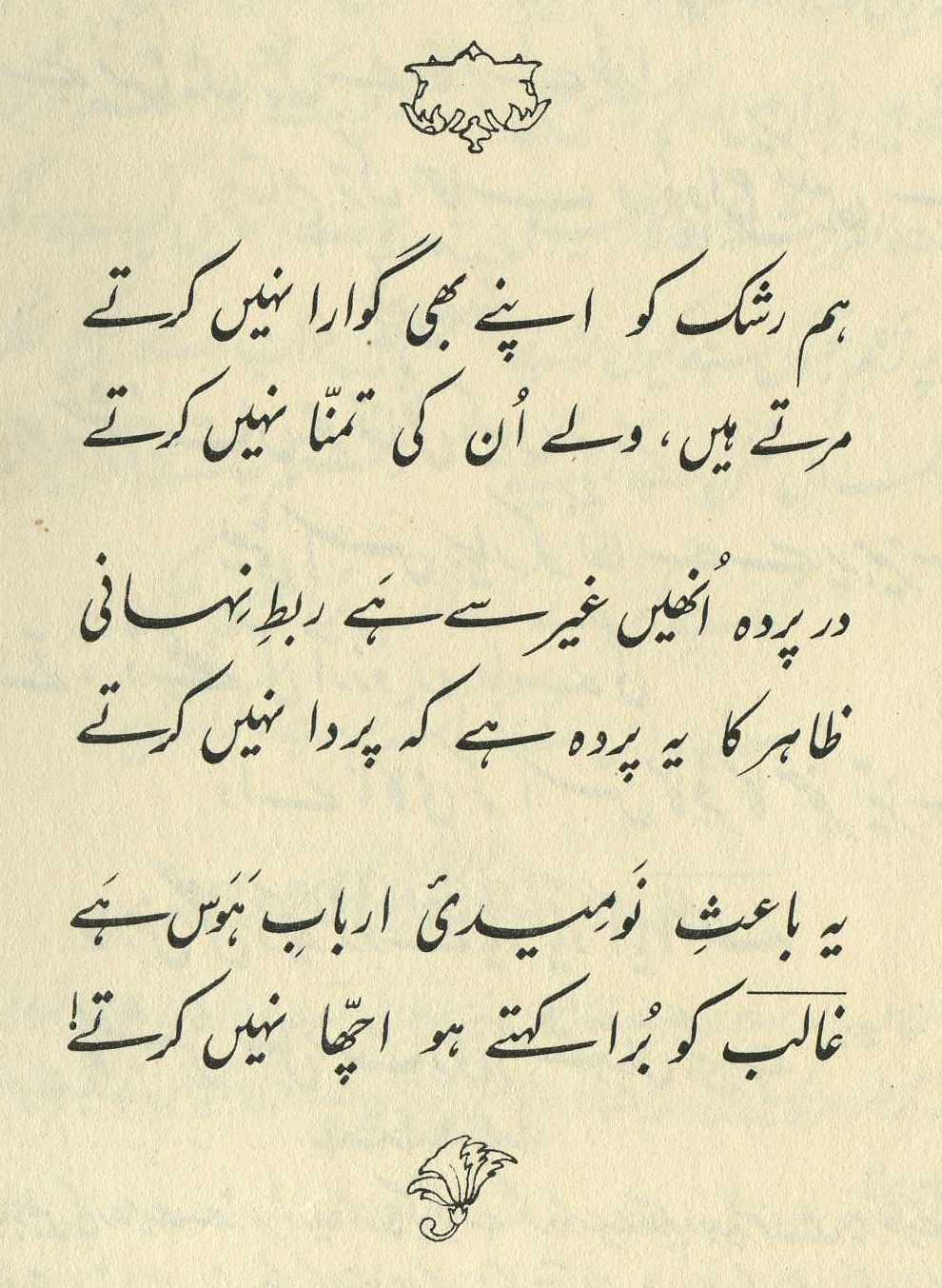
That is, Ghalib was a lover-- when you abused him, then what hope could the lustful Rival have from you? (222)
== Nazm page 222

He says, Ghalib was your true lover. When you abuse him, then the lustful Rival will lose heart as a result, and become hopeless. (281)
Some friend of the beloved's explains to her, 'You abuse Ghalib, who is your true lover; this is not good. Its effect will be that lustful people will become hopeless and sidle away, for where lovers find no respect, how can people like us survive there? And you'll become like a Yusuf without a caravan, when you're deprived of the desirers who are the ornament of beauty.' (390)
Really, it isn't a very interesting meaning, is it? Why should it even be worth mentioning if the lustful lose hope, when that's bound to happen sooner or later? Just look for example at 38,1 , which plays with similar ideas in an incomparably livelier and more complex way. Why should the lustful lovers' plight deserve a whole two lines?
Of course, there's the good/bad wordplay. And there's the double possibility: it might be that she 'doesn't do well' to speak badly of Ghalib (she is wrong, or imprudent, to abuse him); or it might be that she 'doesn't do good' to Ghalib (she not only abuses him, but also treats him badly). In either case, her poor treatment of Ghalib drives her lesser, more lecherous lovers to despair: 'if she treats a madly devoted lover like him so badly, what will she do to us?' And it might be thought enjoyable that Ghalib ostentatiously doesn't complain on his own behalf-- if he, rather than some friend, is taken to be the speaker.
But even then, the verse doesn't-- by Ghalibian standards-- really do much. I can't see why Faruqi has singled it out for admiration.
graphics/yinyang.jpg