Verse 1after 1838aanahii;N karte
G13
1
we don't approve of envy/jealousy, not even our own
2
we die, but we do not long/beg for her
'Wish, desire, longing, inclination ( = ); request, prayer, supplication, petition'.
'To wish (for), to desire; to pray or petition (for), &c.'.
| References | |
|---|---|
| Arshi, Imtiyaz Ali | Ghazal# 209 |
| Raza, Kalidas Gupta | 387 |
| Hamid Ali Khan | Open Image |
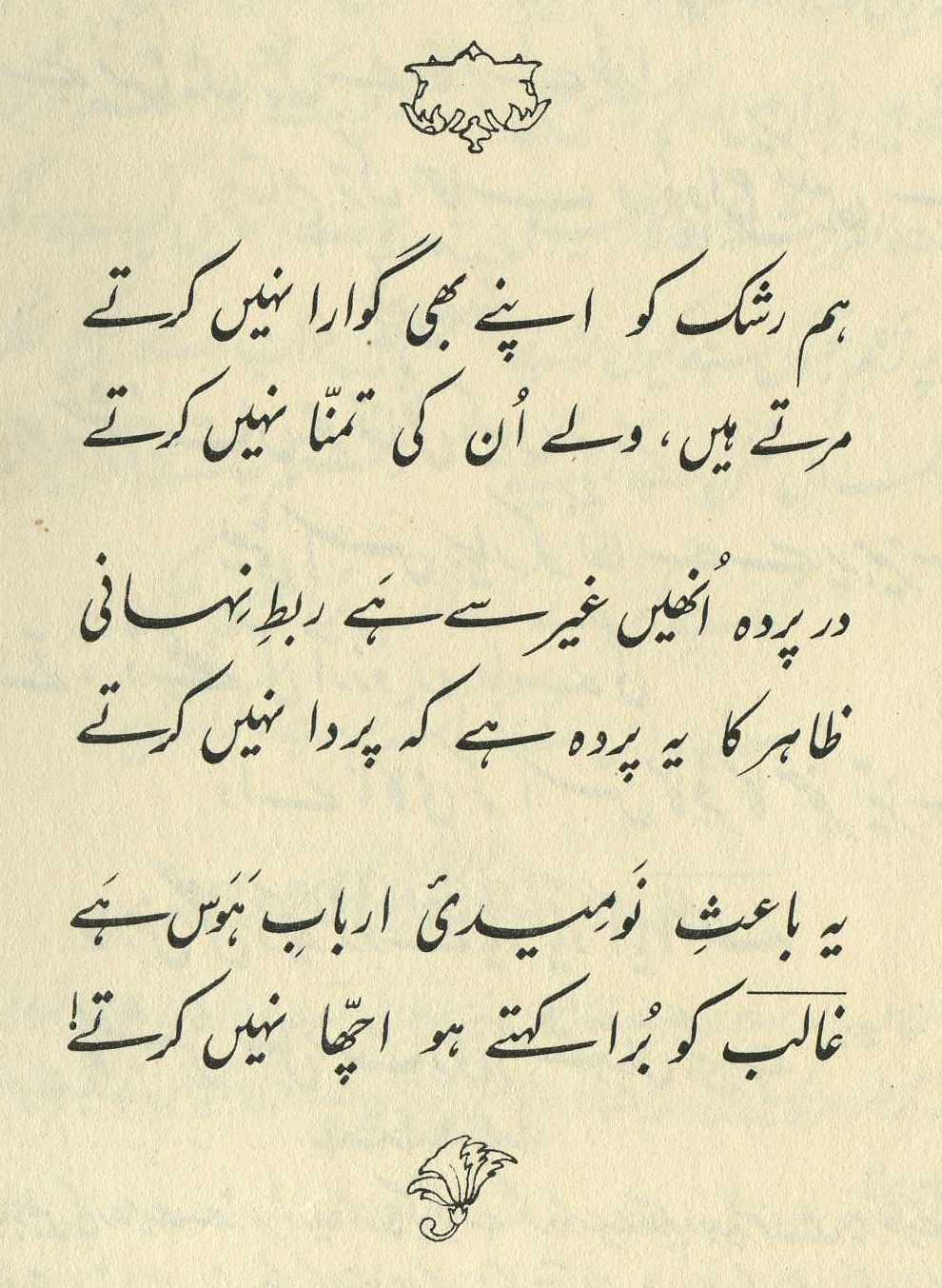
That is, the way avarice for one's own wealth is the extreme of avarice and deprivation, so the same is true of the extreme of envy/jealousy: when we feel a longing for union, we ourself become jealous of ourself. (222)
== Nazm page 222

He says, 'In passion for her, we've come to feel envy/jealousy even over ourself. Thus we've accepted the sacrifice of our life, but we've given up longing for her.' That is, if we long, then she will come or will call us there, and in both those situations our eyes will see her, and we'll feel envious; our hands will touch her hands, we'll burn with envy; our feel will fall on the earth of her street; we'll be jealous. Thus we've left off longing for her. (288)
We have so much envy/jealousy that not to speak of the Rival , it doesn't even please us that we ourself would long for her. Although we're dying, we don't long to meet with her, (390)
[See his comments on Mir's M 217,5 .]
Bekhud Dihlavi labels this not a ghazal but a verse-set , but he seems to be alone among the commentators in taking that view.
The commentators unite to provide one reading, which is basically that of 153,1 ; in its intensely paradox ical way this reading makes perfect Ghalibian sense, and is certainly the primary one. But {153,1} also makes heavy use of wordplay: without the clever triple use of , its enjoyableness would be much diminished.
The same clever use of wordplay energizes the present verse as well, in a subtle but thus all the more amusing way. If the speaker doesn't approve of envy, including his own, then he's speaking in what might almost pass as a Ghalibian mainstream: this verse is part of the set that I call 'independence' verses (for more on these verses, see 9,1 ).
And notice what the result of his rejection of envy is: in the second line, he repudiates all interest in something that belongs or pertains to somebody else: he rejects, literally, the doing of 'her longing' []. Since he radically disapprove of all envy, why should he envy or covet something that's so clearly 'hers'? Of course, this is a secondary reading, a kind of artefact, since is a perfectly normal way to describe a longing for someone. But the discussion of 'our own envy' in the first line tends to activate the apparent contrast of 'her longing' in the second. For more on this ambiguity of the possessive, see 41,6 . On the complexities of , see 53,4 .)
In short, I'm suggesting a parallel with 197,2 and so many other Ghalibian verses, in which the overt meaning and the wordplay interact in complex and doubly enjoyable ways.
graphics/longing.jpg