Verse 5after 1816athii kyuu;N nah ho
G3
1
friendlessness did not enter into dealings/affairs with anyone
2 a
I experience it toward myself, even if it would be shame
2 b
I draw it out of myself, even if it would be shame
'Forlorn state, friendlessness, destitution'.
'Someone, somebody, anyone, one; a person, a man, an individual'.
'Transacting business (with), dealing (with), trading, or bargaining (with); —dealing, transaction, negotiation, business, commerce, traffic; bargain; contract; correspondence; —sexual intercourse; —proceeding, procedure; behaviour; —affair, matter, concern'.
'To draw, drag, pull; to attract, to draw in, suck in, absorb ...; to draw out, to stretch; to extract; ... — to drag out, to endure, suffer, bear'.
| References | |
|---|---|
| Arshi, Imtiyaz Ali | Ghazal# 118 |
| Raza, Kalidas Gupta | 295-96 |
| Nuskhah-e-Hamidiyah | 147-148 |
| Hamid Ali Khan | Open Image |
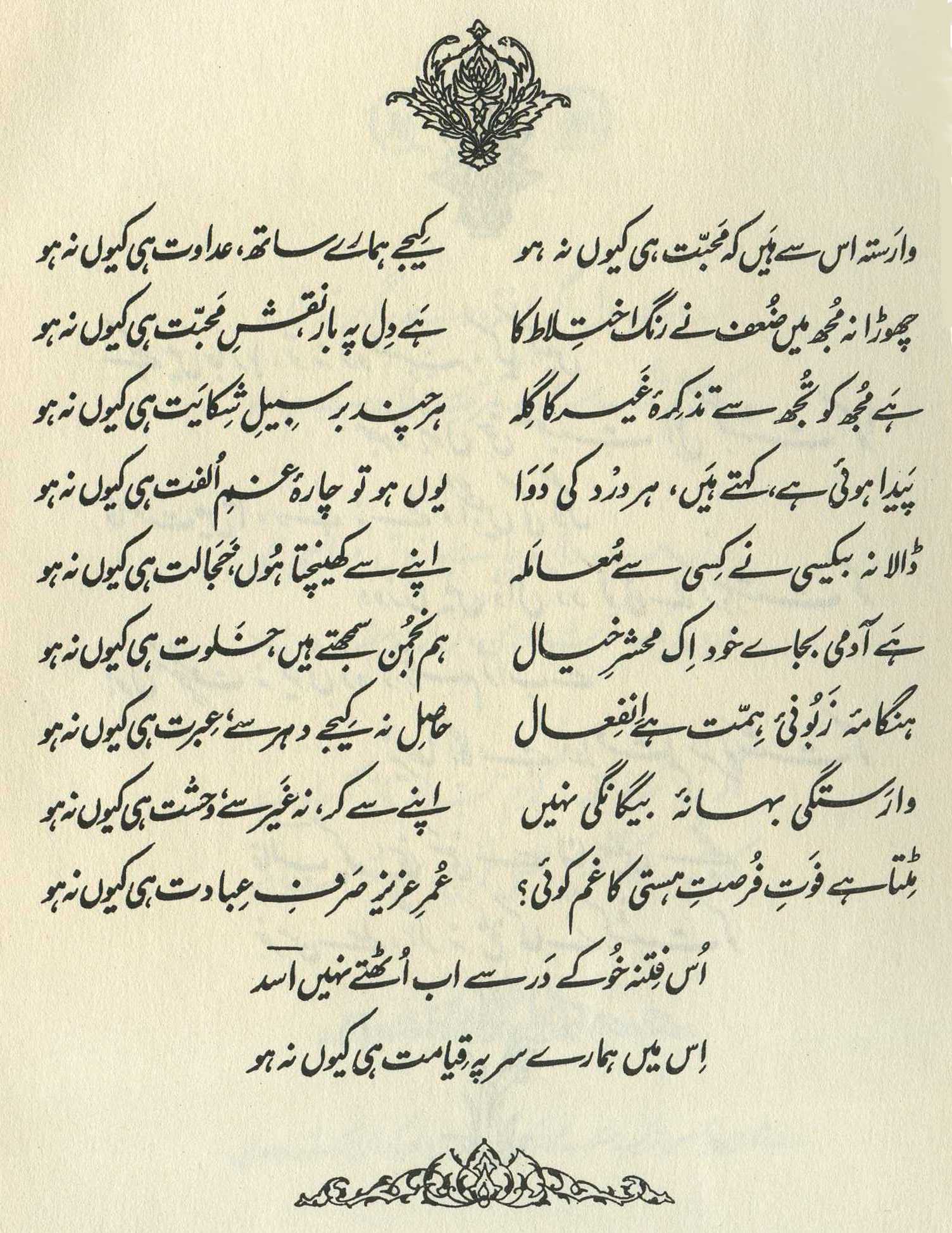
That is, the kindness of friendlessness is that it has prevented everybody's [show of] kindness. If no other advantage is gained from others, then shame is felt toward them. Now if I feel shame at all, then it is toward myself. (127)
== Nazm page 127

He says, 'I'm thankful that my friendlessness didn't put my affairs before any other. No other individual showed kindness toward me. If I didn't gain any benefit from others, then I would certainly have felt ashamed. Now even if I am ashamed, then it's only before myself.' (180)
'He who accepts benefits from somebody remains ashamed. Thanks be to God, and thanks be to friendlessness, that because of their grace I was not forced to humble myself before anybody. Now even if I am ashamed, then it is of my own strength of arm.' (240)
[See his comments on Mir's M 423,1 .]
The commentators don't even mention what is surely the most conspicuous feature of the verse: the spelling/meaning wordplay between ( ) and , which are placed as close together as is grammatically possible-- and are even integrated cutely with and : . Since both words are normally written without short vowel markers, and look absolutely identical on the page. Amusingly, the line thus could be read as saying that -lessness held itself aloof from -- an esoteric but imaginable state of affairs, when you think about it.
And there's also a connection of meaning, even though it's indirect. As can be seen from the definitions above, means 'friendlessness', etc., because it literally means a state of being without any ; and a , in Persian, is a person, 'somebody' or 'anybody'. In Urdu, is the oblique form of , meaning 'somebody, anybody'. So the effect is wonderfully clever semantically, as well as orthographically.
The verb literally means 'to pull, draw, pull out', and metaphorically means 'to experience'. Colloquially, would certainly mean 'to feel shame before somebody'; this is (2a), the sense that the commentators all rely on. The speaker keeps all his emotions to himself-- even the unpleasant ones like shame. If he's too friendless or too proud (and thus too full of shame) to pursue relationships with others, he still definitely feels shame (for that? in general?) before himself.
Literally, though, the meaning of could quite well be 'to draw out shame from oneself', so that the line might also be read as asserting that the speaker obtains, grasps, draws out everything only from within himself, even if it's shame that's in question (2b). Radical self-reliance and self-exploration is one of the most striking pieces of advice that Ghalib's ghazals seem to offer; for more on this tendency in his verses, see 9,1 . (And see, later in this ghazal, 119,7 .)
To make the point clearer, consider 71,5 , which longs for the day that . Here, seems to involve the 'drawing out' of coquetry from the beloved, since she does the and the speaker does the . By contrast , 'to experience a (vain) longing for coquetry', is done entirely by the speaker. (It's true that the commentators tend to disapprove of all this, but that doesn't affect what Ghalib has in mind.)
Although the first line of the present verse seems to be reporting a single past event, this event may be the initiation of a deliberate policy, rather than some kind of passive or helpless reaction to rejection. For the second line is in the present habitual, and is simple and strong-- not 'this is what I'm forced to do' or 'this is what I'm reduced to doing', but 'this is what I do', period. If there's any sentimentality in the atmosphere, it's been laid on by the reader. The verse may be stoical, or even triumphantly solipsistic. Compare 115,7 , in which the beloved's arrogance is matched by the lover's silent, stubborn determination to maintain his own style.
On , see 119,1 .
graphics/mirror.jpg