Verse 8after 1816athii kyuu;N nah ho
G3
1
liberatedness/freed om is not an excuse of/for strangeness/alienness
2 a
do it toward yourself, not toward an Other , even if it might be wildness/madness
2 b
do it neither toward yourself nor toward an Other , even if it might be wildness/madness
'Liberation, deliverance, salvation; —humility'.
[Source of ]: 'Strange, foreign, another, not related, not domestic, not an acquaintance or friend, alien, unknown'.
'Loneliness, solitariness, dreariness; --sadness, grief, care; --wildness, fierceness, ferocity, savageness; barbarity, barbarism; --timidity, fear, fright, dread, terror, horror; --distraction, madness'.
| References | |
|---|---|
| Arshi, Imtiyaz Ali | Ghazal# 118 |
| Raza, Kalidas Gupta | 295-96 |
| Nuskhah-e-Hamidiyah | 147-148 |
| Hamid Ali Khan | Open Image |
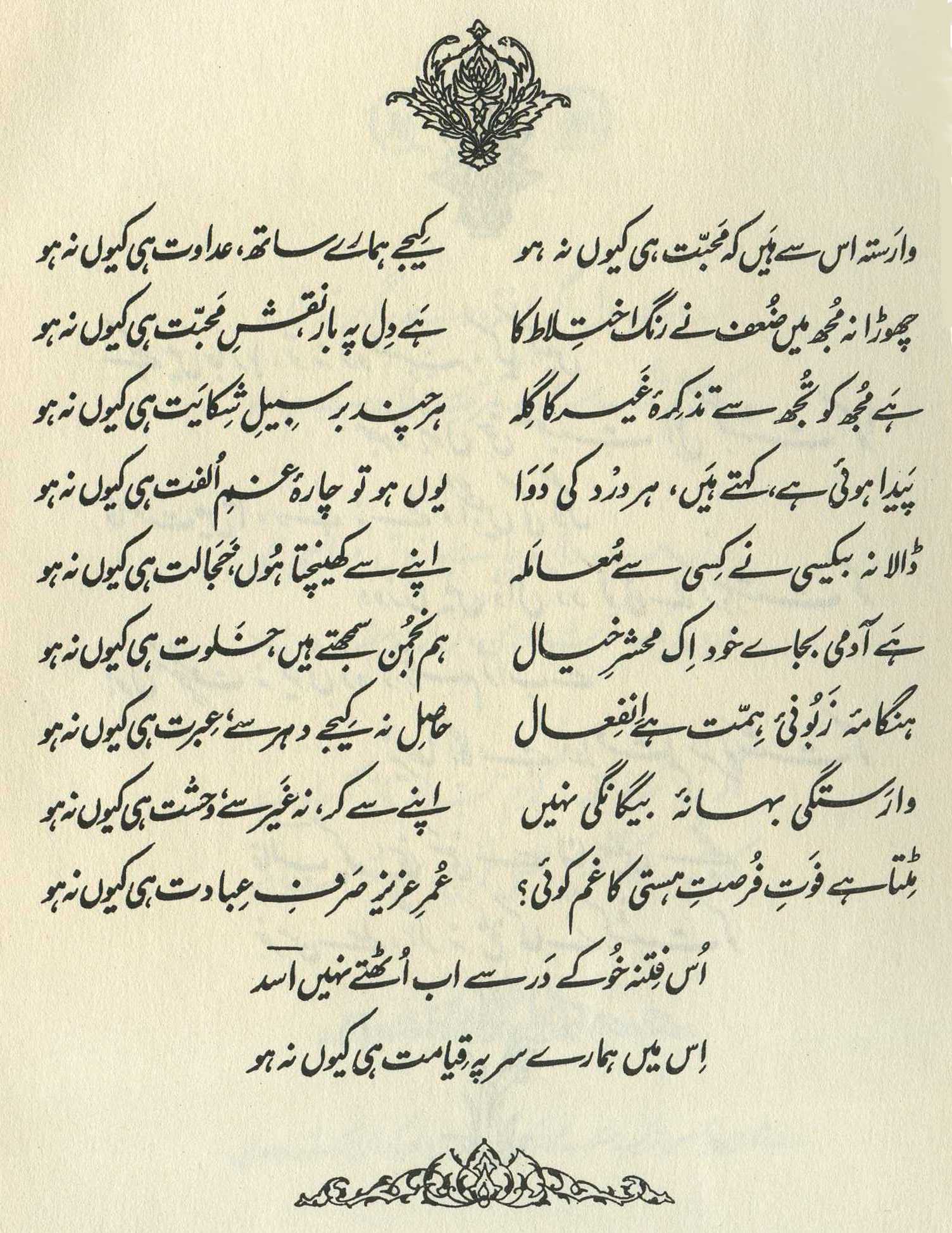
That is, liberatedness and freedom are not a name that can be used as an excuse for strangeness/alienness and wildness, and for considering that we are free from the world. Well [], even if you show strangeness/alienness and wildness, then show them toward your own spirit, not toward an Other! (128)
== Nazm page 128

If you've become free of connections with the world, then this doesn't mean that you would remain far off from the Lord's creatures. If you have to show wildness, then do it toward your own self. That is, the selfhood that has remained in you-- erase it. Because after renouncing relationship with the world, you ought to help the Lord's creatures, not show madness. (240-41)
The meaning of can also be, show wildness 'neither toward yourself nor toward an Other' []....
Now the question is, what is intended by the instruction about not showing wildness toward yourself either? The meaning of showing wildness toward others is to avoid contact with all the Lord's creatures. Accordingly, showing wildness toward oneself means to flee from oneself. Now the meaning of the verse becomes: well, wildness is a fine thing, but don't use liberatedness (which is the state of being wild) as an occasion to abandon the creatures of God, and your own very self. The renunciation of attachments is a good thing, but to renounce love for the creatures of God (among whom you yourself are included too) is not right.... It's as if you would negate human responsibility. Of what use is such liberatedness?
== (1989: 209-10) 2006: 233-34
The first line of the verse sets us up for some kind of movement beyond alienation, strangeness, strangerness, estrangement []. Since the first line denies us an 'excuse' for alienation, we expect to receive a moral injunction in the second line. We expect the second line to say something like 'keep in friendly touch with others', or words to that effect. Or at least it might be expected to say 'keep in friendly touch with yourself, if you can't do so with others'.
However, the second line-- in proper mushairah performance style-- doesn't say anything of the sort. It simply adjures us to do some 'it' toward ourselves, and not toward others. And the 'it' proves to be flexible-- its limit case is , but the full range is much wider. The shock of this sudden injunction forces us to think much more deeply about the verse.
If the 'it' is taken to be some bad, alienating feeling (like ), then it might seem that we should show 'it' toward ourselves, not toward others, as a form of courtesy and kindness. By treating others thoughtfully we would avoid displaying a culpable toward them. This argument represents, however, only a special case.
For the 'it' can clearly also be some other, and quite different feeling, as the grammar of the second line emphatically envisions-- some kind of feeling of which is only the most extreme example. In that case, the sense of the line turns right around and moves off into Ghalib's famous domain of exhortations to radical 'independence' (see 9,1 for more on this). The verse then urges us to behave, basically, in the manner described in 119,5 -- or in 119,6 , which is perhaps even more solipsistic in its moral vision. In {119,5} it's 'friendlessness' that induces us to choose radical self-reliance, in {119,6} it's apparently pride, and here it's 'liberatedness'; in {119,5} and {119,6} it's 'shame' that is in question, and here it's any emotion whatsoever.
But the general thrust of the meaning is the same: whatever (good or bad) emotions we feel, we should feel them toward or before ourselves, not toward or before other people. It turns out in any case, therefore, that avoiding 'strangeness' and 'alienness' is a matter entirely of one's relation with oneself. Other people are very explicitly irrelevant.
Faruqi rightly points out that the initial is often colloquially dropped in the 'neither/nor' construction, and thus may also be taken as implicit before the second line, giving rise to a meaning of 'do it neither toward yourself, nor toward an Other' (2b). This reading, while perfectly plausible in a grammatical sense, causes problems with the . For it's quite possible to imagine an exhortation that one should show wildness neither toward oneself nor toward an Other. But then, why the 'even if it be' wildness? On this reading, wildness would seem to be not a limit case but the main case, a prime example of exactly the kind of bad, alienated behavior that one was enjoined against showing toward anybody at all. But then, perhaps is such a powerful, uncontrollable emotion that 'even if it be' it must still at all costs be suppressed and not shown to anybody.
The sound sequence has a fine rhythm, too.
On , see 119,1 .
graphics/dandelionfluff.jpg