Verse 3after 1816athii kyuu;N nah ho
G3
1
I have a grievance/complaint against you about the memoir/mention of the Other
2
{although / however much} it might be only/emphatically by way of complaint/lamentation
'Memory, remembrance... a memorandum, note; a biographical memoir, biography'
'Complaint; lamentation; reproach, blame; accusation; remonstrance'.
'Although, even if, notwithstanding; --how-much-soever; howsoever; as often as'.
'In the way of, by way of'. (Steingass p.174)
'Complaint, accusation; lamentation, moaning'.
| References | |
|---|---|
| Arshi, Imtiyaz Ali | Ghazal# 118 |
| Raza, Kalidas Gupta | 295-96 |
| Nuskhah-e-Hamidiyah | 147-148 |
| Hamid Ali Khan | Open Image |
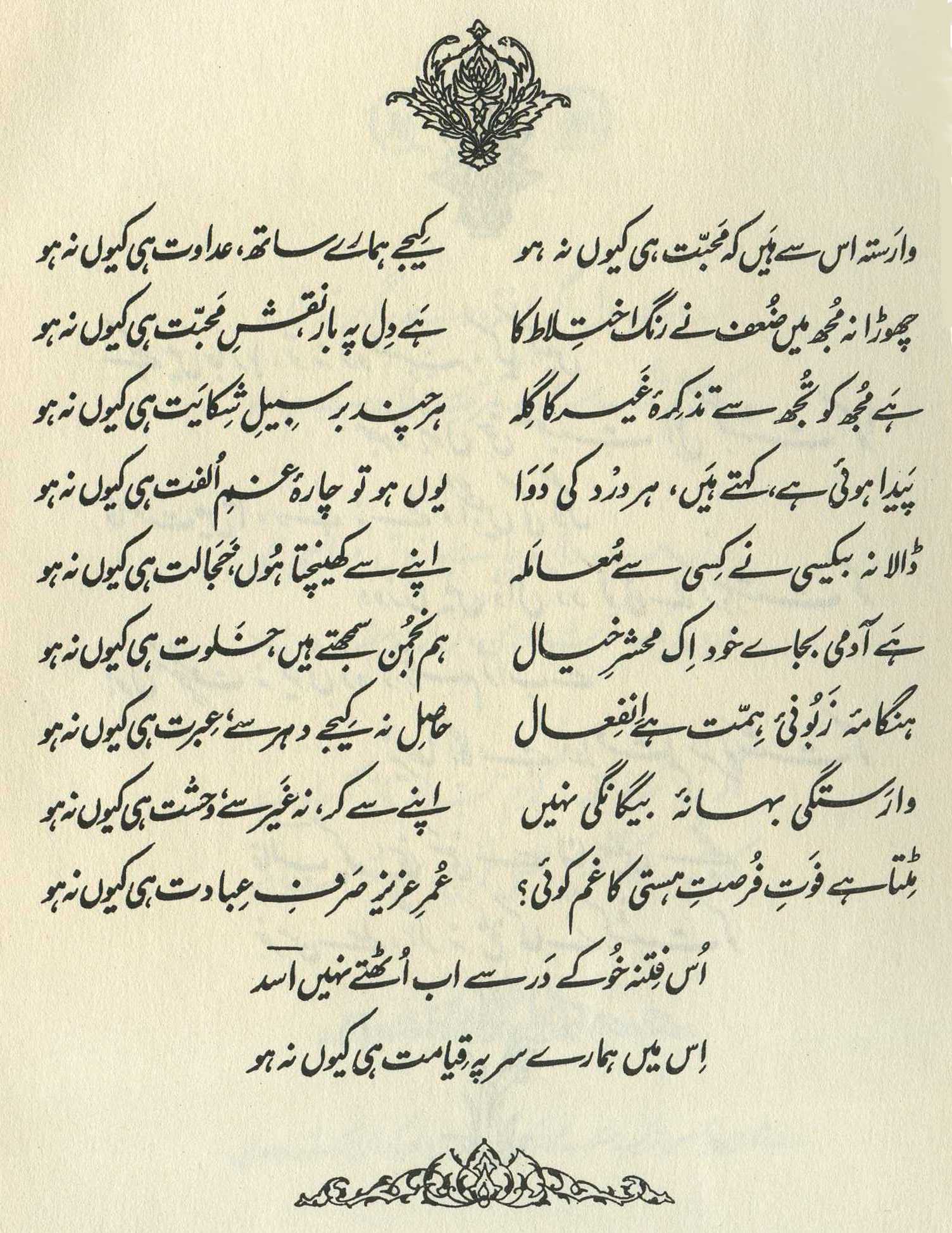
He says, although you complained about the Other, why did you mention him at all? (127)
== Nazm page 127

You said bad things about the Rival . But I have a grievance against you. Why did you mention him at all, in my presence? (239)
It's more enjoyable to assume that the speaker heard somewhere that the beloved had mentioned the Rival. Having heard this, the speaker (the lover) grew jealous, and sent a written message to the beloved to say, 'I have a grievance against you, because you mentioned the Rival'. In this there's also the point that when somebody mentions someone, the one who is mentioned begins to remember the mentioner [as is implied in a verse of the Qur'an].
== (1989: 205) 2006: 227
For more on , see 59,7 . On , see 119,1 .
This verse elegantly opens up at least two possibilities in the first line. Thanks to the multivalence of the construction, can mean the memoir/mention either 'of' the Other (by someone else), or 'by' the Other. Then with the second line, since the subject is left unspecified, either possibility works perfectly. The lover thus says (or writes, as Faruqi maintains) to the beloved:
='You've told (to unspecified hearers) a story about the Other; even though the story might be by way of complaint (about his bad behavior), it still causes me to have a grievance against you (for even mentioning him).'
='The Other has told (to unspecified hearers) a story about his relationship with you; even though the story might be by way of complaint (about your ill-treatment of him), it still causes me to have a grievance against you (for lowering yourself to persecute an unworthy person like him).'
This reminds me of a similar but even more multivalent example by Momin :
[from the 'mention of the Others' it was learned
that the reproach of the Advisor is not bad]
Momin's clever use of could refer to: things said by the Others; or things said about the Others by anybody; or by the beloved; or by the Advisor.
But Ghalib too has another twist to offer, in the second line. The 'it' that is the subject, since it's not specified, might refer not to the at all, but instead to the , the 'grievance'. Then the verse would have the sense of, 'I have a grievance about such-and-such against you-- although really my grievance is really only 'by way of lamentation', it's only for the record and will have no practical effect, it's only to give me the satisfaction of lovingly scolding you, even if only in my own mind'.
graphics/memories.jpg