Verse 9after 1816athii kyuu;N nah ho
G3
1
as if the grief of the passing/loss/death of the interval/respite of life/existence ever gets erased!
2 a
even if the precious lifetime would be expended only/emphatically in worship
2 b
why would the precious lifetime not be expended only/emphatically in worship?
'Passing away, escaping, being lost, failing; —escape; loss; failure; —death'.
'Passing away, dying; escaping; death; annihilation; the space between two fingers'. (Steingass p.941)
'A time, opportunity, occasion; freedom (from), leisure; convenience; relief, recovery; respite, reprieve; rest, ease'.
| References | |
|---|---|
| Arshi, Imtiyaz Ali | Ghazal# 118 |
| Raza, Kalidas Gupta | 295-96 |
| Nuskhah-e-Hamidiyah | 147-148 |
| Hamid Ali Khan | Open Image |
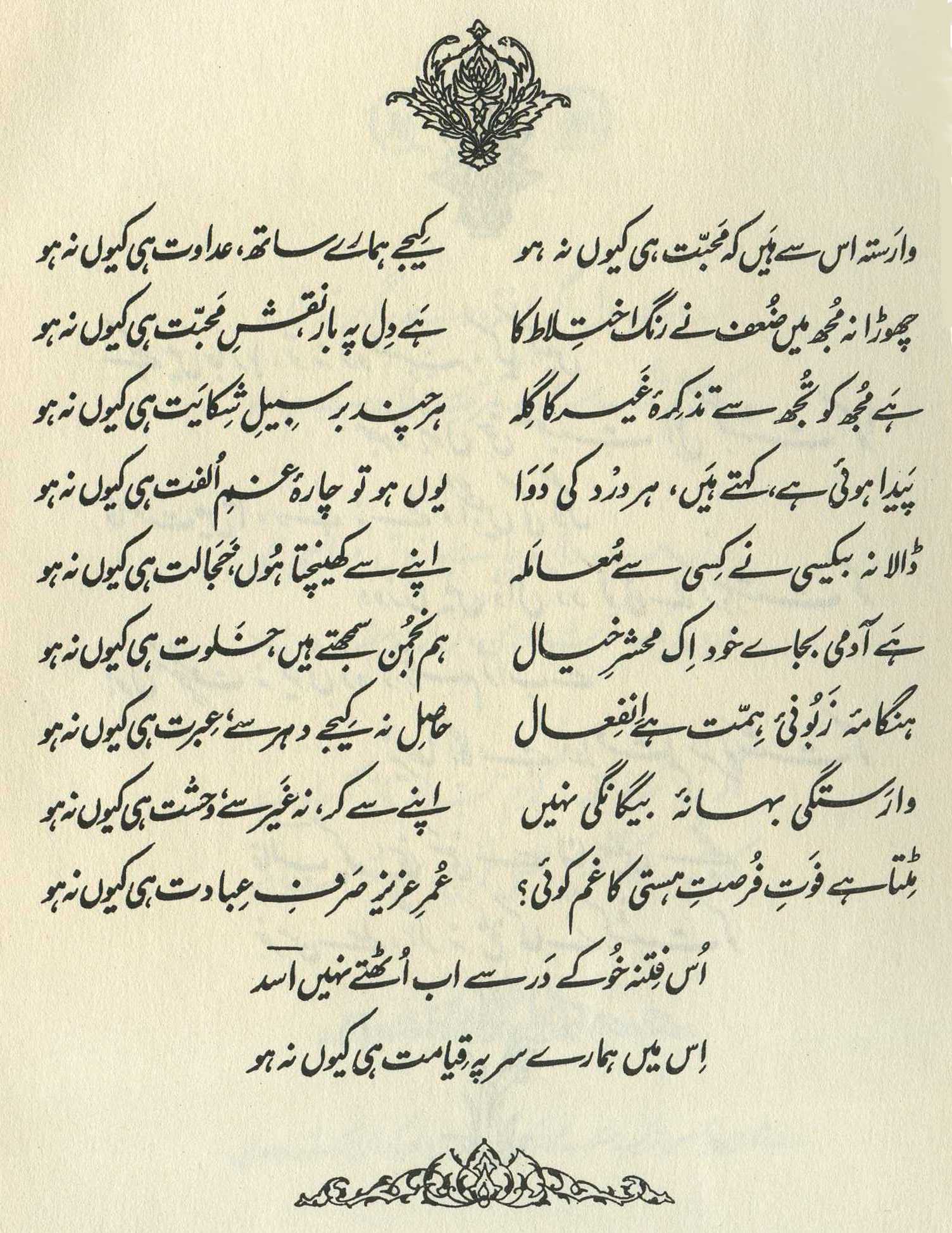
That is, what can man obtain that is beyond the fruit of worship? So if the period of life is spent only in worship, then why will there be sadness over it? This 'interval/respite of life' is an extraordinary occasion, one that won't come again. (128)
== Nazm page 128

If the whole lifetime be passed in worship alone, even then grief about the loss of the life will remain. That is, higher than worship is the level of mystic knowledge. The lifetime that has been spent in worship-- if it had been spent in an attempt to encounter the Lord, then mystical knowledge could have been attained.
[Or:] He says that life is so precious to man that despite the whole lifetime's being spent in such an excellent pursuit as worship, still he doesn't wish to die. In this verse it has been shown to what an extent life is precious to man. (241)
1) ... can mean (1) the finishing, or becoming nonexistent, of that interval which they call 'existence'; (2) the departure, or being wasted, of that interval which they call 'existence'. Ghalib has used with or elsewhere too: in 148,6 ; and in 123,12x .
2) Life has a thousand occupations, but the most pleasureless is worship, because worships deprives man of all pleasure and music, pastimes, amusements, and enjoyable things. But even though a life passed in worship is merely savorless and colorless, man loves life so much that he grieves over the passing of even such a colorless life....
3) When in any case there's the sorrow of the ending of life, then why should it not be spent only in worship?....
4) The meaning of spending one's life in worship is the renunciation of the world and thus the renunciation of life. The claim or attempt of renouncing life through worship alone is merely vain, because when death comes, then the worshipper and the pious man too grieve at the loss of life.
5) There is a hadith that the people of paradise will have no regrets, except for the moments of earthly life that they didn't spend in remembering the Lord.... Thus when death comes, there is grief that they didn't have more leisure that they would have spent in worship and remembering God.
6) .... In the afterlife there will be neither will nor attraction. Everything is easy, no temptation, no sense of sin, no fear. Thus there there's no pleasure of 'leisure'. Thus there's grief at death.
7) The levels that a person reaches through worship are less than the harm that s/he is forced to endure through the departure of life. That is, the loftiness of ascent is not a fair exchange for life; thus one grieves over death.
== 1986: 211-12) 2006: 235-36
On this colloquial, emphatically negative use of , with its implied , see 7,5 . On , see 119,1 .
The first line, with its colloquial use of , is an exclamation-- emphatic, edgy, impatient. It sounds like something that might be said in reply to a clumsy attempt at consolation. The would-be consoler has perhaps said something like, 'Be patient, time heals all wounds'. The speaker is unable even to listen to such obvious nonsense: he contemptuously dismisses even the idea that the grief of death can ever be lifted from the heart. It's grief over someone's death, anyone's death-- and especially, over everyone's death.
For grammatically speaking, it's grief over the death of the 'lifetime' itself. The grief is over the of life-- the 'passing' or loss or death of the 'interval', the 'respite', that life provides. The unusual word deserves some ' fresh word ' credit; this is its only occurrence in the divan .
Then, as so often, we have to decide for ourselves how the two lines should be connected. Colloquially, the second line looks like an adverbial clause that is part of the first (2a). But grammatically, it can also be read as completely independent (2b).
If the two lines are grammatically one, as in (2a), then we have all the possibilities raised by the commentators. 'Even if' the lifetime is spent in worship, grief at its death remains. Does the 'even if' imply that worship is the best possible use of our time, since we thus seek to procure an afterlife? Or, as Bekhud Mohani says, does it imply that outward worship is an inferior choice when compared with the pursuit of mystical awareness? Or, as Faruqi suggests, does it imply that even though a lifetime of unalloyed worship is deadly dull, we still regret its ending?
If the two lines are taken separately, as in (2b), then a new set of questions arises. Realizing that the grief of the death of life can never be erased, why wouldn't we decide to spend that precious, brief life in worship? Perhaps we so decide because this constant awareness of the brevity of life turns our thoughts to the eternity of the Divine. Or perhaps it's a counsel of despair: life is so brief and pain-filled anyway, why even bother to try to enjoy it or make something of it-- why not just go ahead and use it up in some obvious, mechanically virtuous fashion? Or, even more literally, the second line can actually be taken as a non-rhetorical question: why would the precious life in fact not be spent in worship? Perhaps there could be some reason, after all, why it would not be; we, the readers, will have to do our own reflecting on the whole question.
It's a marvelous verse, isn't it? The tone of the first line is so sharp, so edgy, so frustrated with complexities and yet so complex-- it can hardly be read with the eyes alone, it demands a tongue and a voice. We're left to provide that voice ourselves; but that's no problem, we all have that tone in our repertoire.
graphics/vazirkhanlahore.jpg