Verse 6after 1816athii sahii
G11
In this meter the first long syllable may be replaced by a short; and the next-to-last long syllable may be replaced by two shorts.
1
{although / however much} the lifetime is lightning-paced
2
leisure for turning the heart to blood-- indeed
'Although, even if, notwithstanding; --how-much-soever; howsoever; as often as'.
| References | |
|---|---|
| Arshi, Imtiyaz Ali | Ghazal# 182 |
| Raza, Kalidas Gupta | 298-99 |
| Nuskhah-e-Hamidiyah | 243 |
| Hamid Ali Khan | Open Image |
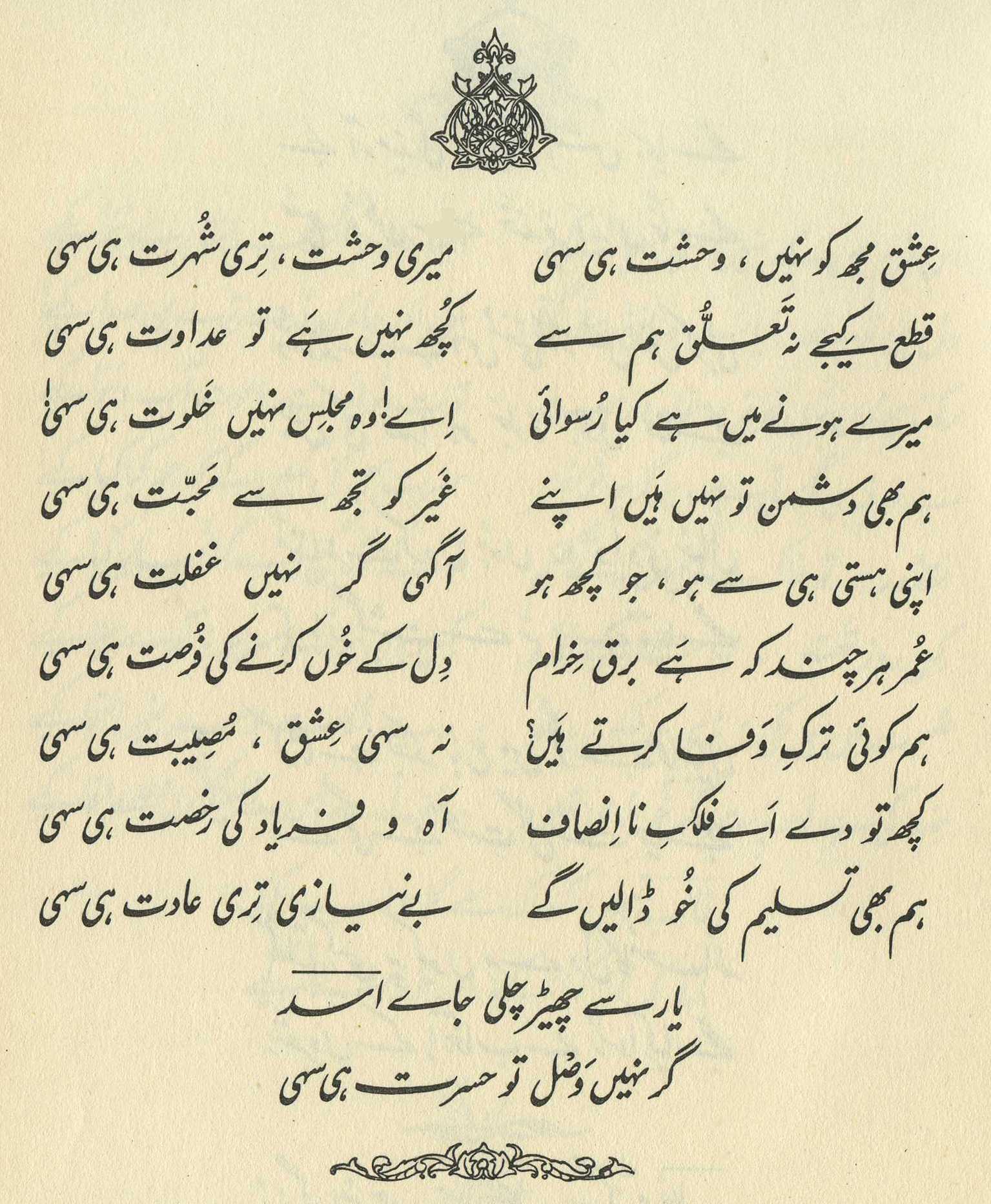
The reason for the affinity is that lightning too is the blood in the veins of the cloud. (156)
== Nazm page 156

He says, we've agreed that a lifetime has the stability of a flash of lightning. But nevertheless, it's possible to find enough leisure to turn the heart to blood. (215)
We've agreed that the speed of a lifetime is the speed of lightning. But if the time isn't enough for many great works, then so what? In this lifetime, we can't even turn our heart into blood, and is this a lesser task? That is, if a lifetime is too short for attaining mystical knowledge, then isn't it also too short for making love? (287)
For discussion of the versatile idiomatic expression , see 148,1 . For more on , see 59,7 .
The commentators point to two possible readings of the second line. Although for us humans life is as brief as a lightning-flash, (1) still there is at least leisure enough to turn the heart to blood (Bekhud Dihlavi's reading); or (2) if only we could have leisure enough to turn the heart to blood! (Bekhud Mohani's reading). In other words, the absent verb in the second line is taken by Bekhud Dihlavi to be , and by Bekhud Mohani to be or .
Reading (1) can be construed ironically or sarcastically-- we hardly live for a moment, and even that moment we spend in suffering and self-torment. By contrast, reading (2) has a wistful air-- the one great wish we have is to turn our heart to blood, and we don't even have time enough for that! Yet the tone of this wish too can be sarcastic. This is a verse in which the tone is interpretively crucial-- and (as so often) the tone is just what is left for the audience to decide, with no guidance whatsoever from the verse itself.
Out of a handful of words, a cleverly missing verb, and , Ghalib has thus made an irreducibly dual expression: one that perfectly contains two opposite, and apposite, views of human life. Needless to say, both fit perfectly with the 'although, however much' of the first line. For Ghalib, after all, this sort of tour de force is commonplace.
For another, more literal-minded use of 'turning the heart to blood', see 123,7 .
graphics/lightning.jpg