Verse 9after 1816athii sahii
G11
In this meter the first long syllable may be replaced by a short; and the next-to-last long syllable may be replaced by two shorts.
1
even/also we will adopt a temperament/custom of acceptance
2
indifference/independence-- your habit, {indeed / so be it}
'Surrender, resignation; conceding, acknowledging, granting; assenting to, accepting'.
'Nature, disposition, temper; habit, custom; way, manner'.
'Petition, supplication, prayer; --inclination, wish, eager desire, longing; need, necessity; indigence, poverty; --a gift, present; --an offering, a thing dedicated'.
'Freedom from want, ability to dispense (with), independence'.
'Custom, habit, manner, wont, usage, practice'.
| References | |
|---|---|
| Arshi, Imtiyaz Ali | Ghazal# 182 |
| Raza, Kalidas Gupta | 298-99 |
| Nuskhah-e-Hamidiyah | 243 |
| Hamid Ali Khan | Open Image |
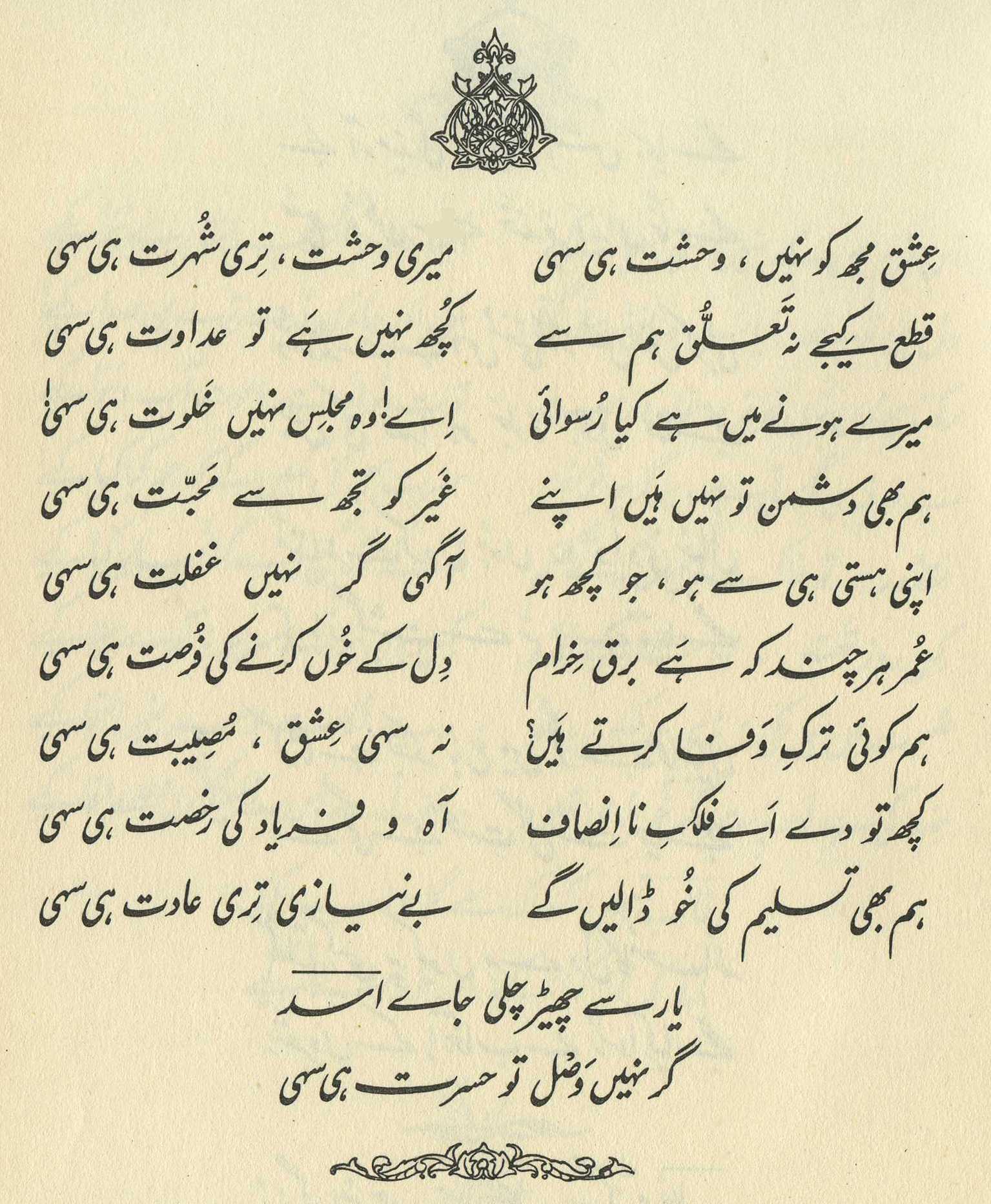
He uses this introductory phrase [] so that proves by implication that now our temperament [] cannot endure the indifference, and her habit is irascible. Nor is there any hope of a quick change in our temperament-- gradually we will take up indifference. Here he has created an introductory phrase, and the author has in mind the conclusion too, and from this the meaning becomes increased. (157)
== Nazm page 157

He says, 'Gradually we too will adopt a habit [] of acceptance and contentment-- when we understand that indifference has become a part of your habit.' (215)
Now we don't have acceptance and contentment-- we make complaints about your indifference. We'll adopt the habit [].
[Or:] You say, 'I am not careless of you alone'-- or, even better, 'I don't practice carelessness, rather it's just my habit'. So we too will adopt the temperament [] of acceptance. (287)
For discussion of the versatile idiomatic expression , see 148,1 .
Here is an enjoyable exploitation of the multivalence of -- one that points up the fact that we have to decide for ourselves whether the two modes of behavior named in the two lines are similar, or mesh together symbiotically, or are opposite.
If is taken to mean 'too, also', then the meaning becomes: we too will adopt a habit that is in conformity with the one you have adopted: if you are indifferent and independent, we will be content and accepting. (Both and can be seen as implying the acceptance of one's present lot, which can be taken as a sign of submission to God's will. But the latter term of course carries much more of a sense of pride and self-will.)
If is taken to mean 'even', then the meaning becomes: even we, who are so determined and intransigent, will eventually have to adopt a temperament of acceptance, in response to your habit of constant indifference.
If is taken to be merely a colloquial emphatic particle with no strong meaning (as in !), then the meaning becomes merely: 'we do X, your habit is Y indeed', and the possible interpretive range becomes even wider-- especially in view of the versatility of .
Then of course the word can mean 'habit, custom, way, manner', which is very close to the core meaning of (see the definitions above); or else it can mean 'nature, disposition, temper', which is much more like 'temperament' []. If the beloved has a 'habit' and the lover responds to it by developing a , is that fighting fire with fire, or is it fighting fire with water? The choice matters, because a 'habit' may be relatively easy to develop, while developing a 'temperament' may be a long-term, uncertain task; the commentators recognize its difficulties. As usual, we're left with all these choices, and allowed-- or required-- to put together our own reading.
For an example of the versatility of , see 101,5 ; for an example of , see 19,2 .
graphics/indifference.jpg