Verse 1after 1816athii sahii
G11
In this meter the first long syllable may be replaced by a short; and the next-to-last long syllable may be replaced by two shorts.
1
it's not passion that I have, it's madness/wildness-- so be it
2
my madness/wildness-- your fame/rumor/report, indeed
'A desert, solitude, dreary place; —loneliness, solitariness, dreariness; —sadness, grief, care; —wildness, fierceness, ferocity, savageness; barbarity, barbarism; —timidity, fear, fright, dread, terror, horror; —distraction, madness'.
'Divulging, publishing; publicity, notableness, notoriety, celebrity, reputation, renown, fame, rumour, report'.
'Just, very, exactly, indeed, truly, only, alone, merely, solely, altogether, outright'.
'Yea, verily, indeed, true enough, forsooth; just so; very well, so be it, let it be; just; pray; please'.
| References | |
|---|---|
| Arshi, Imtiyaz Ali | Ghazal# 182 |
| Raza, Kalidas Gupta | 298-99 |
| Nuskhah-e-Hamidiyah | 243 |
| Hamid Ali Khan | Open Image |
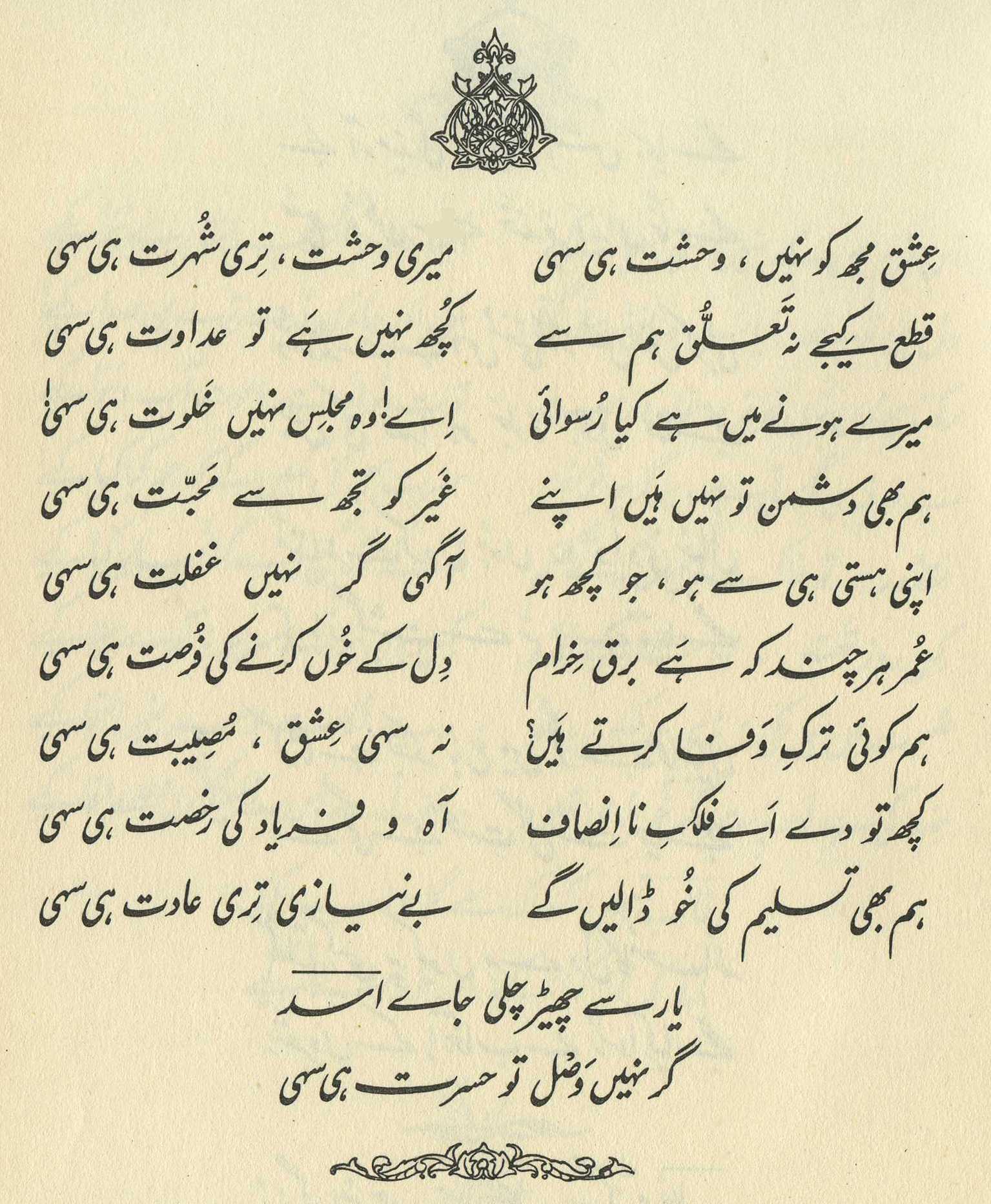
That is, upon my expressing passion, you say, 'You've gone mad!' I'm mad in such a way that my response is, [the verse]. (156)
== Nazm page 156

He says, since upon my claim of passion you say, 'This isn't love that you feel-- rather, it's the turmoil of insanity, that has turned into madness/wildness', then my response is 'All right, let it not be passion [], but madness []-- it's the cause for the fame of your beauty, indeed []. (214)
From it's apparent that the beloved has called the lover's love 'madness'. In reply to this the lover says, 'The truth is that i feel passion for you, but you say that it's not passion, but madness. All right, let it be so []. My madness won't do you any harm; rather, your beauty will be spoken of in every house: 'She's so beautiful that people go mad'. (285-86)
ABOUT : It's impossible to find one single satisfactory translation for such a protean idiomatic expression as . (Even separately, both parts of it are thoroughly flexible and idiomatic; see the definitions above.) Here are some of the possible translations: 'indeed'; 'at least'; 'even if'; 'in any case'; 'so be it'; 'let it be so' (as an assumption). For the purposes of the present ghazal, my solution has been to translate the expression in one of these ways, but to italicize the translation, to emphasize the colloquialness of the original. (Compare its mirror image, , which I've treated similarly in 175 .) Wherever the commentators have used forms of the expression while discussing this ghazal, I have shown the original Urdu. Ghalib himself declared expressions untranslatable: see 148,10 . Other verses that use the same idiomatic : 9,4 ; 91,4 , 228,9 . For discussion of other expressions, see 9, 4 .
This ghazal is in a relatively short meter, and the refrain , , while not unduly long, is conspicuous and powerful. It is emphatic both in its sounds (with the two mutually echoing syllables) and in its vigorous, argumentative colloquialness. Thus it stands out very markedly, and clever use of it constitutes one of the chief pleasures of the ghazal.
The first line, as the commentators note, seems to sarcastically echo something that the beloved has just said. (This effect of being in the midst of a vigorous argument is created largely by .) The beloved has apparently said that what the lover feels is not passion, but merely (?) madness. He responds somewhat snarkily that even if that's true, at least she gets some advantage out of it. The advantage she gets out of it is 'fame' (or perhaps 'notoriety'; see the definition above).
The commentators suggest that this fame takes the form of gossip about her devastating beauty and its power to drive men mad. But of course, we're reminded also of the power of poetry-- think for example of Shakespeare's Sonnet 55 and Sonnet 60 , which promise the beloved immortal fame through the sheer force of their own words. (For another verse along these lines, see 208,5 .)
The second line is so compressed-- it dispenses even with a verb-- that it achieves a kind of sublime crypticness. After all, what is the relationship between 'my madness' and 'your fame'? The multifariousness of leaves us ample room to frame our own possibilities. The repetition of , and its partial echo in , help to focus our attention. And doesn't leave open the possibility that the beloved herself may be involved in spreading these rumors?
graphics/wildness.jpg