Verse 5after 1816athii sahii
G11
In this meter the first long syllable may be replaced by a short; and the next-to-last long syllable may be replaced by two shorts.
1 a
let it be only/emphatically from one's own existence, whatever it might be
1 b
it would be only/emphatically from one's own existence, whatever it would be
2
if not awareness, then heedlessness-- so be it
| References | |
|---|---|
| Arshi, Imtiyaz Ali | Ghazal# 182 |
| Raza, Kalidas Gupta | 298-99 |
| Nuskhah-e-Hamidiyah | 243 |
| Hamid Ali Khan | Open Image |
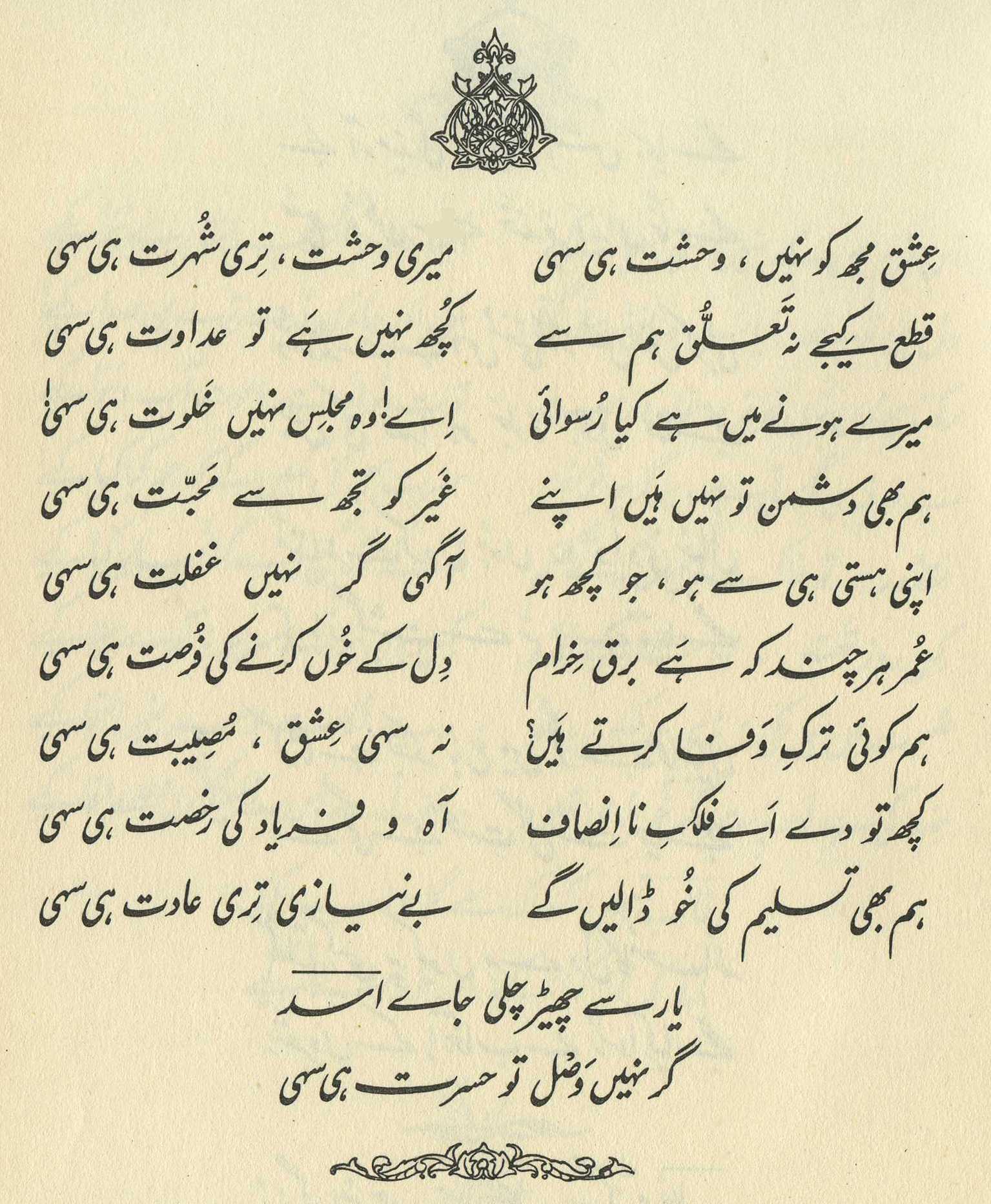
That is, from one's own existence comes awareness-- that is, mystical knowledge itself. And he has taken this theme from a famous hadith, 'He who has recognized his self has recognized his Lord' []. Then he says that if awareness is not attained, then from his own existence one should take heedlessness. When one considers himself to be nothing, then the glory/appearance of the Truth will be visible. There are no words sufficient for the praise of this verse. The truth is that those Shaikhs of the [Sufi] Path, whose divan s are always interpreters of Reality-- even their divans are devoid of the vision of this verse. (156)
== Nazm page 156

He says, to know one's own existence is mystical knowledge itself.... In the second line he says, if awareness is not attained through one's own existence, then it's proper to attain heedlessness itself through one's own existence. That is when one considers himself nothing and nonexistent, then the glory/appearance of the Truth will certainly become visible. This verse too is a well-honed 'razor' [i.e., a 'cutting', excellent verse] among Mirza's 'razors'. (214)
Whatever might be, let it be from one's very own breath and self. The heart wants mystical knowledge and insight to be attained. If this is not possible, then ignorance of the whole world-- so be it []. That is, even if it would be some worse than bad thing. To obtain things from someone else is contrary to manly courage. (287)
For discussion of the versatile idiomatic expression , see 148,1 .
This is another of Ghalib's group of verses that advocate radical autonomy and urge one not to be beholden to anybody for anything. Even something inferior, if it's authentically one's own, is more desirable than something superior that is derivative and obtained from others. Or, on the second reading (1b), one's own inner states are the only ones that are even available at all, and the question of obtaining awareness from any external source doesn't even arise.
The commentators, following Nazm, generally give the verse a mystical turn: God is to be found through knowing oneself, not through knowing external things. The hadith referred to by Nazm is widely known, though apparently not well-documented in the authoritative collections; sometimes it is attributed to Hazrat Ali. (I'm grateful to the members of the Urdulist for sharing their knowledge on these points.) Still, nothing in the verse itself pushes us in a mystical direction. And in fact the use of 'heedlessness' as an alternative to 'awareness' works against a mystical reading, since 'heedlessness' can hardly be considered a recommended means for acquiring mystical knowledge.
To me the verse looks more like a stubborn assertion of individualism, a nail-your-flag-to-the-mast defiance. I'd compare it to the similar, defiantly rakish 9,4 , which also, as it happens, uses .
Also, compare this very similar, very Ghalibian-sounding verse of Mir 's: M 1768,6 .
graphics/independence.jpg