Verse 3after 1816athii sahii
G11
In this meter the first long syllable may be replaced by a short; and the next-to-last long syllable may be replaced by two shorts.
1 a
what disgrace/exposure is there in my presence/existence?
1 b
what disgrace/exposure there is in my presence/existence!
1 c
as if there's disgrace/exposure in my presence/existence!
2
after all-- if not in a gathering, then in solitude/privacy, indeed
'Dishonoured, disgraced, infamous, ignominious; humiliated; open, notorious; accused; one held up to public view, as an example to deter'. (Steingass p.576)
'Loneliness, solitude; seclusion, retirement, privacy; a vacant place, a private place or apartment, a closet, &c. (to which one retires for privacy); a cell (for religious retirement); —private conference'.
| References | |
|---|---|
| Arshi, Imtiyaz Ali | Ghazal# 182 |
| Raza, Kalidas Gupta | 298-99 |
| Nuskhah-e-Hamidiyah | 243 |
| Hamid Ali Khan | Open Image |
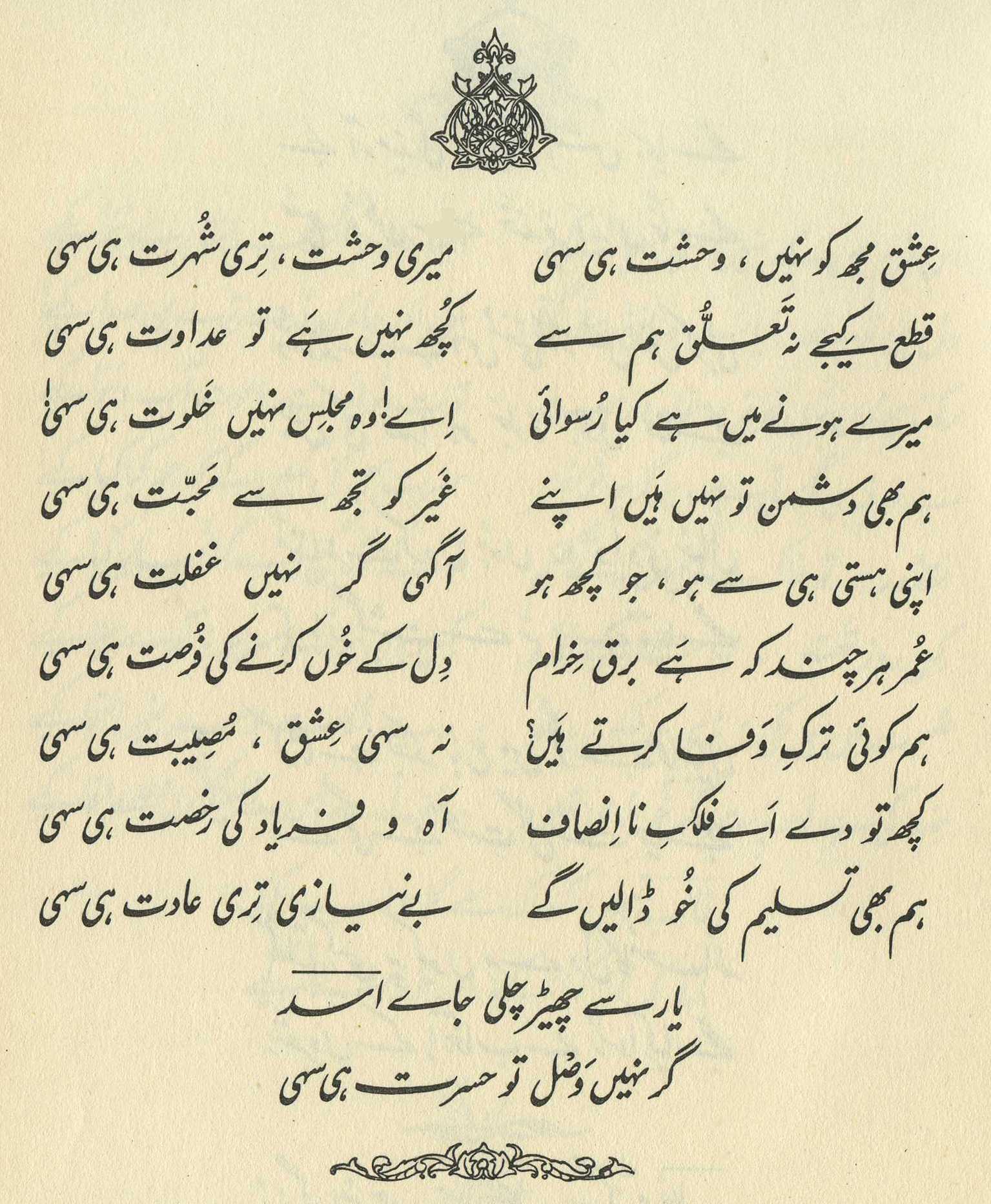
In this the phrase is very subtle-- only the real knowers of language [] will understand it. (156)
== Nazm page 156

He says, if I meet with you in private, then in that what disgrace will there be for you? To meet in both places is the same thing-- if not indeed a gathering [], then at least in private []. (214)
Whether it be your gathering or in private, if we would remain there, what kind of disgrace is this to you? That is, you and we are both free from sin. Or this: that we are your true lover. The subtle meaning in this verse is that the lover considers that from giving true lovers a space near her, the beloved can't at all be disgraced....
In this place, is extremely enjoyable. In it is hidden the picture of the beloved's becoming very angry, and the lover's giving her a reply. (286)
For discussion of the versatile idiomatic expression , see 148,1 .
As in so many verses, is beautifully positioned to do its threefold work-- it can generate a genuine, thoughtful question (1a), an affirmative exclamation (1b), or an indignantly negative exclamation (1c). On the meaning of as first 'public exposure', then by extension 'disgrace', see 20,9 .
In the first line, the ambiguity of , literally 'in my being', leaves us poised between two interpretations. It can easily mean either 'in my existing', or 'in my being there'. We await the second line, expecting to have the question resolved. And is it resolved? Of course not. The choice of company or solitude could perfectly well apply to the speaker's presence in the beloved's company, as the commentators maintain. Most amusingly, the line could even be taken as suggesting that if the beloved finds it too disgraceful to invite the lover to her gathering, she could at least meet with him in private!
But the line could equally well apply to the speaker's very existence, which either might be, or is, or isn't, a disgrace in itself, whether in company or in solitude. After all, not a single word in the verse explicitly introduces the beloved. We know the lover seems to be having some kind of a semi-exasperated or rueful discussion with somebody, even perhaps to be berating somebody-- but the somebody could very well be himself. This verse could very well be a less grim (because more multivalent) reframing of 3,5 . After all, the second line simply names two alternative places, leaving it up to us to decide how they fit into the argument.
graphics/solitude.jpg