Verse 7after 1847arkahe ba;Gair
G3
1
{although / however much} there might be conversation of the seeing/witnessing of God/Truth
2
[the speech/idea] doesn't succeed without saying 'wine' and 'flagon'
'Although, even if, notwithstanding; --how-much-soever; howsoever; as often as'.
'Speech, language, word, saying, conversation, talk, gossip, report, discourse, news, tale, story, account; thing, affair, matter, business, concern, fact, case, circumstance, occurrence, object, particular, article, proposal, aim, cause, question, subject'.
'To be successful, prove a success, answer well; to gain credit or honour, to prosper, flourish'.
| References | |
|---|---|
| Arshi, Imtiyaz Ali | Ghazal# 64 |
| Raza, Kalidas Gupta | 398-99 |
| Hamid Ali Khan | Open Image |
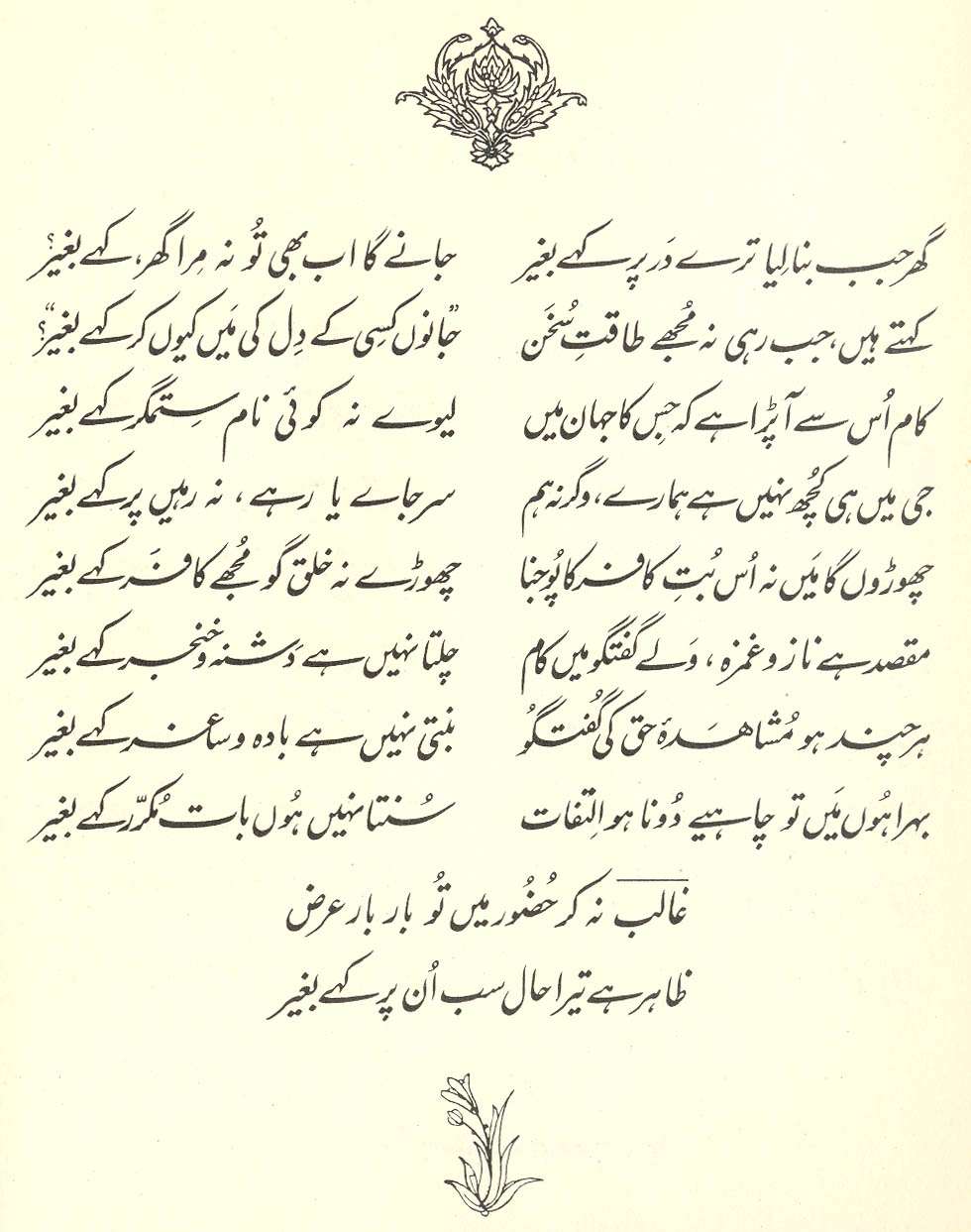
The meaning of this verse is like that of the previous one. (55)
== Nazm page 55

In this verse too, the meaning of the previous one has been expressed in different words. In the second line he's doubled the beauty by leaving the word omitted . That is, without saying wine and flagon, the won't be accomplished. (103)
If you want to mention the seeing of God, then there's no recourse but to mention wine and flagon. Because wine and flagon are such words that upon hearing them the listener understands that the divine glory has made you self-less. (131)
ABOUT : There's an explicit, clear, meaning possible here: 'although' in the logical sense ('although A, nevertheless B'). But there's also a sense in which quantity and style of activity are important, such that it seems to emphasize cumulativeness: 'no matter how much', 'no matter how often', 'no matter how' (see the definition above). The ambiguities of thus parallel those of the more common . Both mean 'although', but then offers as alternatives 'since' and 'to such an extent', while offers 'however much' and 'as often as'. In Ghalib's verses, both senses of seem fully available: 41,9x ; 62,5 ; 62,7 ; 119,3 ; 133,4 ; 143,2 ; 148,6 ; 167,6 ; 196,3 ; 196,4 .
This verse is a companion piece to the previous one, 59,6 , and much of what I want to say about it has been said there. Here too, the key word is , 'conversation'. This is a verse about the persuasive strategies of rhetoric, not the nature-- much less the limitations-- of the ghazal.
Bekhud Dihlavi points out a clever touch: in the second line, the one that contains the refrain , 'without saying', Ghalib has (surely deliberately) composed the line itself 'without saying' the extremely important word . Instead of saying it, he's caused us to infer its presence from the grammar, and from our knowledge that it's often colloquially omitted in such situations. For more on the colloquial omission of , see 59,2 .
Then, the excellently suitable idiom basically means 'for a plan/task/idea to come to fruition' (see the definition above), which works perfectly well in the second line. But can also literally mean 'for conversation/speech to develop', so that it echoes the concerns of the first line-- although there can be conversation, , it depends on speech/conversation-- the cleverly missing but powerfully present, and obviously highly necessary, .
On the structure of , see 59,1 .
graphics/flagon.jpg