Verse 31826ainahii;N hai
G19
In this meter the third and fourth syllables may be replaced by one long.
1
{although / however much} in every single thing, You are
2
but no thing is like You
'Although, even if, notwithstanding; --how-much-soever; howsoever; as often as'.
'A thing, object; a matter, an affair; an article, &c.'.
| References | |
|---|---|
| Arshi, Imtiyaz Ali | Ghazal# 194 |
| Raza, Kalidas Gupta | 366-367 |
| Hamid Ali Khan | Open Image |
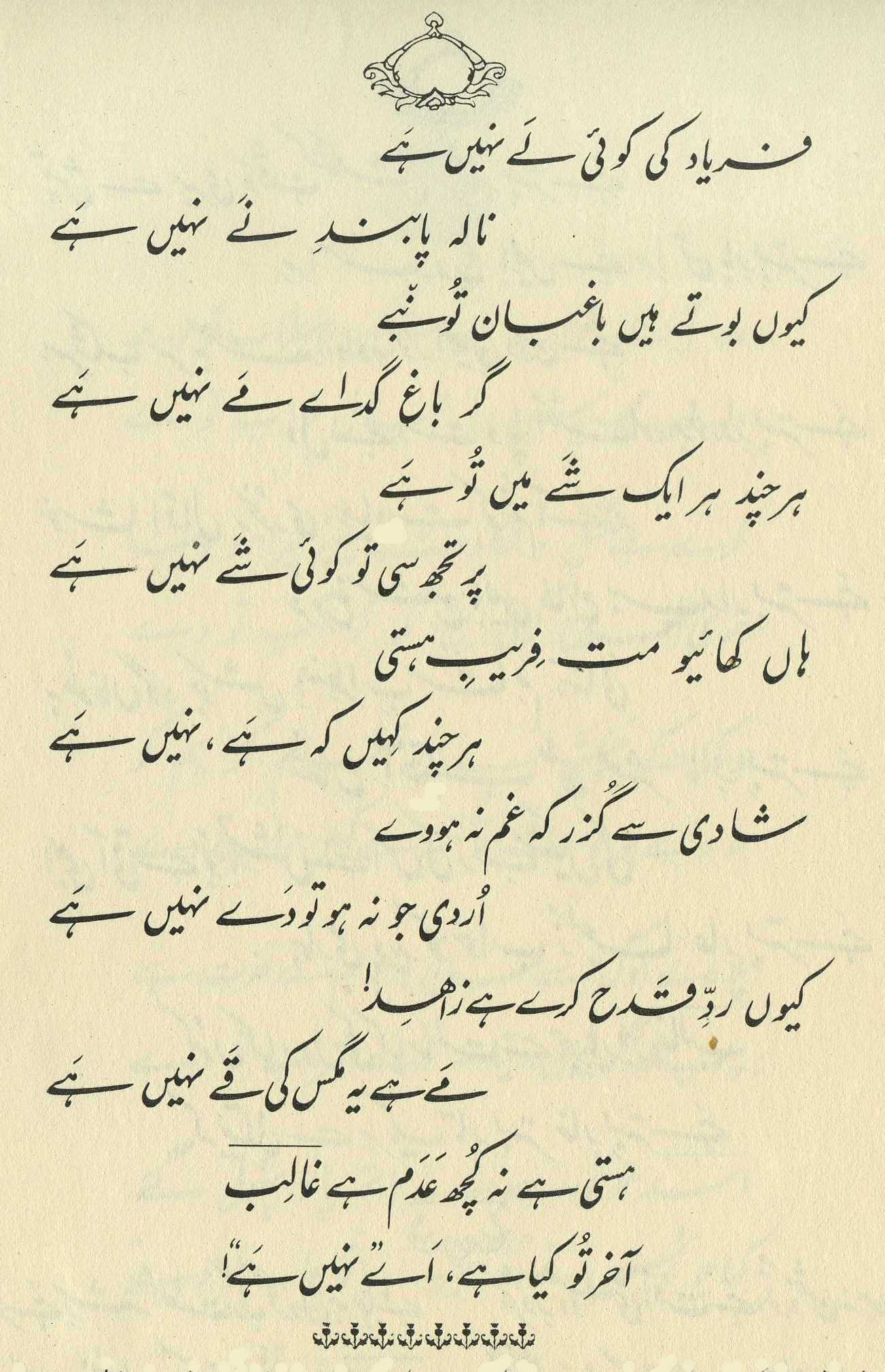
The meaning of is for a simile . That is, You are beyond all physical similes. (221)
== Nazm page 221

He says, despite Your manifestation of Your power in every thing, no thing has been engendered in the world that is like You. That is, You are beyond all physical similes. The verse is immersed in the flavor of Sufism, and is very fine. (279)
Although there's no doubt that in every thing is the manifestation of Your power, nothing in the world is such that we would be able to call it a simile and illustration of You. That is, betweey You and the world of things there's the distinction between Maker and made, between Creator and created. (386-87)
Note for meter fans: If the meter of the second line bothers you, see 196,1 for a discussion.
There's a textual discrepancy in this verse that's perhaps partly caused by its unusual metrical pattern: many editions, including Hamid, insert before in the second line, thus restoring the more usual form of the meter (and also seeming to give the second line a more colloquial balance). But as always, I follow Arshi; and there's really no problem, since several lines in this ghazal have the same unusual scansion, and the paradoxical force of the verse is, if anything, enhanced by the absence of .
For more on , see 59,7 .
The paradoxical quality of the verse is enhanced by its repetition: there are two occurrences of , two of , two of , and two forms of . There's also a particularly enjoyable wordplay in the sequence : apart from the normal reading as two two-word pairs, and the repetition of , the real delight is that means 'every', and means 'some' or 'a number of', while is of course 'one'. This wordplay is most elegantly appropriate to the content of the verse. For another example of such number-wordplay in a very similar context, see 20,10 .
Here the beloved does seem to be God, or at least an extremely God-like being; for more such verses, see: 20,10 .
graphics/cosmicvision.jpg