Verse 9x1826ainahii;N hai
G19
In this meter the third and fourth syllables may be replaced by one long.
1
the heart in which 'till when? to what extent?' would be contained/settled--
2
there, there's no esteem/honor for the throne of Kai [Kavus
'Till what time? to what extent? to what length? when? how much? how many?'.
'To be contained or held (in, -), to go or get (in or into), to enter (in or into), to fit (in); to take up room fill or occupy space'.
'Might, power, grandeur, glory, honour, dignity, respect, esteem, reputation, good name'.
'A king, or a great king (esp. a king of Persia of the Kyanian dynasty): — , or , 'Just or noble king'; name of a king of Persia'. (Steingass p.887)
| References | |
|---|---|
| Arshi, Imtiyaz Ali | Ghazal# 194 |
| Raza, Kalidas Gupta | 366-367 |
| Hamid Ali Khan | Open Image |
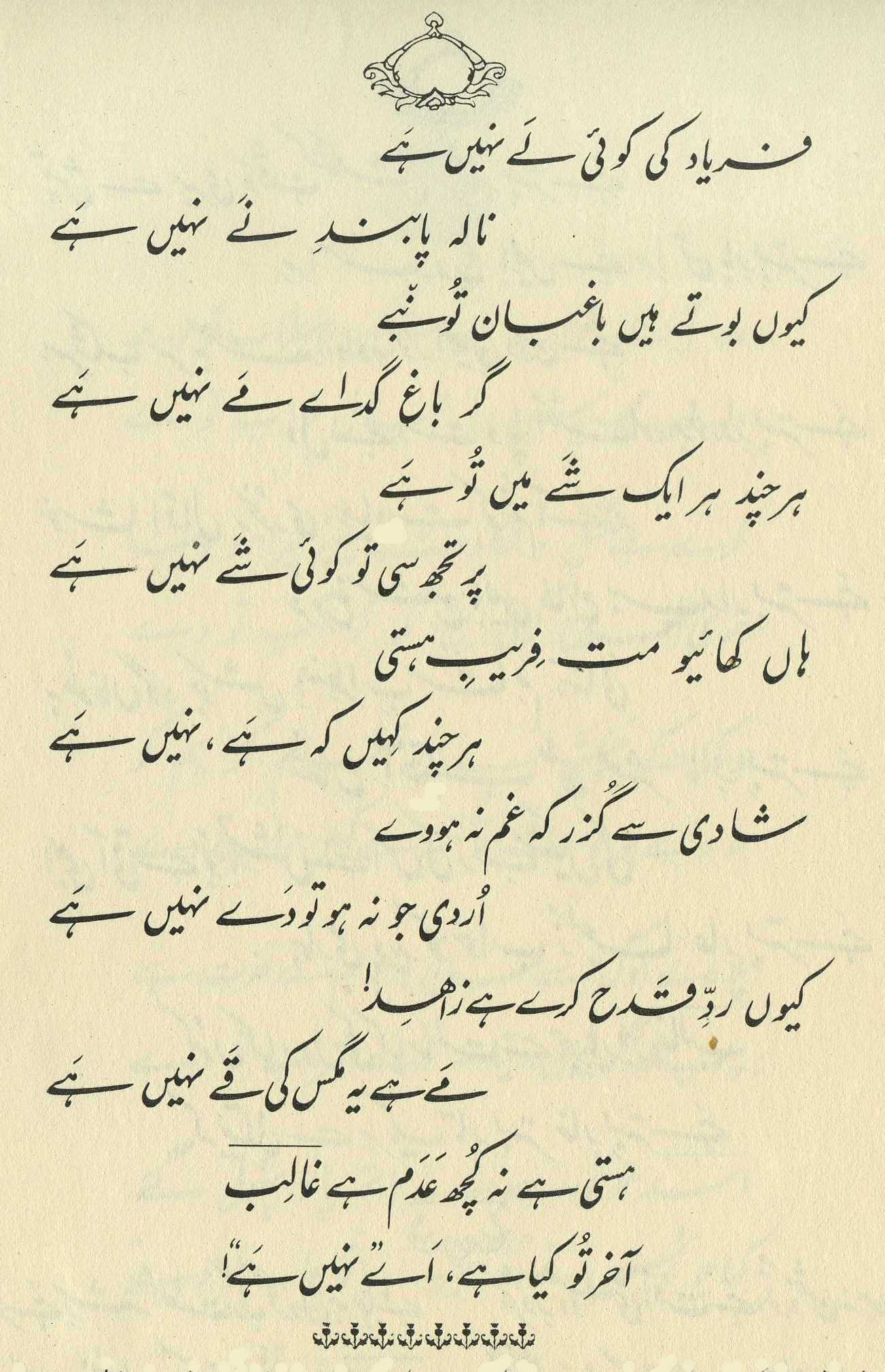
For background see S. R. Faruqi's choices . This verse is NOT one of his choices; I thought it was interesting and have added it myself. For more on Ghalib's unpublished verses, see the discussion in 4,8x .
Persian kings of the the semi-mythological Kayanian dynasty were the heroes of the great Iranian epic the Shah-namah . One of them, Kai Kavus , was famously said to have a flying throne. But of course, to the person with in his heart, such spectacular perks are about as impressive as the flicker of a firefly.
This verse about the transience of worldly glory (or of worldly life in general) can hardly help but evoke Shelley's Ozymandias .
graphics/kaithrone.jpg