Verse 61826ainahii;N hai
G19
In this meter the third and fourth syllables may be replaced by one long.
1
why does the Ascetic reject/'vomit' the flagon?
2
this is wine-- it's not the vomit of a fly!
'Returning; restitution; rejection, repulsion; casting off, turning back, averting; resistance, opposition; disproving, refutation; --vomiting'.
is an archaic form of ( GRAMMAR )
'Vomiting; vomit'. (Platts p.796
| References | |
|---|---|
| Arshi, Imtiyaz Ali | Ghazal# 194 |
| Raza, Kalidas Gupta | 366-367 |
| Hamid Ali Khan | Open Image |
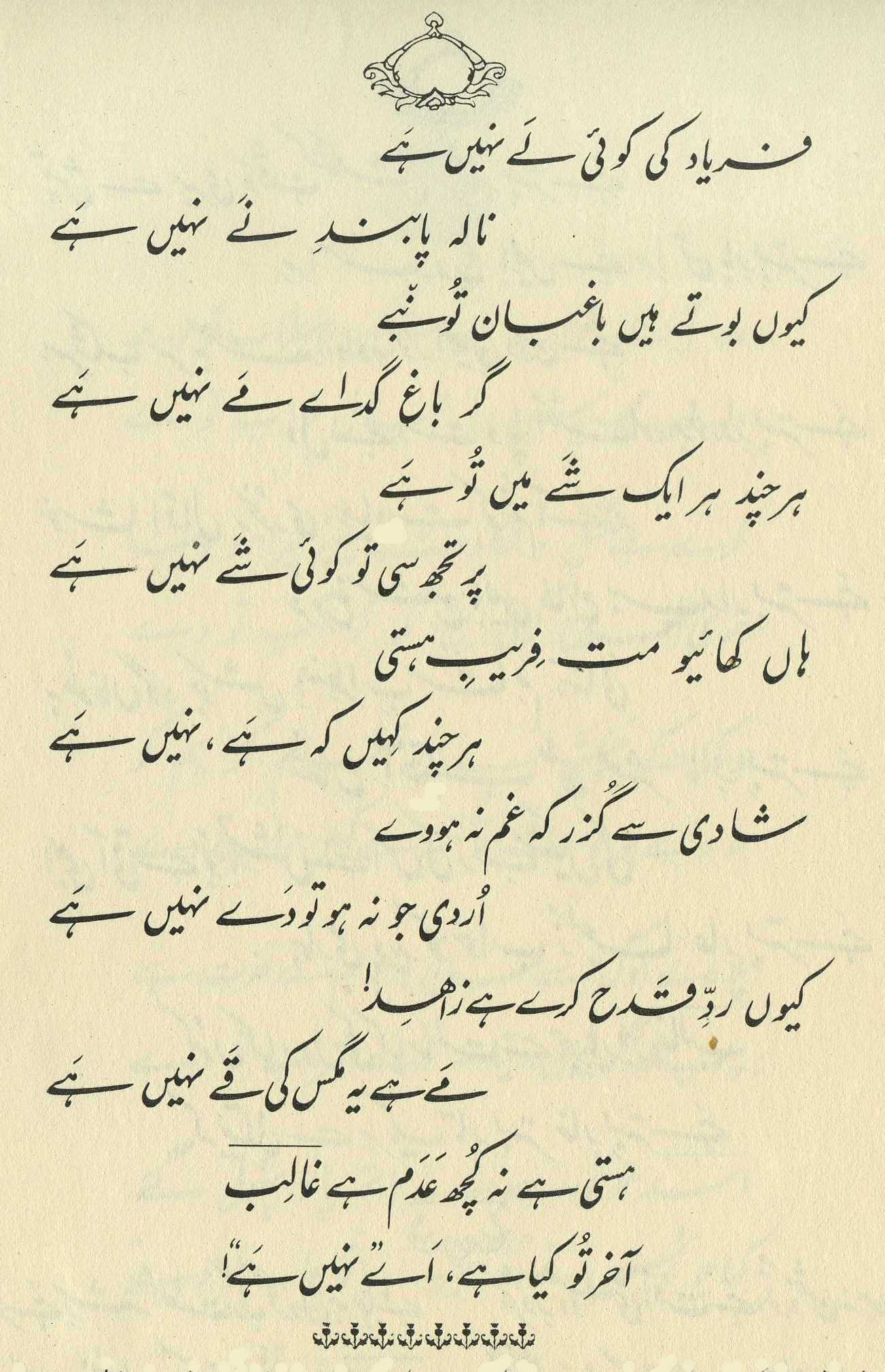
The vomit of a fly-- that is, honey. To the Ascetic, who considers it in accordance with religious merit to drink honey and despises wine, he offers temptation toward wine, and emphasizes that the detestable thing is not wine, but rather that thing which is obtained from the vomiting of a fly.
==Urdu text: Yadgar-e Ghalib , p. 161
Oh Ascetic, don't reject the flagon of wine! This isn't the vomit of a bee, which you consider a great boon. (222)
== Nazm page 222

In saying one more pleasure is that it is an extremely famous idiom of which the meaning is 'objection'. (387)
Well, as one might well say, ! (On this idiomatic expression see 219,9 .) Who could think of a verse like this, except a highly unconventional poetic genius? Can't you just feel that he must have started, in the classic way, with the rhyme -word , and then gone on from there? (And indeed, itself rhymes with .) This verse certainly belongs to what I call the 'grotesquerie' set. But there's much more to it than that.
For this is a delightful, highly amusing mushairah -verse. The first line is unexceptionable: the ghazal world is full of protests by the rakish lover/drinker about the way pious people reject wine. The word has a whole set of suitable meanings that well describe the way the Ascetic might be expected to react to wine (see the definition above). How exactly, we wonder, will the second line rebuke his rejection? After a suitable delay, we get to hear the second line; but in proper mushairah-verse style, it withholds its punch-word until the last possible moment-- and what a shocker that word is! Only after we've heard the word do we go back and recall that one of the secondary or tertiary meanings of is also 'vomit'. In effect, we now 'get' a whole different first line. Here too, as so often, Ghalib gives us three or four lines' worth of poetic enjoyment, within two lines' worth of words.
Sura 16 of the Qur'an is called 'The Bee'; its two relevant verses are these: 'And thy Lord taught the Bee to build its cells in hills, on trees, and in (men's) habitations; Then to eat of all the produce (of the earth), and find with skill the spacious paths of its Lord: there issues from within their bodies a drink of varying colours, wherein is healing for men: verily in this is a Sign for those who give thought.' (Qur'an 16:68-69, trans. Yusuf Ali )
Thus, as Hali and Nazm emphasize, honey is considered not just neutral, but an especially blessed substance, while wine of course is forbidden. Ghalib mischievously reverses these valuations by calling honey the 'vomit' of a fly. (The word is cognate to , and literally means a 'fly'; a bee is normally called a 'honey-fly' [].) This description actually isn't so far from the words of the Qur'an-- except that through the word 'vomit' the idea has been made to seem deliberately disgusting.
Yet it has also been semantically linked with the activity of the Ascetic toward wine, so now we feel that his act too has a certain off-putting association. The verse vigorously defends wine-- not in any elaborate or rational way, but simply by naming it: it's wine, you foolish Ascetic! To say and hear its name is enough to justify it. What more could one need?
graphics/honeywine.jpg