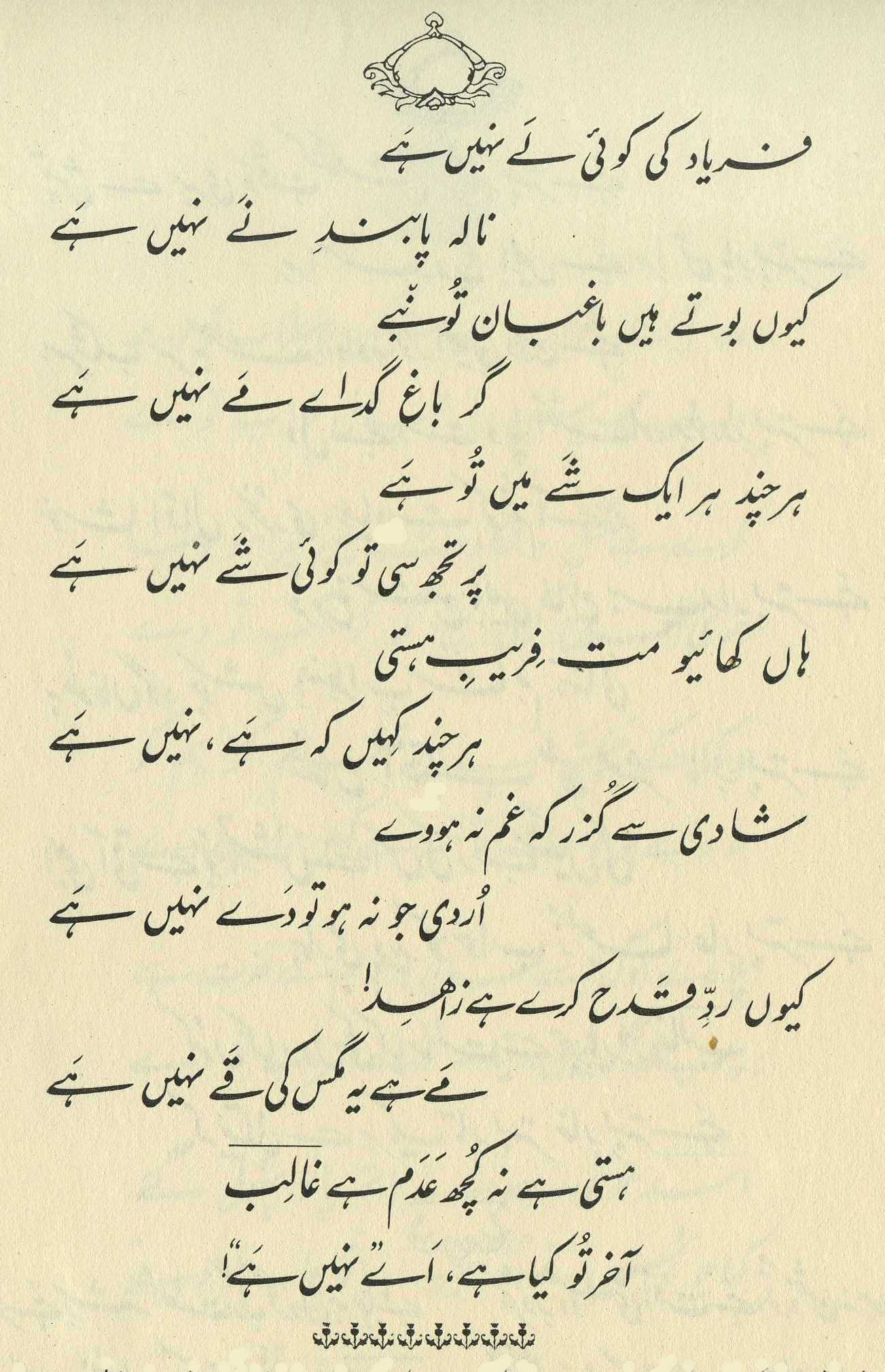
Verse 51826ainahii;N hai
G19
In this meter the third and fourth syllables may be replaced by one long.
1
pass over/through/beyond joy, so that grief would not remain
2
if there would be no April, then there is no December
is a variant spelling of .
'To pass, go, elapse; to come to pass, to happen, to befall; to pass (by or over, ); to pass (through, , or ); to pass (before, or under, or in review, ), to be put or laid (before, ), be presented; to pass (over, ), to overlook, to omit; to abstain (from), desist (from); to decline; --to pass (beyond), to surpass; to pass away, to die'.
is an archaic variant of ( GRAMMAR )
'The second Persian month, mid-spring, April; the third day of every month, which the old Persians celebrated by a festival; the angel who presides over the mountains; fire'. (Steingass p. 36)
'Name of the tenth month of the solar year; winter, or the first month of it, December; name of the ninth (?) day of the month; name of an angel presiding over the affairs of the month , and of the eighth, fifteenth, and twenty-third day of every month'. (Steingass p. 550)
| References | |
|---|---|
| Arshi, Imtiyaz Ali | Ghazal# 194 |
| Raza, Kalidas Gupta | 366-367 |
| Hamid Ali Khan | Open Image |
That is, if you don't make yourself habituated to the joy of spring, then the grief of autumn too would not exist. (222)
== Nazm page 222

He says, 'Withdraw yourself from happiness, then you won't feel grief. That is, if you don't obtain the joy of spring, then why will you be sad and sorrowful at the grief of autumn?' is a month of spring, and of autumn. (279)
is the name of a spring month; is the name of an autumn month. If you abandon the thought of happiness, then there won't be grief either. If spring wouldn't come, then autumn too wouldn't come. That is, if a man would no longer long for happiness, then he wouldn't know any grief either. (387)
Some modern editions, including Hamid, have in the first line not but . As always, I follow Arshi.
What an excellent effect is achieved with minimalist means, in this verse of what I call 'word-exploration'. The heart of the verse is the superbly complex (see the definition above), which can mean one of three sometimes overlapping but in principle distinct things:
=(1) pass over, overlook, omit, abstain from
=(2) pass through, pass under, be presented to
=(3) pass beyond, surpass
So the verse advises us to reject joy; or to pass through joy in some linear way; or to transcend the whole concept of joy in some qualitative way. By doing so, by rejecting or passing through or transcending joy, we'll find that grief would not remain-- it too would be rejected or passed through or transcended. The exact mechanism of this is still a bit ambiguous, so we look hopefully to the second line for enlightenment. But of course, the two lines are grammatically quite separate, and we're left to decide for ourselves how to juxtapose them.
The Persian months are not very familiar to Urdu-knowers, so the commentators identify them. From the above definitions it's clear that they are opposed in very basic ways: April versus December; spring versus winter. Just as with joy versus sorrow, the two evocative month-names seem to suggest a markedly Stoic view: we should somehow dispense with the desirable (joy/spring), in order to escape from its opposite, the undesirable (grief/autumn).
Yet strong similarities and continuities also make themselves apparent. Grief and joy are both emotions, April and December are both months; these names identify particular points among others along a much larger and more significant spectrum. If one rejects a single point on the seamless spectrum of emotions, one moves away from the whole spectrum, into some kind of emotion-free realm; similarly, one can't simply reject one month without rejecting the whole ordering of the year and the sequence of human time. The verse may thus call for a more radical, mystical transcendence, so that a Sufistic reading is as readily available as a Stoic one. And both, of course, are well supported by the various complex nuances of . For more discussion of such complexities , see 152,7 .
graphics/winterspring.jpg