Verse 71826ainahii;N hai
G19
In this meter the third and fourth syllables may be replaced by one long.
1 a
you are not existence, nor are you in any way nonexistence, Ghalib
1 b
there is no existence, nor is there any nonexistence, Ghalib
1 c
it is not existence, nor is it in any way nonexistence, Ghalib
2 a
after all, what are you [], oh 'Is not'?!
2 b
after all, then [] what is there, oh 'Is not'?
2 c
after all, then [] what is it, oh 'Is not'?
'Something, somewhat, anything, aught; some, any; a little, a few; ever so little; whatever; in any manner or degree, at all'.
| References | |
|---|---|
| Arshi, Imtiyaz Ali | Ghazal# 194 |
| Raza, Kalidas Gupta | 366-367 |
| Hamid Ali Khan | Open Image |
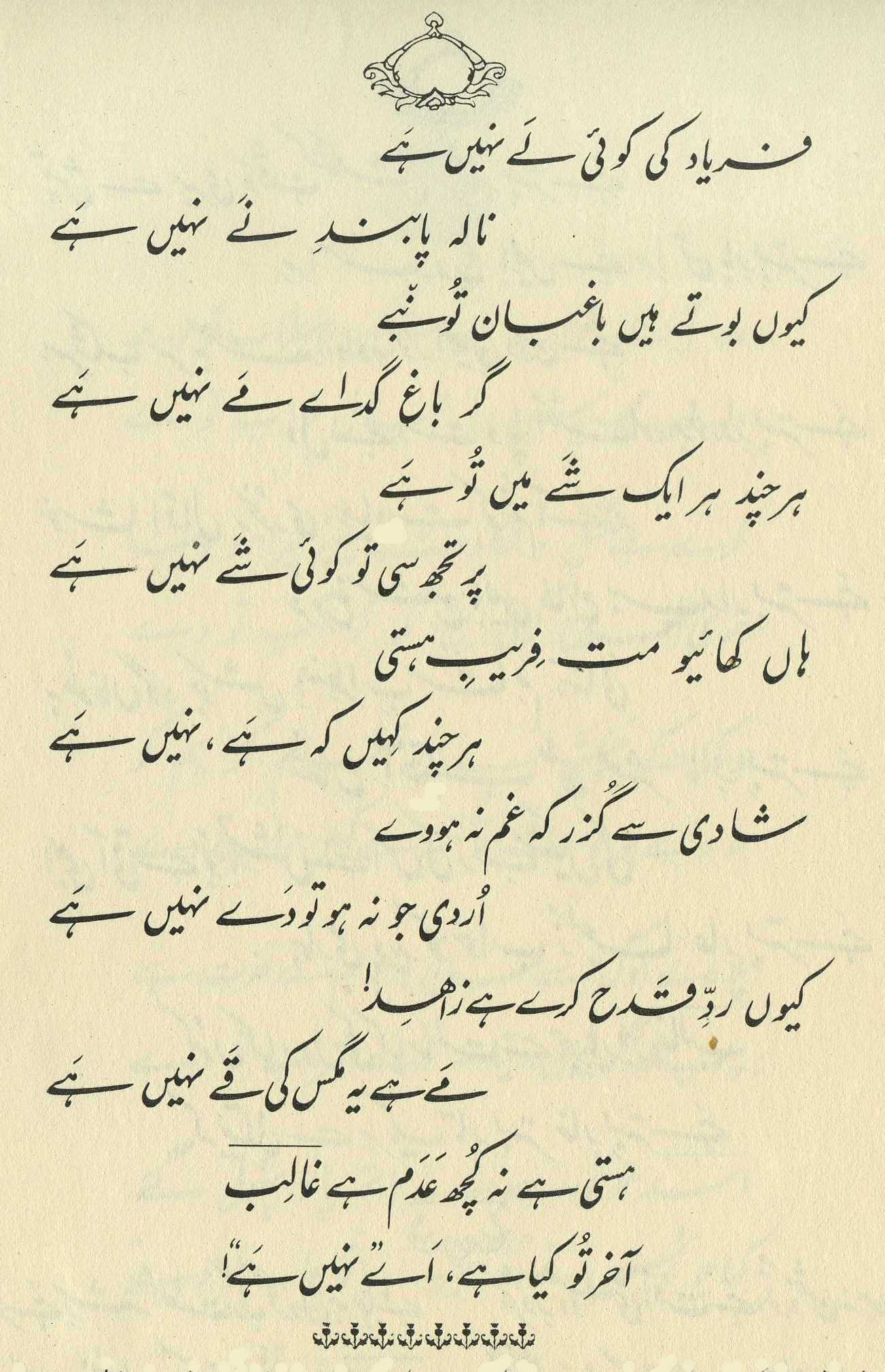
He's done an extraordinary piece of mischief in this verse-- he's made 'It is not' into a name. He says, 'Neither is there purely existence, as in the case of necessity, nor is there simply nonexistence, as in the case of impossibility. That is, you exist, and also do not exist, so you ought to be named 'Is not'.' (222)
== Nazm page 222

Because he's used the words 'is not', 'is not', again and again in the refrain of the ghazal, by way of mischievousness Ghalib has adopted 'Is not' as his own name. (152)
He says, 'Oh Ghalib, when you say that there is neither any existence nor any nonexistence, then tell us-- after all, what are you, oh 'Is not'?' The meaning is that he's made the phrase 'Is not' into a name. He says, oh Hazrat 'Is not', you are neither purely existence, like the Necessary Existence, nor are you nonexistence, like the impossible; in this situation it's necessary that Your Excellency's noble name should be 'Is not'. (279)
Out of mischievousness, Mirza has named himself 'Is not'. About existence he says, 'it is not'; about nonexistence he says, 'it is not'. Then, oh 'Is not', after all what are you? That is, when you're neither this nor that, what should we consider you to be? (388)
This verse sets up what must be close to a maximum amount of paradox , in what must be close to the fewest possible words. In the first line the subject is omitted, as is permissible; and since the subject is something masculine singular, it can be 'he', 'it', or 'you' in the intimate form. Then in the second line, the second word can be read either as 'you' in the intimate [] or 'then' [], which means that the second line cleverly declines to resolve the question of subject.
Then to add a final flourish of 'mischievousness' or ambiguity, Ghalib addresses-- as we can tell by the vocative -- someone (or something) called 'Is not'. The words appear to be a quotation, so that 'Is not' seems to speak, and thus to exist; but of course the words themselves may easily be construed to deny the existence of the speaker-- for of course the speaker is literally 'Is not', since here too the subject is colloquially omitted. (Unfortunately, that rendering tends to give a petulant, childish-quarrel flavor in English that is not present in the Urdu.) The 'Is not' whom Ghalib is so playfully addressing could thus be himself or the beloved; it's harder to think of the addressee as God, since 'Is not' isn't a characteristic divine utterance, and seems an inappropriate way to address the principle of life. (For other verses in which the beloved seems not to be God, see 20,3 .)
Mahmood Piracha points out (February 2023) that the need not be taken only as a vocative marker; it could also be taken as a more general exclamation. In support of this possibility he very persuasively cites the non-vocative usage in 71,7 .
The supreme example of this kind of open-ended 'generator' verse-- and one that's also full of ambiguity about who or what does or doesn't exist-- is 32,1 .
graphics/itisnot.jpg