Verse 5after 1821ardthaa
G3
1
as if the tug-of-war of the sorrow/anxiety/trouble of passion ever at all goes [away]!
2 a
if even/also the heart would go, then there would be that very same pain in the heart
2 b
if even/also the heart would go, then that itself would be a pain in the heart
here has an idiomatic, intensive, negative use; GRAMMAR .
'Repeated pulling; pulling backwards and forwards, or to and fro'.
| References | |
|---|---|
| Arshi, Imtiyaz Ali | Ghazal# 33 |
| Raza, Kalidas Gupta | 354 |
| Hamid Ali Khan | Open Image |
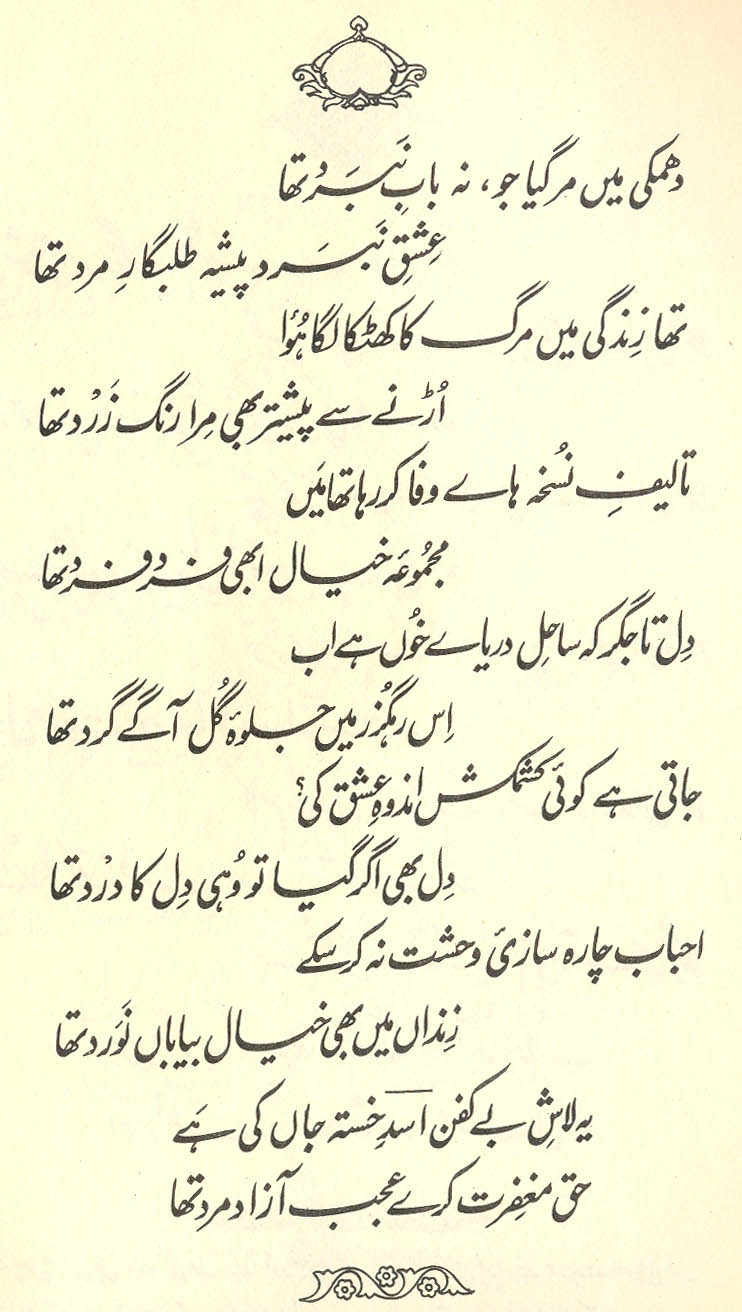
That is, it's not possible in any way for the sorrow of passion to become less. If the heart departed, even then grief of the heart would remain. (8)
== Nazm page 8

Urdu text: Vajid 1902 {7}
He says, after passion arises, then it's not possible in any way that a man should be able to find salvation from it. That is, as long as the heart was in the body, so long did the sorrow of passion take on different moods and different aspects. When the heart was departing, the pain and grief of the heart's going remained in the body just the same. The meaning is that there was no way to save the life-- neither in the heart's presence, nor after its going. (19)
The pain of the grief of passion is not something that erases other griefs. We used to consider that after losing the heart, our spirit would be free of conflicts. But even now there's just the same pain, because the heart's going is itself a pain with no cure. (14)
[See his discussion of Mir's M 126,1 .]
ABOUT the emphatic, negative use of : This usage is idiomatic, and rests on an implied but colloquially omitted , which displays its virtuoso power here. It isn't even present in the verse, and yet the first line would be nonsensical without it. Since the line contains no negator, without the implied to make it an indignant negative rhetorical question (or, conceivably, a genuine question), it would end up affirming that the tug-of-war does go away. More such examples: 119,9 , 148,7 .
Of course, 'losing your heart' is just as painful as keeping it. Especially, no doubt, when the process involves a prolonged tug-of-war in which the heart constantly seeks to pull away and join the beloved. Does such pain ever depart? Of course not! As if!
The pivotal word in the second line is , which anchors the two distinct ways in which the grammar of the second line can be arranged. Either is an adjective modifying (2a), or it is a noun referring to the heart's going (2b). (For an example of an equally pivotal , see 20,1 .)
If we adopt (2a), then the result is a vision of something like the phantom pain in an amputated limb. Even if the heart goes, it somehow still aches. If we adopt (2b), then even if the heart goes, its going is itself painful to the heart (or to the place in the lover's chest where it still metaphorically is). The result is a kind of tug-of-war between keeping and losing, a process of seeking to root out grief while finding it ever more subtle and ineradicable. A related paradox of losing and finding the heart appears in several verses of 4 .
graphics/tugofwar.jpg