Verse 11854aa;Nkyuu;N ho
G2
1
having given the heart to someone, why would anyone be a song-measurer of lamentation?
2
if/when there would not be only/emphatically a heart in the breast, why then would there be a tongue in the mouth?
'Voice, sound; modulation; song; air;... riches, opulence, wealth, plenty; subsistence; --prosperity; goodness or splendour of circumstances; --a splendid situation; --a happy life'. (Platts p.1157
'Weigher, measurer; examiner (used as last member of compounds, e.g. or [for] a measurer of sounds, i.e. a musician'.
'Cry of pain or distress, wailing, groaning, lamentation, complaint; clamour'.
| References | |
|---|---|
| Arshi, Imtiyaz Ali | Ghazal# 127 |
| Raza, Kalidas Gupta | 449-50 |
| Hamid Ali Khan | Open Image |
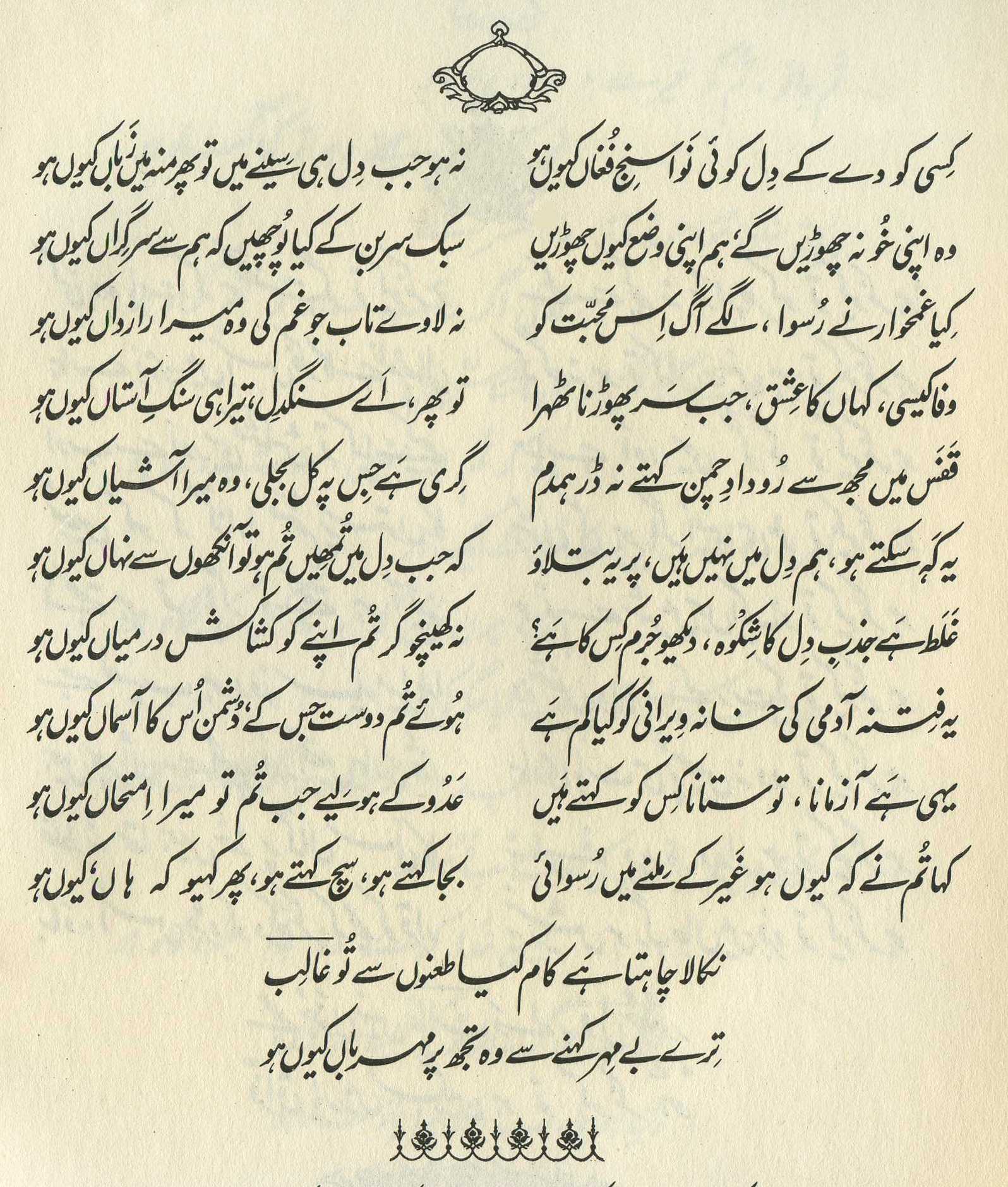
[1854, to Haqir: at the end of the letter he writes down all the verses of this ghazal, in order]
==Urdu text: Khaliq Anjum vol. 3, pp. 1148-49
[1858, to Mihr:] First of all the question is asked of you: in a number of letters, I've found you continuously complaining of grief and sorrow. Enough! If your heart has been lost to some pitiless one, then what scope is there for complaint? Rather, such grief is to be wished for one's friends as well, and to be considered worthy of increase. In the words of Ghalib (God's mercy be upon him!), this verse []: {126,1}. Bravo, bravo-- the 'glory of the opening-verse ' []: 126,8 . Alas, that I'm not able to remember more verses of this ghazal! ==Urdu text: Khaliq Anjum vol. 2, pp. 713-14 ==another trans.: Russell and Islam , pp. 183-84 ==another trans: Daud Rahbar , pp. 89-90
[1858, to Mihr:] First of all the question is asked of you: in a number of letters, I've found you continuously complaining of grief and sorrow. Enough! If your heart has been lost to some pitiless one, then what scope is there for complaint? Rather, such grief is to be wished for one's friends as well, and to be considered worthy of increase. In the words of Ghalib (God's mercy be upon him!), this verse []: {126,1}. Bravo, bravo-- the 'glory of the opening-verse ' []: 126,8 . Alas, that I'm not able to remember more verses of this ghazal! ==Urdu text: Khaliq Anjum vol. 2, pp. 713-14 ==another trans.: Russell and Islam , pp. 183-84 ==another trans: Daud Rahbar , pp. 89-90
That is, having become a lover of somebody, what's the point of complaining about it? (135)
== Nazm page 135

He says, having become a lover of somebody, to keep complaining and lamenting about it is contrary to the honor [] of passion. The lover ought to remain silent. As if the concealment of passion is the honor of passion. When the heart wouldn't be in the breast, and it would be given to someone else, then it's necessary that the tongue too would not be in the mouth. One ought to cut it too out and fling it away, or it's proper to nail it down. What a fine opening-verse he has composed! (190)
After becoming a lover, why weep over the cruelty of the beloved? That is, the glory of passion is that the lip should not be acquainted with complaints about the beloved. (254)
[Further discussion of the dating of this ghazal, based on letter references.] (252)
The commentators offer the obvious prose sense and are content to stop there. Of course, the second line provides a nice, wry, punchy image that gives them something to enjoy. Indeed, if the lover doesn't even have a heart, why should he have a tongue? Why not just accept his destiny and resignedly fall silent, or even make it a point of honor to keep his lips grimly sealed, as Bekhud Dihlavi declares to be incumbent on the lover? Or, as he also suggests, why should the lover not cut out his tongue and fling it away?
Yet surely there's more to the verse. After all, Ghalib doesn't say 'why lament?' He says, 'why be a ?'-- which is considerably more complex. The obvious meaning of is a 'singer' (literally, 'song-measurer'). Someone who is a 'singer' or 'musician' of cries and groans is surely someone who turns them into an art form. This gives us a delicious vision of the Rival , the false lover, who orchestrates his laments for effect, and always keeps at least one eye on the audience. About him and his ilk, the speaker's implied message is clear: they are not true lovers, their performance is not fooling anybody-- they should just shut up.
Hovering just above the primary meaning of the verse, there also remains the meaning of as wealth, prosperity, even happiness (see the definition above). Beyond the piquant condition of being 'a happiness-measurer of suffering', what would it mean to be a 'wealth-measurer of lamentation'? Surely even the true lover might be tempted to indulge in this secret pleasure: cherishing his sorrows, enjoying the heat of his sighs, relishing the constant flow of laments, considering his lamentation to be his real 'wealth'. For him, the speaker's message is equally stern: give up these games; all such clamor is inferior, the truer pledge of passion is silence. The one who loses his heart should lose his tongue as well; the higher disciplines and deeper sufferings of passion occur without words, and even without sounds. Ghalib suggests in his letter that even the lover's (wordless) feelings should be only those of heartfelt gratitude.
I've had a go at translating (1991) this one.
graphics/heartlost.jpg