Verse 71854aa;Nkyuu;N ho
G2
1
the complaint about the attraction of the heart is erroneous; look-- whose is the fault?
2
if you wouldn't draw/pull yourself away, why would there be tension/struggle/attraction between us?
'Drawing, attraction; allurement; absorption'.
'A sin, crime, fault, offence, transgression, misdemeanour'.
'To draw, drag, pull; to attract, to draw in, suck in, absorb'.
'Repeated pulling; pulling backwards and forwards, or to and fro; jostling, hustling; bringing and taking away; command after command; commanding and countermanding; great unpleasantness, or grief, or pain; distraction, dilemma, perplexity, difficulty; struggle, contention, wrangle, squabble; attraction, allurement'.
| References | |
|---|---|
| Arshi, Imtiyaz Ali | Ghazal# 127 |
| Raza, Kalidas Gupta | 449-50 |
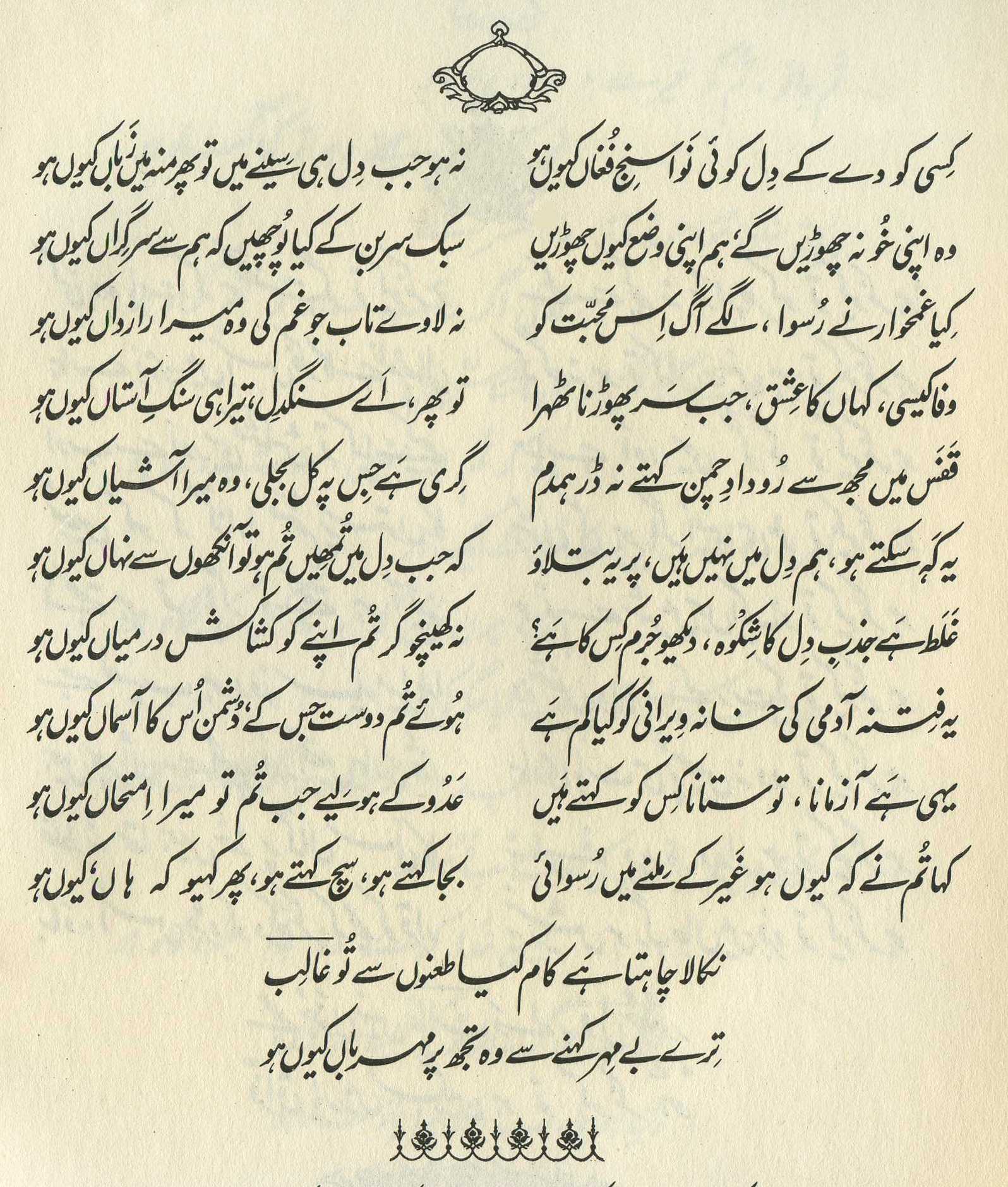
| Hamid Ali Khan | Open Image |
That is, the attraction of the heart draws me this way; you draw me that way; this is the cause of tension. (137)
== Nazm page 137

He says, if you complain to me about the attraction of my heart, that 'this draws me toward it'-- this is incorrect. Just reflect and look: whose is the fault in this? That is, is it mine, or yours? If you would not be drawn by me, then why would there be a tension between us? The meaning is that you are drawn by me. The attraction of my heart draws you-- thus the aspect of a mutual tension has been created between us. (191-92)
The lover has said to the beloved, 'This is the state of your and our love-- and you take no care of us!' In reply, the beloved said, 'You have a complaint against us; we have a grievance against you. If you loved us from your heart, then it would be quite impossible that the attraction of your heart would not have had an effect on us.' In reply to this the lover says, 'This complaint is inappropriate. Do justice-- is it the fault of the attraction of my heart, or of yours? My attraction draws you toward itself. And your heart tries to stay drawn away [] from me. This is the reason that the attraction of my heart does not affect you.'
The case is like that of an Ustad who puts his heart and soul into teaching, and a student who would have been forced by his mother and father to come to the madrasah, and would himself flee from studying. He would have stubbornly resolved that his parents might insist till they dropped dead, but he would not study, and will not study. In such a situation, no wise person could place any blame on the Ustad's instruction.
Momin Khan has composed a fine verse:
[this excuse of the test of the attraction of the heart-- how it turned out!
I used to lay the blame on her; the sin turned out to be my own] (256-57)
Isn't this a classy mushairah verse? And it's full of wordplay which is also, as so often, meaning-play. It's lucky for the translator that we have the English word 'attraction', which can do many of the same tricks that can: it can include the mechanical action of a magnet, and (by an obvious extension) the effects of an 'attractive' person or quality on one who is 'attracted'. The senses of 'drawing, pulling' [], and a number of the meanings of , work perfectly with this semantic range.
The final two words before the refrain are the excellently multivalent (full of negative senses, but with some positive ones as well; see the definition above) and then the crucial rhyme -word , which suddenly drives home the point: that it takes two to tango, that a (desirable or undesirable) exists not in the beloved's heart or in the lover's heart alone, but in the space between them. Between them the air is charged with electricity-- or with magnetic attraction (or repulsion). And the lover claims that this whole is not his fault, but hers.
But the possibilities for the , the 'attraction', seem to be enjoyably complex. The beloved's beauty might 'attract' the lover. The lover's passionate devotion might 'attract' the beloved. What might be the results?
=The lover's passion draws the beloved toward him, but she draws herself back-- so the tension is her fault. (This is Bekhud Mohani's reading.)
=When the lover seeks to approach the beloved, she draws herself back-- so the tension is her fault. This is the reading proposed by Dalpat Rajpurohit (Oct. 2017) and Tahira Naqvi and Mahmood Piracha (Nov. 2020).
=The beloved's beauty draws the lover toward her-- he is as helpless as an iron filing near a magnet, so the situation is her fault. This reading requires us to read in the sense of , which is a bit dicey of course. But I find that this reading looms so large that it's hard to avoid seeing it as a possibility.
And of course, the very complaint itself is also a part of the constant --whatever form(s) it may take-- between the lover and the beloved. The caused by the (one-sided or mutual) 'attraction' produces the complaint, and the complaint is part of the delightful mischievousness and perversity [] that only increases the 'attraction' and thus prolongs the .
graphics/heartpulled.jpg