Verse 91854aa;Nkyuu;N ho
G2
1
if only/emphatically this is 'to test', then what do they call 'to torment'?
2 a
when you've become the enemy's, then why would [there] be a 'test' of me?
2 b
when you've become the enemy's, then why would [this] be a test of me?
| References | |
|---|---|
| Arshi, Imtiyaz Ali | Ghazal# 127 |
| Raza, Kalidas Gupta | 449-50 |
| Hamid Ali Khan | Open Image |
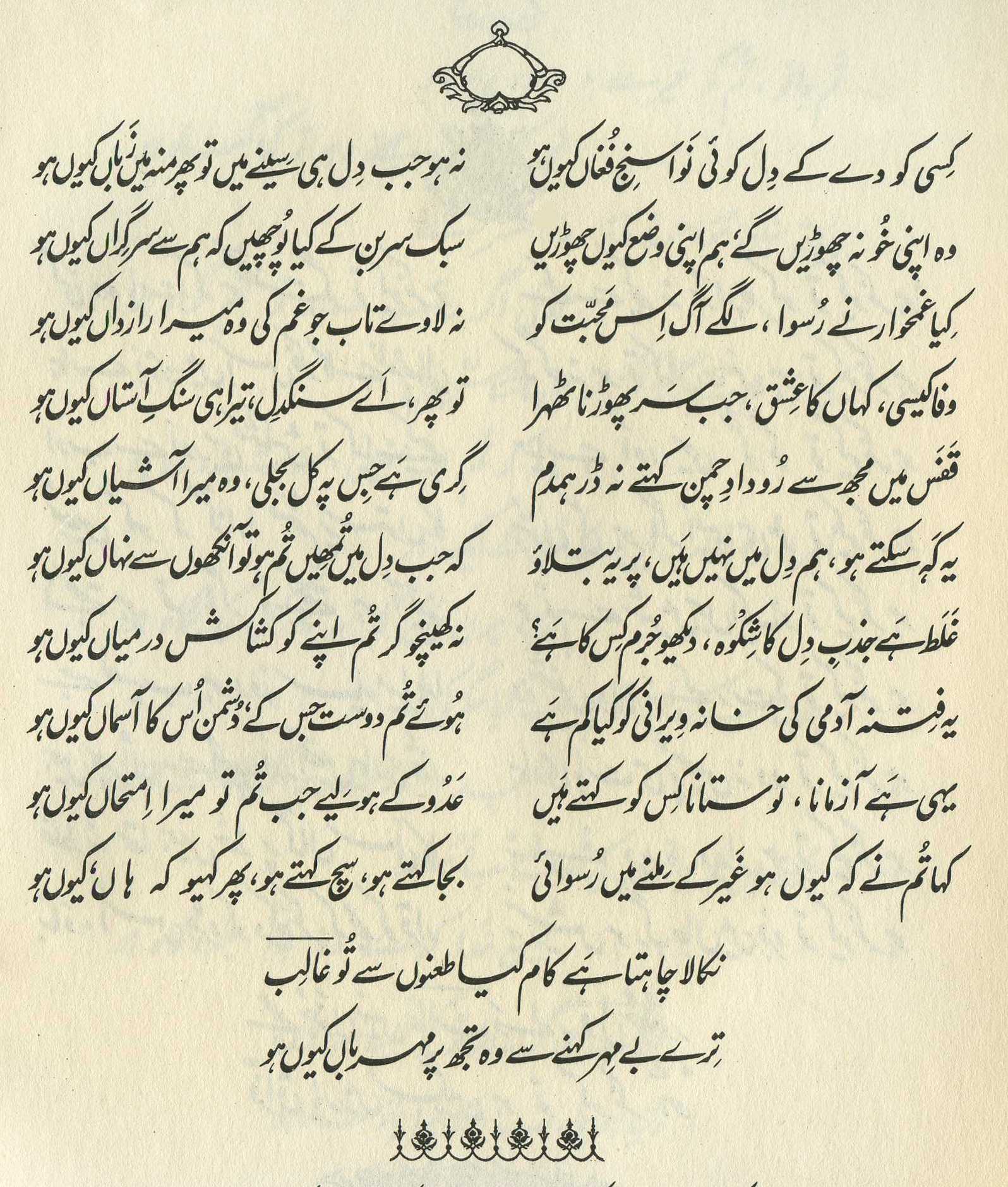
Having become the enemy's beloved, she doesn't want to test and try me, but to torment me. (137)
== Nazm page 137

The beloved said, 'We are testing you'; the reply to this is, 'When you've become the Rival 's, then this is not testing, it's tormenting. I decline such a test.' (257)
The commentators have assumed that 'to test' and 'to become the enemy's' are two separate things.... A better scenario is that when the beloved began an affair with the enemy, then the lover complained. The beloved replied, 'We took up with the enemy in order to test your steadiness and firmness'. In reply to this, the lover says, 'If you call giving your heart to the enemy a test of us, then what is 'tyranny' the name of? When you have become the enemy's, then what's the good of testing us? Even if we are successful in the test, you still won't become ours, because you've already become the enemy's, so now leave us alone.'
== (1986: 241) 2006: 263
Everybody uses (2a), a straightforward reading that works perfectly well. When the beloved has already given herself over to some Rival, then she can't claim that this is a 'test' of the lover-- it can only be called a form of torment. She should give it up, stop showing this wanton cruelty, and at least leave the lover alone.
But if we shift the stress from 'test' to 'me', as in (2b), then we find another enjoyable meaning as well. The grammar of (2b) is , with the as the implicit subject. I take the (permissibly omitted) 'this' to refer to the beloved's having given herself to the enemy, which is the nearest and most obvious antecedent. And this reading emphasizes the -- 'If you've so flagrantly flunked your own faithfulness test (by giving yourself to the enemy), then it's not as if you could even pretend to pass this off as a test of me!'. This reading offers a rare and well-deserved sneer at the beloved's faithless behavior.
graphics/torment.jpg