Verse 3after 1821ardthaa
G3
1
I was doing a compilation of the manuscripts/prescriptions/recipes of faithfulness
2 a
the collection of thoughts was still in bits and pieces
2 b
the sum/aggregate of my thought was still fragmentary
'Uniting, connecting, bringing together; ... collecting, compiling'.
'A copy or model (whence anything is taken), an exemplar, a prototype; a manuscript-copy, a copy, an edition; a copy-book, writing-book; --a recipe, prescription (of medicine, or of ingredients for any composition'.
'The collective mass (of), the whole (of), the aggregate (of); the sum (of); a crowd, an assembly; a collection; meeting; a compendium; a body (of laws); a magazine; a miscellany; --a form (in printing)'.
'Now, presently, just now, now-a-days, a little while ago, recently. — , adv. Even now, yet, as yet, still'.
'Single, sole, only, one (and no more); singular; odd; unique, unequalled, incomparable; --s.f. A single person, an individual; a single thing or article; a unit; an odd number; (in Gram.) the singular number; a half, one of a pair or couple; a hemistich, a verse; couplet (being the half of a four-line stanza); a single sheet or strip (of paper); a piece, fragment; the outer fold (of a quilt, &c.); a draft (of an account); a register, record, statement, account-sheet; a list, roll, catalogue'.
| References | |
|---|---|
| Arshi, Imtiyaz Ali | Ghazal# 33 |
| Raza, Kalidas Gupta | 354 |
| Hamid Ali Khan | Open Image |
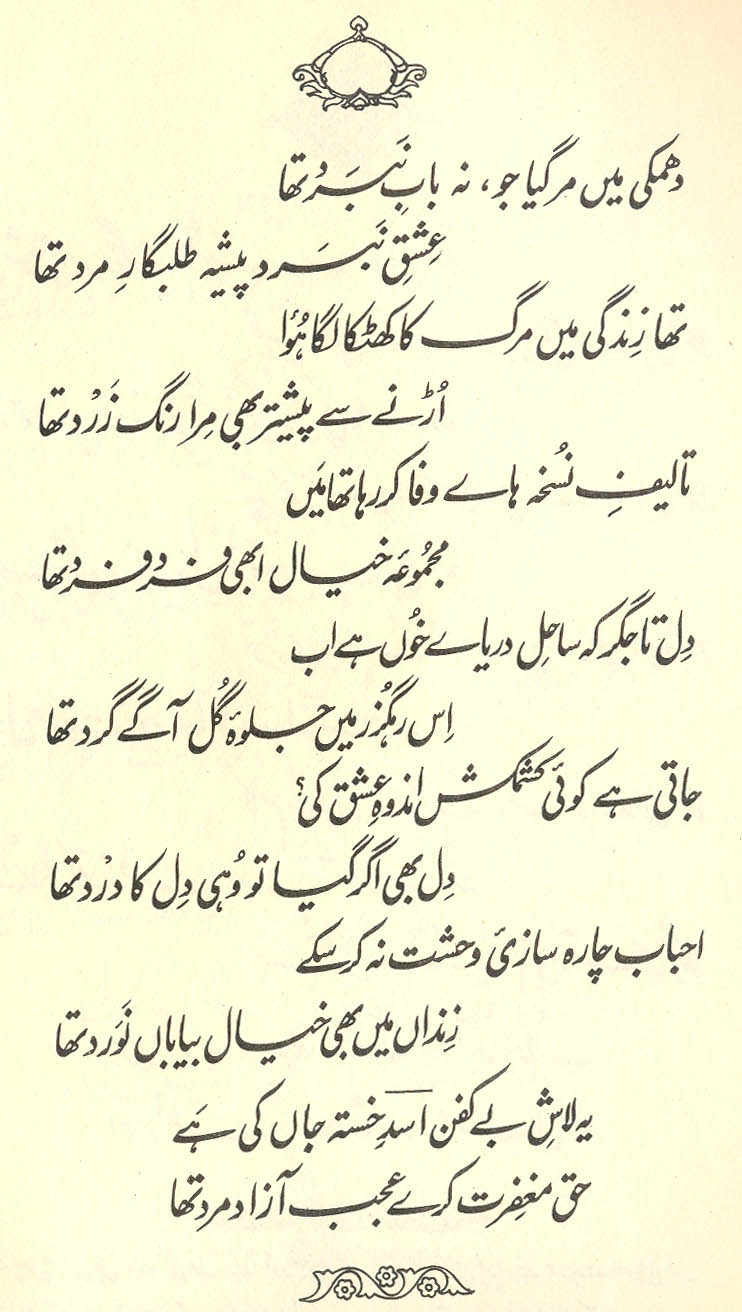
That is, I had already attained the rank of author in the art of passion, and as yet even my intelligence and enthusiasm had not been collected and were still in bits and pieces, unedited; that is, it was the time of inexperience. (7-8)
== Nazm page 7 ; Nazm page 8


Urdu text: Vajid 1902 {7}
I was establishing the special features and nature of every single medicine from among the medicines for faithfulness, and that was a time when my thought was examining every single excellence of faithfulness separately. Then I began to be tyrannized over, and my prescriptions for faithfulness remained incomplete and partial. (18)
As yet the book of my thoughts hadn't even been compiled-- that is, the thoughts had not been brought together. I had not even become properly conscious that I was composing books of faithfulness. That is, the Eternal Destiny-assigner had bestowed on me faithfulness from all eternity. (13)
There's such a powerful whipsaw back and forth between the collecting and uniting activity in the first line, and the dispersedness of thoughts in the second line! Does the dispersedness of the speaker's thoughts make his collecting activity even more impressive (as Nazm and most other commentators would say), or does it serve to demonstrate the immaturity and folly of his project, as in the perfectly defensible (2b)? And if the task is foolish, exactly why is it so? Needless to say, a variety of possible reasons can be adduced, depending on one's interpretive choices about the first line.
And even beyond those first-line choices, this is an 'A,B' verse: how are we to put the two lines together? As so often, Ghalib allows (or forces) us to do the decision-making work ourselves, with no guidance from him. Here are some enjoyable possibilities:
=The speaker was compiling manuscripts of faithfulness, because he was still young and foolish and didn't know any better.
=Since he was young and naive and needed advice, he was compiling manuscripts of faithfulness to help him understand the world.
=He was compiling manuscripts of faithfulness-- and he was only at the chaotic beginning of that huge task.
=He was compiling manuscripts of faithfulness, but he couldn't seem to make any headway-- no matter what he did, they remained chaotic.
Moreover, the grammatical ambiguities of the are in full flower in the first line: are the manuscripts (etc.) about faithfulness, or do they belong to faithfulness, or are they constituent parts of faithfulness? And even if we follow Bekhud Dihlavi, are they 'prescriptions' for enhancing one's faithfulness, or for curing one of faithfulness? (Faruqi proposes (July 2000) that should mean 'manuscript', since faithfulness is not a disease with a prescription. With regard to the ghazal world, I'm not sure I agree.) Or even if not 'manuscripts' or 'prescriptions', what was being compiled could also be 'recipes' or 'outlines' of some other kind.
The wordplay about writing is also spectacular, including as it does almost every significant word in the verse: 'compiling', 'manuscripts', 'collection', 'thought', 'fragmentary' (see the definitions above).
The use of here has the meaning of 'still', or of 'now' in the sense of 'at the time' (see the definition above). This versatile usage brings it closer to (on this see 3,4 ).
Faiz, who famously called his first divan (thus inserting an into the first words of 1,1 ), and his fourth one (see 230,7 ), chose as the title of his collected poetry [].
graphics/scatteredthoughts.jpg