Verse 7after 1816athii kyuu;N nah ho
G3
1 a
a crowd/gathering/occasion of lowness/disgrace of spirit/courage is [a cause for] shame
1 b
shame is a turmoil/confusion/occasion of lowness/disgrace of spirit/courage
2
nothing would/should be obtained from the world/age, even if it would be admonition/example
'A convention, an assembly, a meeting; a crowd; --noise, tumult, commotion, confusion, uproar; sedition, disturbance, disorder'.
'Season, time, period; —an assembly'.
'Infirmity, weakness, helplessness; vileness, badness, ill, faultiness, wickedness, vice, depravity; infamy, disgrace'.
'Mind, thought; anxious thought, solicitude; attention, care; --inclination, desire, intention, resolution, purpose, design; --magnanimity; lofty aspiration; ambition; --liberality; --enterprise; spirit, courage, bravery; --power, strength, ability; --auspices, grace, favour'.
'An act which causes a blush (as its effect); shame, modesty; confusion'.
is an archaic form of the passive subjunctive ( GRAMMAR )
'Admonition, warning, example; (met.) fear'.
| References | |
|---|---|
| Arshi, Imtiyaz Ali | Ghazal# 118 |
| Raza, Kalidas Gupta | 295-96 |
| Nuskhah-e-Hamidiyah | 147-148 |
| Hamid Ali Khan | Open Image |
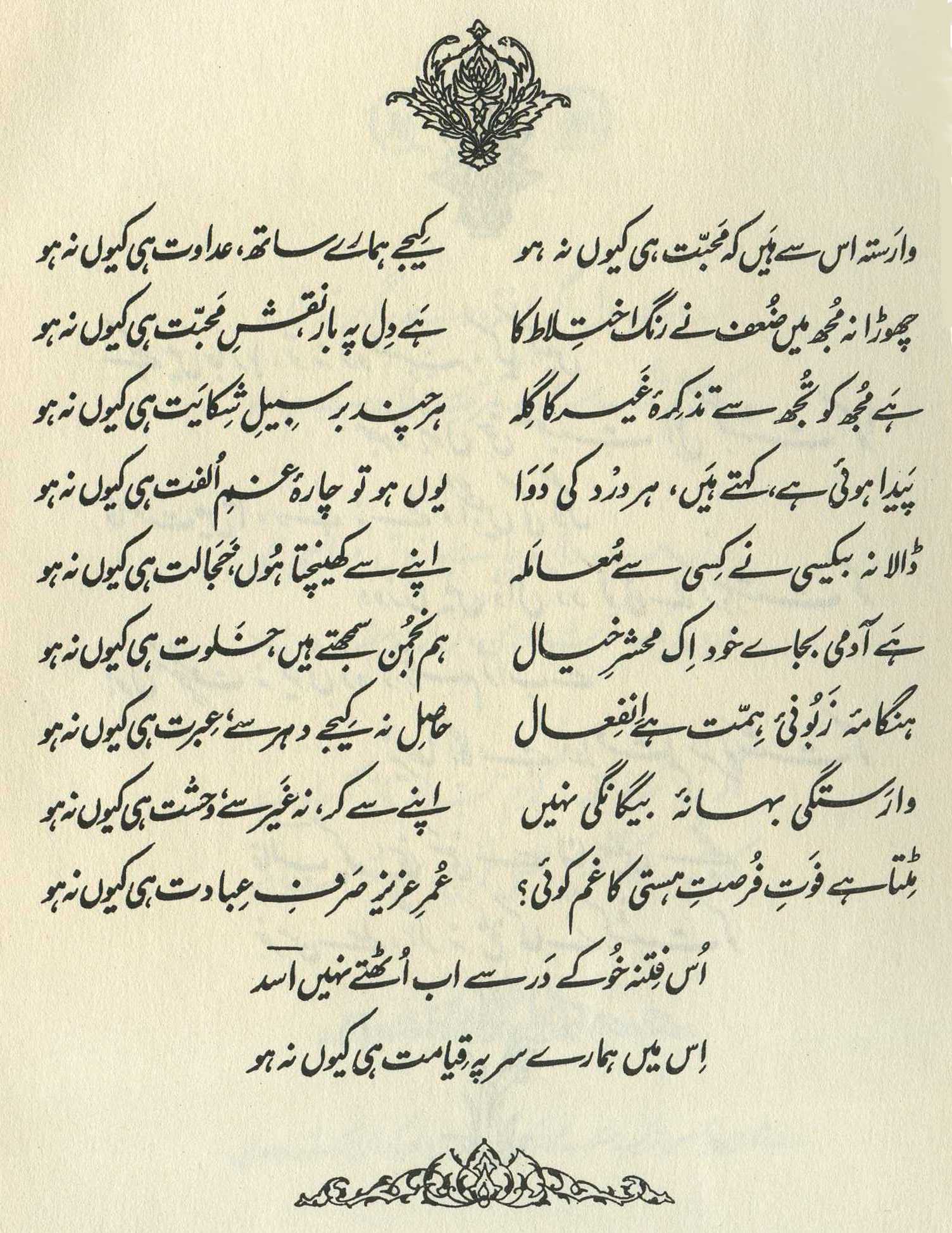
[1862, to Taftah:] What a cause for laughter it is, that you consider me too to be like other poets! That I would place before me the ghazal or ode of some Ustad , or write down his rhyme s, and begin to add on words to those rhymes! I take refuge in God [against this]! In childhood when I began to write Rekhtah , a curse/reproach [] be upon me if I ever put before my eyes any Rekhtah, or its rhymes! I only looked at the meter , and the refrain and rhyme, and began to write a ghazal or ode in that ground . You say, 'at the time of writing, the divan of [the Persian poet] Naziri must have been before your eyes; and the rhymes you saw in his verse, you must have written "on" them'. By God, [evil befall me] if before reading this letter of yours I ever even knew that Naziri had an ode in that ground! Well, it's like this: Brother! Poetry is meaning-creation , it's not the measuring-out of rhymes [].
==Urdu text: Khaliq Anjum vol. 1, p. 335
==another trans.: Russell and Islam , pp. 279-80
==the last line is quoted by Hali, Yadgar-e Ghalib , p. 139
[Compare Nazm's description in 60,4 of how to practice ghazal composition.]
That is, to obtain anything from anybody, and accept anybody's kindness, is a cause for shame. Such shame is pure lowness/disgrace of spirit/courage. It follows from this that if to take anything from anybody is a cause of lowness of spirit/courage, then one ought to take nothing from the world/age-- nothing, even if it be admonition/example. (127)
== Nazm page 127

He says, to obtain something from anybody-- that is, to accept his kindness-- is a cause for shame. And to incur shame is an act of a lack of spirit/courage. So much so that even admonition/example ought not to be taken from the age. (180)
To accept anybody's influence, and not to be the agent oneself, is a proof of lowness of spirit/courage. Even something like admonition/example ought not to be obtained from the world. (240)
[Many commentators have taken in its usual modern Urdu sense of clamor and noise; but this is obviously inappropriate.] I have often written that our commentators were very learned, but they didn't have the habit of consulting dictionaries. For example, if here any commentators had sought for the meaning of in a dictionary, then the verse would have become [as clear as] a mirror. In the [dictionary] and are a single word, and their meaning is 'time, age'. That is, the time of something's taking place. In the another meaning of has been written: 'gathering, collection of men, arena of , etc.'. From this the meanings of 'gathering, meeting, companionship' are helpful. The third meaning is 'mob, brawl'. Now the meaning of the verse under discussion has become that shame-- that is, to accept something from someone, or to accept someone's influence-- in reality is a lowness of courage; that is, a time or occasion or gathering of weakness. That is, a mood of shame proves the weakness and defeat of courage.
== 2006: 231-32
[See also his comments on Mir's M 423,1 .]
This verse is of course a classic example of Ghalib's advocacy in his ghazals of radical autonomy at all costs (for more such examples, and discussion, see 9,1 ). But in its intensity, and the directly hortatory tone of the second line, it also reminds me strongly of a famous passage from one of his letters (cited above). This passage first repudiates with almost violent indignation even a casual suggestion by one of his best friends that he might have composed a poem the way everybody else often did-- by starting with a famous exemplar and composing verses 'on' its verses. Such a suggestion was clearly not thought by his correspondent, his dear friend Taftah, to be an insult; but Ghalib obviously took it that way, calling down curses on his own head if he ever, even in his earliest youth, had done such a vile thing. He apparently didn't consider it vile for other poets to do this-- it would only have been so for himself. (Compare the two passages cited in 219,1 , in which he repudiates with abuse and actual obscenities the idea that other people's verses might be mistaken for his own.)
After this tirade Ghalib concludes with his famous assertion that poetry is the creation of meaning, not the measuring-out of rhymes. He seems to take this remark as a kind of summing-up or culmination of what he has been saying. Thus his notion of meaning-creation seems to be strongly linked with that of poetic originality or autonomy, and with a passionate rejection of (direct or conscious) outside influences from other poets and earlier poetry.
In the case of the present verse, the first line is so broad and abstract that, in good mushairah style, it remains uninterpretable until we hear the second line. Even then, the first line, combining as it does multivalent words like and and with the multivalence of the constructions, demands to be chewed on for a while by the mind.
If we read A=B, as in (1a), we discover a radically disdainful reason for taking nothing from the world. For what is the world, or at least the age we live in? It is a bunch of cowardly, spiritless conformists: a 'gathering' or 'crowd' or collective mass of 'lowness/vileness of courage/spirit'. A gathering of such a kind is a disgrace, a 'shame', in itself; and it would be even more shameful for a proud, thoughtful person to lend his countenance to such an ignominious display. Better to leave the mob to themselves, and let them share their lowness and spiritlessness with each other; God forbid that one would take anything at all from such a useless crew! Even taking something as minimal as an example or admonition from them would be shameful: it would probably be worthless anyway, and even if by some accident it might have a bit of value, it would be hopelessly polluted by its disgraceful source.
If we read B=A, as in (1b), we discover that shame itself is the problem. What is shame but a collection of fears and anxieties, a 'tumult' or 'confusion' that is full of 'lowness of spirit' and 'disgrace of courage'? If shame is to be endured at all, it must come from self-criticism alone, and one must wrestle with it privately and somehow endure or transform it. Why should a proud, thoughtful person let the vulgar 'example' or 'admonition' of the people of the world be a cause of shame or humiliation? Whatever shame or pride he might feel should be based only on his own judgments about himself.
Rather than interacting with the world, the proud and spirited person should ignore the world entirely, should take nothing from it. Caring only for his own opinion of himself, he should cultivate a stoic 'friendlessness' and a radical moral autonomy. This is exactly the kind of behavior enjoined in 119,5 , and in 119,8 too (though with a bit of palliative courtesy enjoined as well). With three such broadly similar verses (perhaps initially sparked by the refrain ), this ghazal is a kind of locus classicus of Ghalibian exhortation to 'independence'.
On , see 119,1 .
graphics/globe.jpg