Verse 31847aabme;N
G3
1
why does life begin to leave the body at the moment/breath of hearing
2
if that voice is contained in the lute and rebeck?
'Hearing, listening to; listening to music or singing; the sense of hearing;—singing, song, music (instrumental or vocal); ecstasy occasioned by hearing singing or music (particularly in Derwishes when hearing hymns)'.
'To be contained or held (in, ), to go or get (in or into), to enter (in or into), to fit (in); to take up room fill or occupy space'.
| References | |
|---|---|
| Arshi, Imtiyaz Ali | Ghazal# 110 |
| Raza, Kalidas Gupta | 392-93 |
| Hamid Ali Khan | Open Image |
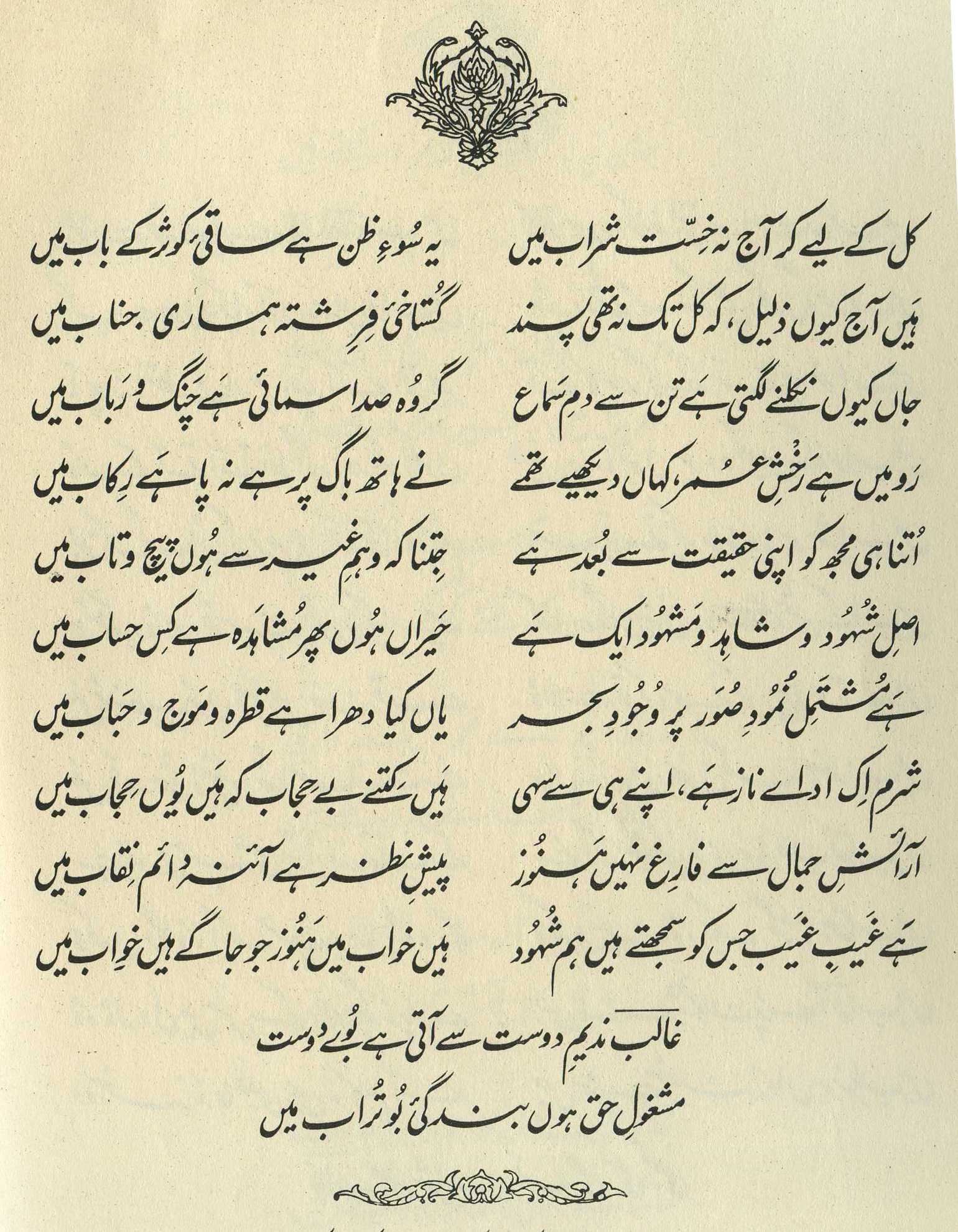
[The poet and Sufi Khvajah Mir Dard was well skilled in music. Well-known and accomplished singers used to sing their compositions before him, to receive his correction. A is a thing full of emotional effect. The Greek philosophers and the ancient learned men have determined it to be a branch of mathematics. It opens the heart and exalts the spirit. For this reason, some circles among the practitioners of Sufism have treated it as a form of worship. Thus on the second and the twenty-fourth of every month it was customary for the well-known masters of music, [the caste of musicians called] Doms, singers, accomplished persons, and people of taste to gather together and sing mystical pieces. These dates were the death anniversaries of certain of his elders. Muharram is the month of grief; thus on the second [day], instead of songs, there was elegy-recitation.
==Azad: Pritchett and Faruqi , p. 178
Here too [as in 98,2 ], the interrogative form is only to alert the listener; the poet does not want an answer. The meaning is, reflect that when the voice of that immanent Authority is raised, then the lives of the music-listeners begin to be obliterated. That is, before His presence, everyone's existence is trivial. And He is the drawer-out of everyone, and everyone is drawn out. And He is the destination, and everyone is destined for Him. He [Ghalib] has presented this theme in this way: that if it's true that His voice is contained in the lute and the rebeck, then why, when we listen to them, does our life leave us? In short, the listener should be alerted. (101)
== Nazm page 101

He expresses surprise, that if that voice is life-giving, then why does it have this effect? (87)
He says, when listening to songs, why does the life begin to emerge from the body-- that is, why does this state begin to prevail, that causes one to writhe? If that voice-- that is the voice of the True Beloved-- is contained in the lute and rebeck, then why does this not have the effect of life-bestowingness? (152)
He will have previously established from the lips of the Preacher himself that whatever is found in every substance is entirely due to the active power of th e Lord. After this, he asks, when such is the case, then why, while listening to music, does the life leave the body? (198)
[See his comments on Mir's M 602,1 .]
When I read the first line, the image that came to me immediately-- and I was surprised that the commentators missed this-- was the whispering of the call to prayer in a Muslim newborn's ear. The reason death starts at the moment of hearing is because of course we start to die the moment we are born. This is hardly a far-fetched image because there is the Sufistic (or in your coinage from class, 'sufisticated') idea of the material world as the 'world of death'. The call to prayer consists, of course, of God's words; and that is what the speaker is claiming the 'divine' music of the to be as well. If we have the capacity to hear something divinely inspired (whether the call to prayer or the lute) then isn't it ironic that we still have to die? This philosophical reading is the only way I could make sense of an otherwise impenetrable verse. (Mar. 2009)
To understand the meaning of this verse (and the wordplay) you have to hear the word 'hear' [] contained in the word 'contained' [], a masterful rhetorical echo, echoed by the word 'echo' []. This point will become clearer after I provide my interpretation of the verse. In addition to FWP's readings, which all seem valid and illuminating, I see two more, which turn on the meanings of as 'life' and self'. Using 'life', the first line asks, Why does life begin to leave the body at the moment of hearing?
In Arthur Dudney's excellent reading, we are reminded of the custom in which at the moment of birth, a Muslim baby has the call to prayer whispered in her ear. And so, as Dudney observes, the connection with the second line is the great irony that one should have to die despite answering God's call. This points us in the right direction, but I think we can unpack it even a bit further. That is, the lute and rebeck can be seen as the vessels of , a voice in general, or more specifically, the voice of God. In the light of Sufi idiom, we can view both the physical body [] and the lute/rebeck as vessels. Therefore, Dudney is right to suggest that the central irony of the verse is the juxtaposition between the two vessels, animate and inanimate, one mortal and one immortal. However, a further paradox can be seen in the notion of the classical ghazal regarding death as a reunion with God, or the beloved. Though we feel as though we are leaving this life, if we are good Muslims then we are actually slowly being reunited with the beloved. Despite the fact that we seem mortal and the the lute and rebeck seem immortal, the opposite is true, according to this ideology. Whereas our souls unite with the beloved in , the things of this world are , ephemeral.
A second meaning of , 'self', helps us provide a fuller reading in response to this question, at least from a traditional Sufi perspective. In traditional Sufi idiom, when one hears the Voice of God (as Muslims do at birth, or during a mystical musical performance [], this begins the process of purifying the heart of the base 'self' in order to make room for the Voice of God. In order to obtain , or to reach the mystical level of Hallaj's famous utterance or 'I am God', one must purify the heart of the lower self (in its manifestations as lust, greed, wrath, etc.) and make room for the Voice of God. That is, the Voice of God brings one 'out of oneself' and replaces the self with itself-- that is, with the Voice of God. The tension raised by the contrast between the movement out (by the ) and in (by the ) and the animate/inanimate natures of the body/lute create an even stronger connection between the two lines and add relish to the verse.
And with this in mind, from the puns that I mentioned at the beginning, I think we can generalize slightly about Ghalib's style of writing. That a word can have a similar sound and variant meanings such as between and , is absolutely central to Ghalib's conception of himself as a poet and of his chosen medium. Perhaps it goes without saying that what I read as a pun in the connection between these two words could theoretically be a coincidence. Yet repeated coincidences of this nature indicate the hand of the creator. And so these confusions and possibilities for misinterpretation do not necessarily distance the writer from the reader. Rather, the more repeatedly and the more insistently he uses them, the more faith he gives the reader to look for the hand of the author in the meaning of his 'meaningless' verses. (Oct. 2009)
Like the previous verse, this one too, as Nazm notes, poses a rhetorical question. In both cases the question is a broad one with a mystical or cosmic scope. And in both cases the question is delicately balanced between an interrogation of God's treatment of humans, and an uncertainty about human responsiveness to God's presence and commands.
As Azad's account of Mir Dard make clear, Sufis have sometimes had a favorable attitude toward , or listening to music; but it's also true that very often they've been opposed to it. The resulting controversies have been vehement, and in some circles the issue remains contentious today. Some Sufi orders disapprove on principle of all religious uses of music, while others make a (carefully controlled) place for it in their practice. Mir Dard , as both a poet and a Sufi, is a particularly interesting case; for discussion of these controversies and his somewhat ambivalently expressed attitude toward music, see Annemarie Schimmel's Pain and Grace (Leiden: E. J. Brill, 1976), especially pp. 53-57. Ghalib and his original audience would have been well aware that the mystical use of music, as an approach to the Divine, was a theological hot potato. Whatever else Ghalib is doing in this verse, he's also throwing a hot potato into a hornets' nest (I know, I know, it's a horrible image).
Thus it's not surprising that the verse can be understood in ways that might well suit the predilections of different listeners. If you're opposed to the use of music for mystical experience, you can say: 'Good question! As this question shows, music is just another intoxicant like wine, and its power can knock you out or leave you swooning just as wine can. Like wine, music can wreck you; it can destroy your proper self-control and piety. So it's clear that 'that [divine] voice' is by no means present in the lute and rebeck.'
And if you believe that music is a legitimate part of mystical experience, you can say: 'Why, that's an easy question to answer! Music transports you outside your petty this-worldly self, it renders you 'self-less' [] in the way that great mystics have always desired. Listening to music, you reach a higher state that is a close cousin to mystical oblivion [], so that outsiders might indeed think your life was leaving your body. This 'self-lessness' is the human response to the divine Presence. So the very fact that listening to music can transport you outside yourself is clear proof that 'that [divine] voice' is indeed present in the lute and rebeck.'
Needless to say, it's impossible to tell from this verse what Ghalib himself thought about the mystical use of music. All we can say is that he presents music as a powerful force that can sweep the listener away.
For more on the wordplay involving , see 1,3 . There's also, as Owen Cornwall points out, the excellent echo effect between and . Owen provides an extended mystical meditation on the verse that situates it close to the heart of Sufi theory and practice. Arthur Dudney (who was also, like Owen, a graduate student at Columbia at the time) offers an original and piquant reading that adds a powerful extra dimension to the first line, though the connection with the second line then becomes a bit tenuous.
graphics/rabab.jpg
graphics/musiccharmmet.jpg