Verse 21847aabme;N
G3
1
why are we despicable/insulted today? --since up to yesterday, not pleasing [to God/you] was
'Base, mean, vile, wretched, contemptible, despicable, ignominious; brought low, abased, humbled, disgraced, insulted'.
'Presumption, arrogance, insolence, audacity, assurance, sauciness, rudeness; contempt (of court); cruelty'.
'A place to which one repairs for refuge, &c. (hence, as a title of respect, in addressing, or speaking of, a great man) your honour, your excellency, your majesty; his honour, &c'.
| References | |
|---|---|
| Arshi, Imtiyaz Ali | Ghazal# 110 |
| Raza, Kalidas Gupta | 392-93 |
| Hamid Ali Khan | Open Image |
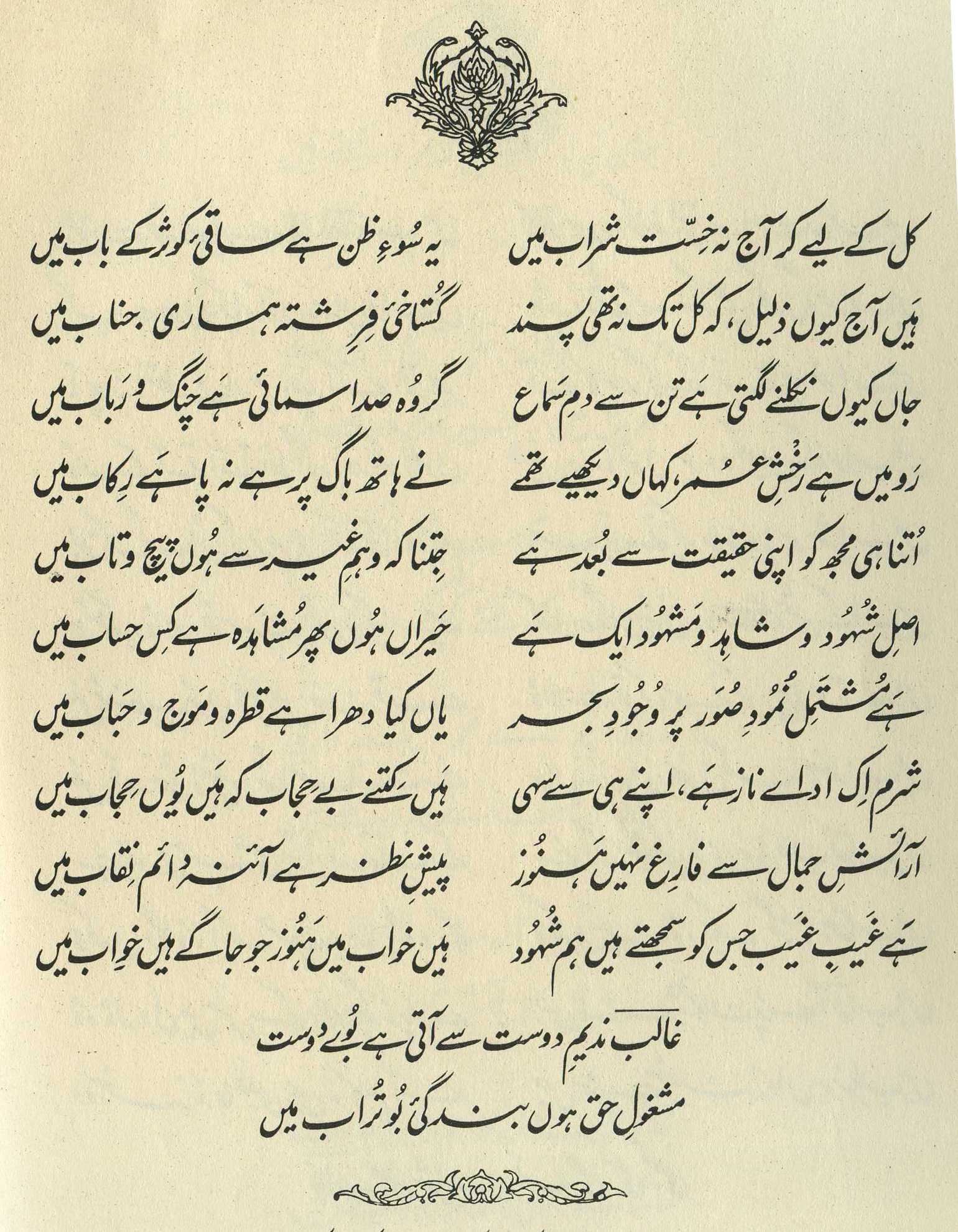
One meaning of this is that once regard for us was so precious to the beloved that even supposing an Angel had treated us insolently, she would not have been pleased; and now we have completely fallen from her view. And the second excellent meaning is that in this verse there’s an allusion to the story of Adam and the Angels, which is mentioned in the Noble Qur'an [Qur'an 2:30-34]: that when the Lord Most High expressed an intention to create Adam, the angels said, 'Do you want to create in the world this individual-- that is, this species-- who would create turmoil and bloodshed in it?' From there the command came, 'You do not know what I know'. And then through Adam he checked them, and ordered them to prostrate themselves before Adam. He [=Ghalib] says, 'Why are we today lowly/vile in the world to such an extent, when up to yesterday we received such honor?'
==Urdu text: Yadgar-e Ghalib , pp. 131-32
In this verse by 'yesterday' is meant that 'yesterday' when the angels had petitioned, 'If you create man, then he'll create turmoil and bloodshed', and this was not pleasing [to God]. The poet has here used a question not because he seeks an answer; rather, his purpose is only so that the listener will realize-- that is, to cause him to reflect that it is in his hands alone to confront his lowness/vileness. (100-01)
== Nazm page 100 ; Nazm page 101


By 'yesterday' is intended the day of Adam's creation. When the Lord commanded the angels, 'I will create a creature, and make him my viceroy in the earth', then the angels had said, 'How will such a creature who will spill blood act as a viceroy?' On this some questions were posed. Beside Adam, no one was able to give the correct answers. In this verse, there is an allusion to this. (197)
In the previous verse, was for the future; here, it is for the past. And by this is meant the day of creation-- that is, that day when Adam was created out of dust, and the angels were given the order to prostrate themselves before him. On the grounds that he was a creature of dust, Azazil [] considered him petty and refused to prostrate himself. This insolence was considered to be disobedience; Azazil was punished. He was expelled from the Divine Court, and became famous by the name of Satan [].... This verse contains the verbal device of 'reference to a famous past event' []. (191-92)
This verse and the previous one, 98,1 , form a nicely juxtaposed set, with each exploiting one meaning of . This verse is about today in relation to a (cosmic) 'yesterday'; the previous verse was about today in relation to a (cosmic) 'tomorrow'.
Hali's first point, that the verse could be about, or addressed to, a human beloved, is no doubt possible; but it can't make nearly such trenchant use of the reference to the Angels. On the whole, this is one of the verses in which the beloved clearly seems to be God; for others, see 20,10 .
For the verse's most obvious reference is to Qur'an 2:30-34, as Hali and others observe. This passage contains the account of God's announced intention toward mankind and the angels' reaction, followed by God's response. In verses 2:35-36, a brief reference to Satan as the cause of Adam and Eve's expulsion from the Garden appears. Since the grammar of the second line would permit to be not only a sort of collective noun but also a singular, Josh's claim that the verse can refer to the behavior of Azazil/Satan is also plausible.
As Nazm observes, the angels tell God that humans will turn out to be too bloody-minded and violence-prone to serve as His viceroys over the earth. The case could be made that our history has proved them right, and that our present 'lowness' is our own doing, so that we should reflect on how we can improve our moral standing enough to regain our former status.
And yet-- in the definition above, look at the cleverly wide range of meanings for . The first group of them suggest moral agency and personal iniquity ('despicable'), while the second group suggest victimization ('insulted'). Thus although it seems clear that 'up to yesterday' we were glorious and honored by direct Divine decree (though not without dissent from the angels), and it's clear that we no longer have that status, it's not clear what has caused our downfall. Are we sinned against, or sinning? Are we victims, or villains? (Or, surely most likely, both?)
With his characteristically structure, Ghalib leaves the question open. He doesn't even clarify for us to whom the question is addressed. Is he asking God, in a reproachful tone, why He has abandoned the children of Adam whom he once delighted to honor? Or is he meditating on the subject, asking himself (and all of us) why our species has fallen so low?
Compare the similar reproach addressed to a (more plausibly) human beloved in 15,13 .
graphics/adamangels.jpg